


what is a digital sketch
A digital sketch is a form of live sketching, graphic recording, or sketchnotes executed on a digital surface such as an iPad, Cintiq, or other digital tablets. It utilizes digital tools to visually represent concepts, characters, or messages through pixels rather than physical pigments on paper or canvas.
This medium allows for the creation of visual content that can be live-streamed and cast to an unlimited number of screens simultaneously. Because it is performed on a digital interface, the process can be executed remotely from any location and broadcast to any device globally.
Digital sketching provides several functional advantages for professional environments:
- Faster delivery of multiple versions compared to traditional methods.
- Ability to convert sessions into video time-lapse replays.
- Reduced environmental impact through the use of fewer paper products.
What is a digital sketch compared to traditional sketching?
The distinction between digital and traditional sketching lies in the technical capabilities and the specific artistic options available to the creator. While traditional sketching relies on the tactile resistance of paper, ink, and canvas, digital sketching utilizes a digital surface—such as an iPad or Cintiq—to manipulate light and pixels. This shift allows for specific technical advantages that physical media cannot replicate, including the ability to showcase creative techniques not found in traditional mediums.
Beyond the physical medium, the digital workflow offers logistical advantages for large-scale projects. The digital medium supports diverse formats, including graphic recording, sketchnotes, and various digital visual representations. Because the process is inherently electronic, it results in faster deliverables and a higher volume of output compared to traditional methods. Additionally, digital sketching is more environmentally sustainable, as it requires fewer paper products and physical consumables.
Key comparisons include:
- Technical Versatility: Digital tools allow for the application of specific textures and creative techniques that are not achievable with standard physical mediums.
- Efficiency: The digital medium supports the creation of video time-lapse replays from sketching sessions, providing a secondary way to review the work.
- Output Formats: Digital sketching facilitates the creation of diverse visual formats, ranging from simple sketches to complex digital illustrations.
What tools and software are used to create digital sketches?
Digital sketching utilizes hardware such as iPads, Cintiq tablets, and other pressure-sensitive digital tablets alongside specialized software. These tools allow artists to use vector drawing tools, shapes, and colors on an infinite canvas to achieve high levels of precision and control.
Software like Photoshop is frequently used in the workflow to process hand-drawn elements. In applications such as Sketch, artists can utilize specific tools including:
- Vector Tool: For creating paths and points to form precise shapes.
- Pencil Tool: For free-hand drawing that the software automatically smooths.
- Shape Tools: Pre-made options for ovals, rectangles, lines, arrows, triangles, stars, and polygons.
- Boolean Operations: Functions such as Union, Subtract, Intersect, and Difference to combine overlapping shapes.
How does the digital sketching process work?
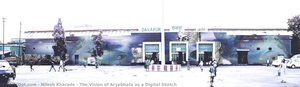 The Vision of Aryabhata as a Digital Sketch
, Nilesh Kharade
The digital drawing workflow is a multi-stage process that integrates manual input with digital refinement. It typically begins with initial pencil sketching, followed by importing hand drawings into software like Photoshop, then selecting colors and shades, applying textures, and finally presenting the completed concept.
This structured approach allows for high-fidelity results in large-scale projects. For example, Nilesh Kharade utilized digital techniques to create The Vision of Aryabhata as a Digital Sketch for the walls of Danapur Station. This work depicts the mathematician-astronomer Aryabhata (476–550 CE), who was born in the Pataliputra/Kusumapura region.
The technical stages of the workflow include:
- Sketching in pencil.
- Importing hand drawings into digital software.
- Selecting colors, shades, and applying textures.
- Finalizing and presenting the concept for delivery.
Frequently asked questions
When did Aryabhata live?
Aryabhata lived from 476–550 CE.
Who is Jakub Jernajczyk?
Jakub Jernajczyk is an artist from Poland.
What is The Vision of Aryabhata?
The Vision of Aryabhata was created by Nilesh Kharade as a Digital Sketch.
How is digital sketching performed?
Digital sketching can be performed on an iPad or Cintiq, and the digital workflow includes importing hand drawings into Photoshop.
Learn more
- Nilesh KharadeThe Vision of Aryabhata as a Digital SketchSee how historical figures are reimagined through digital sketching techniques in this specific artwork project.


