Introduction
To step into the world of Duccio di Buoninsegna is to witness a profound moment in the history of human expression—the precise instant when the rigid, celestial hierarchies of the Byzantine tradition began to breathe with the warmth of Italian humanity. Born in the vibrant Sienese streets around 1255, Duccio did not merely paint icons; he orchestrated a visual revolution that bridged the gap between the eternal and the earthly. As you wander through this curated selection of his most significant works, you are not just observing religious devotion, but tracing the very dawn of a new Italian vision, where gold leaf meets the soft, emerging shadows of naturalism.
During the late 13th and early 14th centuries, Siena was a pulsing heart of commerce and faith, and Duccio was its most luminous voice. His mastery lay in a delicate synthesis: he retained the awe-inspiring splendor of the East—the shimmering golds and deep ultramarines that evoke the divine—yet he infused his figures with an unprecedented emotional intimacy. In the gentle tilt of a Madonna’s head or the subtle, contemplative gaze of a saint, we see the first tremors of a movement toward realism that would eventually pave the way for the Renaissance. These works remain deeply meaningful today because they capture the universal struggle to find human connection within the monumental; they remind us that even in the most sacred of narratives, there is room for tenderness, sorrow, and grace.
In the following exploration, we shall journey through twenty-five of his most transformative masterpieces. From the iconic Rucellai Madonna to the sweeping, complex narrative of the Maestà , each piece serves as a window into a pivotal era of art history. Whether you are a scholar of the Sienese School or a lover of classical beauty seeking to bring the prestige of a museum-grade reproduction into your own home, this collection invites you to rediscover the master who taught the divine to smile.
Maestà (Madonna with Angels and Saints) - Duccio di Buoninsegna
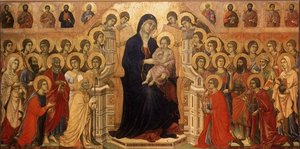
Imagine stepping into the dim, incense-filled atmosphere of the Siena Cathedral in 1311, where the Maestà first emerged from its gilded crate to a city in celebration. Duccio di Buoninsegna’s monumental altarpiece is not merely a painting; it is a celestial vision rendered in a symphony of deep ultramarine, rich vermilion, and shimmering gold leaf. The composition breathes with a sacred hierarchy, as the enthroned Madonna and Child are surrounded by a dense, rhythmic procession of angels and saints, their forms emerging from the luminous background through masterful light and shadow.
The texture of the egg tempera and the delicate modeling of drapery create a sense of profound weight and divine presence. This masterpiece transcends its era, offering a timeless sense of serenity and spiritual grandeur. For the modern collector, bringing a reproduction of this Sienese treasure into a home provides more than decor; it introduces an anchor of historical depth and contemplative calm, elevating any space with the enduring elegance of the Italian Trecento.
MaestÓ (front, central panel) - Duccio di Buoninsegna
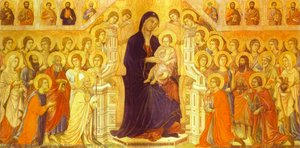
To stand before the central panel of the Maestà is to witness the very moment the heavens descended to earth. In this breathtaking 1311 masterpiece, Duccio di Buoninsegna orchestrates a celestial court where the Virgin and Child sit enthroned, radiating a serene, divine grace that pierces through centuries of time. The atmosphere is one of profound opulence; a sea of radiant gold leaf and warm ochre tones creates a luminous glow, as if the painting itself were a window into an eternal, sun-drenched sanctuary.
Duccio’s mastery lies in his ability to balance Byzantine grandeur with a tender, humanizing touch. While the stylized halos and geometric precision evoke sacred awe, the soft, fluid lines of the saints' robes suggest a newfound vitality. This piece does more than depict history; it captures an emotional depth that invites quiet contemplation. In a modern home, a high-quality oil reproduction of this Sienese treasure serves as a powerful anchor, bringing a sense of historical weight, spiritual calm, and sophisticated architectural elegance to any curated space.
Rucellai Madonna - Duccio di Buoninsegna
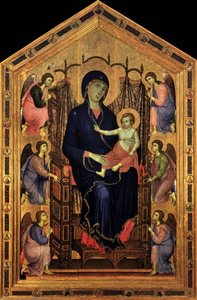
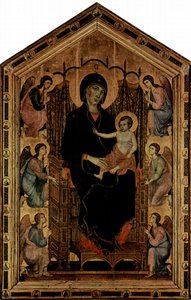
The Rucellai Madonna by Duccio di Buoninsegna is a breathtaking symphony of faith and light, capturing the precise moment when the rigid formality of Byzantine tradition began to breathe with human emotion. As one of the most significant entries in our collection of the top 25 artworks of Duccio di Buoninsegna , this 1285 masterpiece serves as a bridge between eras. The painting radiates a quiet prestige, utilizing luminous gold leaf and deep azure pigments that seem to glow from within, evoking a celestial atmosphere that transcends time.
Duccio’s mastery of tempera on wood creates a rich, tactile texture, where the delicate drapery of the Virgin’s robe suggests a softness rarely seen in 13th-century iconography. For the modern collector, this work offers an unparalleled sense of historical depth and elegance. Its sophisticated palette of gold, cream, and lapis lazuli integrates seamlessly into refined home interiors, providing a focal point of serene, classical beauty. Whether you are studying its historical impact or seeking a museum-quality hand-painted oil reproduction to anchor a room with timeless grace, the Rucellai Madonna remains an eternal testament to the Sienese School's brilliance.
Annunciation - Duccio di Buoninsegna
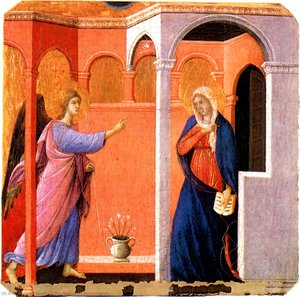 Annunciation - Duccio di Buoninsegna
While many view the Annunciation as a mere fragment, it was actually a vital piece of the monumental Maestà predella, designed to guide the faithful through the sacred narrative of Siena. In this 1308 masterpiece, Duccio di Buoninsegna achieves a breathtaking conceptual leap; he moves beyond the static, golden rigidity of Byzantine icons to introduce a tender, human vulnerability. As the Archangel Gabriel descends, his wings captured in graceful motion, we witness the precise moment where divine decree meets earthly acceptance. The deep, symbolic red of the background wall vibrates against the ethereal gold, while the delicate lilies and the descending dove infuse the scene with a quiet, spiritual breath.
The technical mastery required to balance such profound theological symbolism with emerging Gothic naturalism is truly awe-inspiring. Bringing a hand-painted reproduction of this Sienese treasure into your study does more than decorate a wall; it invites the same focused, contemplative energy that Duccio poured into his brushstrokes, fostering an atmosphere of intellectual depth and timeless sophistication in your professional workspace.
The Virgin and Child with Saints Dominic and Aurea - Duccio di Buoninsegna
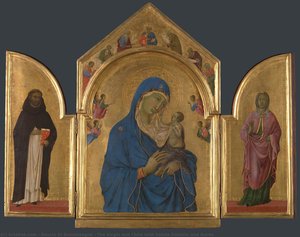 The Virgin and Child with Saints Dominic and Aurea - Duccio di Buoninsegna
While many view the 1312 masterpiece The Virgin and Child with Saints Dominic and Aurea as a static icon, it was actually designed for movement—a portable window to the divine intended to accompany Cardinal Niccolò da Prato on his travels. This intimate tempera on panel, now held in the National Gallery, represents a profound conceptual leap in Duccio di Buoninsegna’s career. Within its gilded borders, the artist achieves a breathtaking synthesis of Byzantine splendor and Gothic tenderness; the luminous gold leaf creates a celestial atmosphere, while the delicate rendering of Saint Dominic and Saint Aurea introduces a palpable, human warmth.
The composition is a complex theological map, featuring a procession of Old Testament prophets that weave together salvation history. The meticulous attention to detail—from the soft folds of Mary’s robes to the symbolic presence of sacred objects—demonstrates the technical genius that secures its place among the top 25 artworks of Duccio di Buoninsegna . Much like this devotional piece, bringing a high-quality oil reproduction of such a profound work into a modern study can foster an atmosphere of deep focus, intellectual rigor, and timeless sophistication.
Nativity - Duccio di Buoninsegna
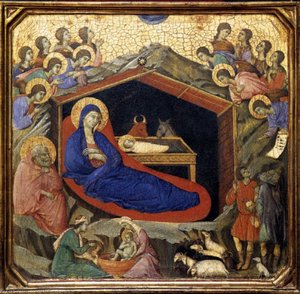 Nativity - Duccio di Buoninsegna
There is a profound, quiet stillness in Duccio di Buoninsegna’s Nativity that seems to pulse with the very heartbeat of the Trecento. As you stand before this 1308 masterpiece, you are not merely observing a historical scene; you are being invited into a sacred, intimate sanctuary. The painting possesses a gaze that follows you—not with judgment, but with an ancient, maternal understanding . It is as if the luminous gold leaf and the deep, celestial blues act as a mirror, reflecting our own capacity for wonder and reverence.
Duccio masterfully weaves together the rigid elegance of Byzantine tradition with a burgeoning humanism. You can almost feel the texture of the rustic cave walls and the soft warmth radiating from the infant Christ, illuminated by a divine, directional light. The presence of the ox and donkey adds a touch of earthly reality to this heavenly event, grounding the spiritual in the tangible. To possess a hand-painted oil reproduction of such a work is to bring this sense of eternal peace into your home, reminding you that even in the smallest, most quiet moments, we are part of a much larger, magnificent story.
Triptych - Duccio di Buoninsegna
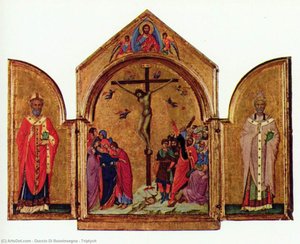 Triptych - Duccio di Buoninsegna
Duccio di Buoninsegna's Triptych (c. 1300) serves as a profound window into the spiritual fervor of the late Middle Ages, marking a pivotal moment where Byzantine rigidity began to soften into Gothic grace. As one of the most significant works in our collection of the top 25 artworks of Duccio di Buoninsegna , this piece captures the dawn of a new Italian vision. The luminous gold leaf and meticulous tempera glazes create an ethereal glow, guiding the viewer through a sacred narrative of the Nativity—from the tender nursing of Christ to the humble presentation before shepherds.
The work transcends its era, offering a timeless meditation on maternal compassion and divine majesty. Its structured composition, featuring celestial angels and revered saints, invites us to reflect on the intersection of the earthly and the divine. For the discerning collector, bringing a reproduction of this Sienese masterpiece into a modern space creates a sophisticated dialogue between historical devotion and contemporary elegance, infusing a room with the quiet, golden light of the Trecento.
Calling of Peter and Andrew - Duccio di Buoninsegna
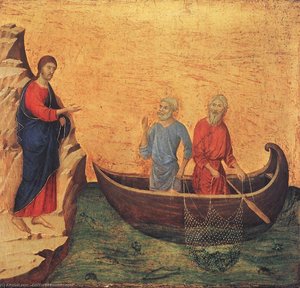 Calling of Peter and Andrew - Duccio di Buoninsegna
In the Calling of Peter and Andrew , Duccio di Buoninsegna captures a profound moment of spiritual transition, where the divine intersects with the mundane. As one of the most significant works within the top 25 artworks of Duccio di Buoninsegna, this panel serves as a masterclass in the Sienese Gothic style. The painting vibrates with a quiet tension; Christ stands upon the rocky shore, his hand extended in a gesture that bridges the gap between the celestial and the earthly, while the fishermen, caught mid-motion, represent the sudden weight of destiny.
The composition utilizes a stable, triangular arrangement that brings a sense of eternal calm to the narrative, making it an exquisite reference for those seeking to introduce classical serenity into modern interiors. The luminous tempera and subtle use of gold leaf evoke a sacred atmosphere that transcends centuries. For collectors looking to honor this legacy, our hand-painted oil reproductions recreate these delicate textures and spiritual depth, allowing the timeless elegance of the Sienese School to reside within your own curated space.
Ezekiel - Duccio di Buoninsegna
 Ezekiel - Duccio di Buoninsegna
In the intimate scale of Ezekiel , created around 1308, we encounter a profound moment of transition in the Sienese School. This panel painting serves as a vital window into the dawn of the Italian Renaissance, capturing the precise second when the rigid, golden formality of Byzantine tradition began to breathe with human emotion. As one of the most significant works in our collection of Duccio di Buoninsegna’s top masterpieces, Ezekiel demonstrates his unparalleled ability to blend celestial grandeur with a nascent naturalism.
The figure, clutching a sacred scroll that symbolizes divine wisdom, emerges from a luminous gold leaf background, creating a sense of quiet prestige and spiritual authority. The delicate modeling of the drapery and the solemnity of the prophet’s gaze invite us to reflect on the enduring power of prophecy and the weight of sacred knowledge. For the discerning collector, bringing a reproduction of this work into a modern space offers more than mere decoration; it introduces a timeless conversation between historical gravity and contemporary elegance, anchoring a room with the glowing light of the Trecento era.
Crucifixión con San Nicolás y San Gregorio. San Nicolás de Mira - Duccio di Buoninsegna
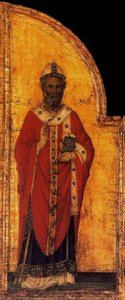 Crucifixión con San Nicolás y San Gregorio. San Nicolás de Mira - Duccio di Buoninsegna
In the Crucifixión con San Nicolás y San Gregorio. San Nicolás de Mira , a profound and somber crimson dominates the composition, immediately enveloping the viewer in a mood of sacrificial solemnity and divine passion. This deep, regal red, draped across the figures, serves as more than mere pigment; it is a masterstroke of the Sienese School, bridging the gap between Byzantine intensity and the emerging Gothic tenderness. Duccio’s ability to manipulate this palette—contrasting the weight of the red robes against luminous gold leaf—is precisely why this work earns its place among the top 25 artworks of Duccio di Buoninsegna .
For the modern collector, integrating a reproduction of this piece into a dining room or study allows one to curate an atmosphere of historical gravity and warmth. The rich, saturated tones provide an anchor for sophisticated interior design, offering a focal point that evokes emotional depth and timeless elegance. Whether you are seeking a museum-quality oil painting to inspire contemplation or a transformative centerpiece for a grand hall, this work brings the sacred light of the Trecento into the contemporary home.
Crucifixion - Duccio di Buoninsegna
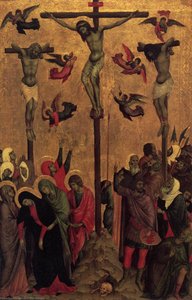 Crucifixion - Duccio di Buoninsegna
In the Crucifixion (circa 1310), Duccio di Buoninsegna does not merely depict a historical tragedy; he composes a profound visual sonata of grief and divine glory. As you stand before this masterpiece, notice how the light does not simply hit the surface—it seems to emanate from within the gold leaf itself, transforming the background into a celestial portal. This work is a cornerstone of the Sienese School, capturing that precise moment where the rigid, iconic traditions of Byzantium began to breathe with Italian humanism.
The central figure of Christ is flanked by smaller crucifixions, a deliberate structural choice that expands the narrative of universal suffering. While the monumental drapery folds recall the grandeur of Constantinople, the expressive, sorrowful faces of the mourning figures introduce a nascent naturalism that was revolutionary for the Trecento period. The interplay of luminous tempera and gold creates an atmosphere of sacred weight. For those seeking to bring this era of spiritual depth into a modern space, our hand-painted oil reproductions capture every meticulous brushstroke and gilded shimmer, allowing this window into 14th-century devotion to illuminate your own walls.
Agony in the Garden (detail) - Duccio di Buoninsegna
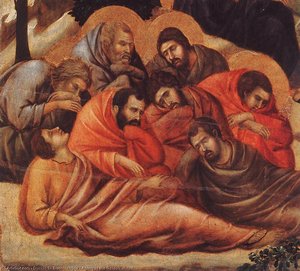 Agony in the Garden (detail) - Duccio di Buoninsegna
While the monumental Maestà often commands the spotlight, it is in the intimate detail of the Agony in the Garden that Duccio di Buoninsegna truly whispers the secrets of the human soul. In this 1308 masterpiece, the artist achieved a breathtaking conceptual leap: he moved beyond the static, golden icons of the Byzantine era to capture the heavy, palpable weight of spiritual exhaustion. As you gaze upon the kneeling Christ, surrounded by disciples draped in symbolic, crimson robes, you witness a masterclass in emerging naturalism. The way the light catches the subtle folds of the tempera paint creates an ethereal glow, yet the faces betray a raw, human vulnerability that was revolutionary for the Sienese School.
The profound focus and psychological depth required to render such intense emotion make this detail a cornerstone among the top 25 artworks of Duccio di Buoninsegna . Bringing a high-quality oil reproduction of this scene into a modern study or home office does more than decorate a wall; it introduces an atmosphere of contemplative strength and historical gravity, inspiring a workspace defined by intellectual depth and quiet, sophisticated purpose.
Last Supper - Duccio di Buoninsegna
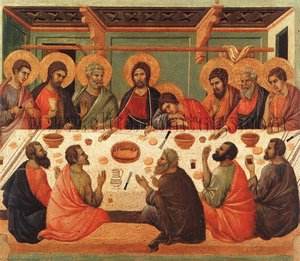 Last Supper - Duccio di Buoninsegna
In Duccio di Buoninsegna's Last Supper (c. 1308), light does not merely illuminate the scene; it breathes life into a moment of profound human tension. As you stand before this masterpiece from the Sienese School, you witness the precise second where Byzantine rigidity dissolves into Renaissance emotion. Duccio uses light to sculpt the faces of the apostles, capturing furrowed brows and questioning glances that transform a sacred ritual into a visceral human drama. The rich interplay of deep reds and celestial blues creates a symbolic rhythm, guiding your gaze toward the central figure of Christ.
The painting’s true magic lies in its tactile intimacy—the way the shadows pool in the folds of medieval garments and the delicate rendering of hands that convey both reverence and dread. It is this very depth, this invention of light and shadow, that makes the work a cornerstone of Italian art history. For those seeking to bring this era of spiritual gravity into a modern space, our hand-painted oil reproductions capture every subtle brushstroke and tonal nuance, allowing the luminous legacy of Duccio to transform your walls into a portal of historical inspiration.
Washing of the Feet - Duccio di Buoninsegna
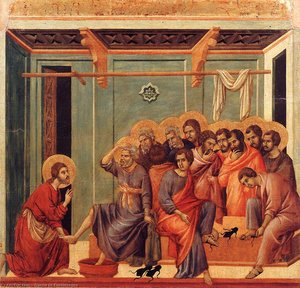 Washing of the Feet - Duccio di Buoninsegna
To possess a study of Washing of the Feet by Duccio di Buoninsegna is to invest in a profound legacy of spiritual grace and refined historical taste. As a vital component of the monumental Maestà altarpiece, this work stands within the top 25 artworks of Duccio’s career due to its revolutionary departure from rigid Byzantine icons toward a tender, humanized Gothic naturalism. The composition draws the eye to the central act of humility, where Christ’s gentle movements are mirrored by the varied, emotive reactions of the apostles. Soft light plays across the figures, while the subtle presence of birds introduces a sense of divine tranquility to the scene.
For the discerning collector, this masterpiece offers more than historical significance; it provides an anchor of cultural authority. A high-quality, hand-painted oil reproduction of this Sienese treasure brings a sophisticated depth of texture and gold-leaf brilliance to modern luxury interiors, allowing the timeless themes of service and devotion to command presence in any contemporary architectural space.
Conjectural reconstruction of the Maestà (front) - Duccio di Buoninsegna
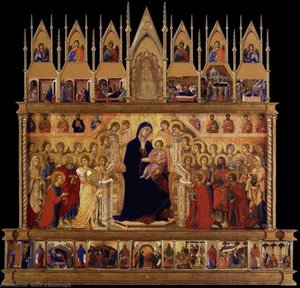 Conjectural reconstruction of the Maestà (front) - Duccio di Buoninsegna
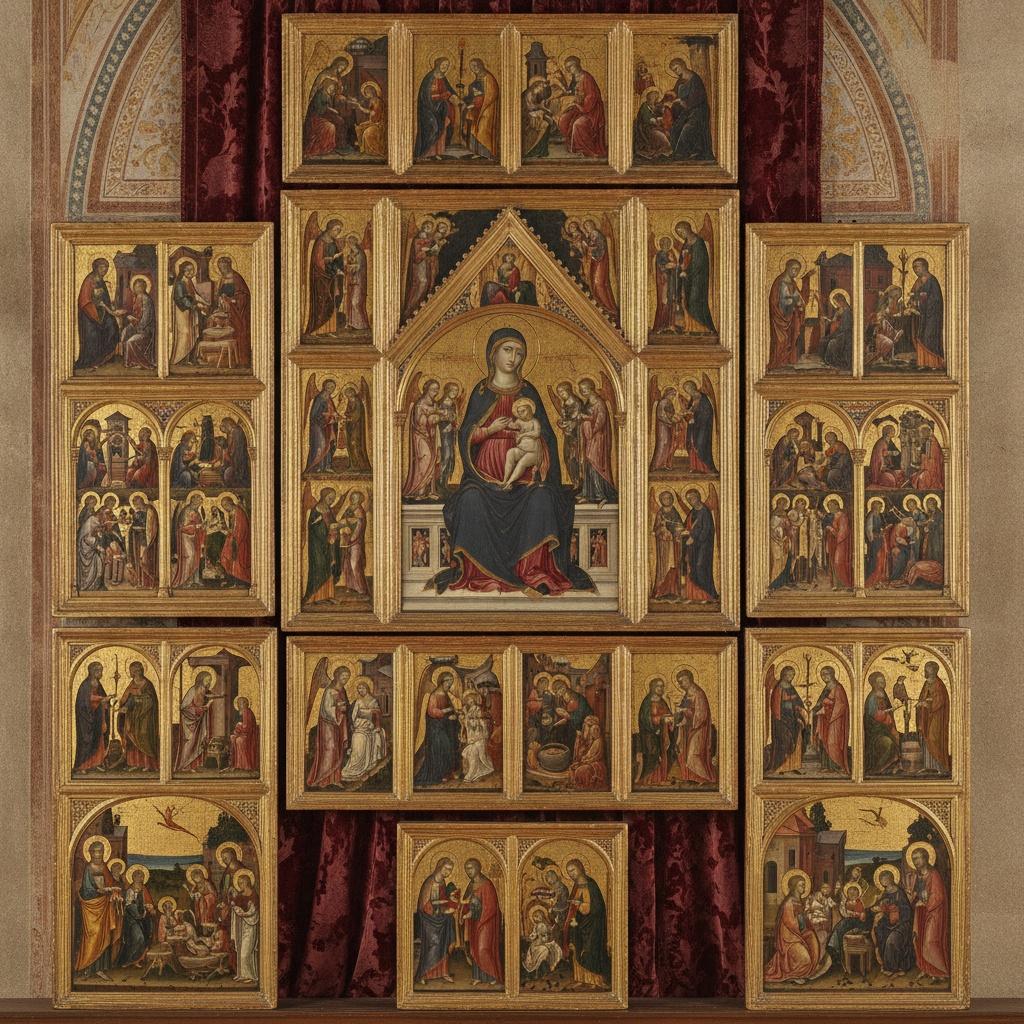
To stand before the Conjectural Reconstruction of the Maestà (front) is to feel the weight of a thousand prayers and the shimmering light of a celestial court. Before the eyes even settle on the central figures, one is enveloped by an atmosphere of profound sanctity, as if the golden veil between the earthly and the divine has momentarily been lifted. This reconstruction captures the breathtaking scale of Duccio di Buoninsegna’s greatest achievement, presenting the Virgin Mary enthroned with the Christ Child amidst a sea of angels and saints.
This work earns its place among the top 25 artworks of Duccio di Buoninsegna because it embodies the very dawn of the Sienese School. It is a masterclass in transition, where the rigid elegance of Byzantine tradition begins to breathe with the soft, human emotion of the Gothic style. The intricate architecture and the rhythmic arrangement of figures create a symphony of devotion that transcends centuries. Bringing such a masterpiece into a modern home through a hand-painted oil reproduction allows this ancient serenity to anchor your space, offering a window into a time when every brushstroke was an act of profound spiritual storytelling.
Christ Mocked (detail) - Duccio di Buoninsegna
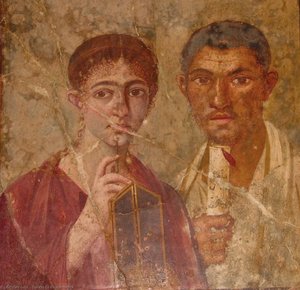 Christ Mocked (detail) - Duccio di Buoninsegna
While the monumental Maestà is celebrated for its vast scale, it is within its smallest, most intimate fragments that Duccio di Buoninsegna truly captures the human soul. In this poignant detail of Christ Mocked , we witness a masterclass in narrative tension. The scene is defined by a sharp, accusatory gesture from an elder figure, whose furrowed brow and pointed finger pierce the stillness, contrasting sharply with the veiled, sorrowful presence beside Christ. This fragment exemplifies why Duccio is a cornerstone of the Sienese School; he moved beyond rigid Byzantine icons to introduce a palpable, breathing emotion.
The technical genius lies in his ability to use subtle modeling and light to suggest physical weight and psychological depth, turning a moment of public humiliation into a profound meditation on dignity. To possess such a piece—whether through a museum visit or a high-quality oil reproduction—is to invite a sense of historical gravity into one's surroundings. Much like the focused intensity required to execute such delicate brushwork, displaying this masterpiece in a modern study or home office fosters an atmosphere of deep contemplation and intellectual sophistication.
Arrest of Christ (Fragment) - Duccio di Buoninsegna
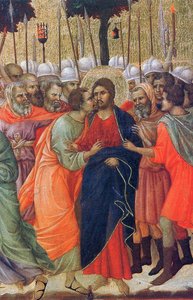 Arrest of Christ (Fragment) - Duccio di Buoninsegna
In the quiet intensity of Duccio di Buoninsegna's Arrest of Christ (Fragment) , we witness a pivotal moment where the rigid hierarchies of Byzantine iconography began to yield to a profound humanism. Painted around 1311, this fragment captures a visceral, unfolding tragedy; the tension is palpable as Roman soldiers and onlookers converge in a swirling composition of movement and mounting dread. Through the luminous brilliance of tempera on wood, Duccio achieves a delicate balance between rhythmic, formal grace and an unmistakable sense of physical weight and emotional vulnerability.
Every element whispers of deeper theological truths, such as the symbolic placement of a bowl and cup near Christ’s head, connecting this betrayal to the ultimate sacrifice of the Eucharist. Owning a reproduction of this top artwork by Duccio di Buoninsegna is not merely a purchase; it is an inheritance of a lineage of taste. At Mus3ums.com, we allow you to bring this historical legacy to your own walls through our museum-grade, hand-painted oil reproductions, ensuring the master's emotional depth and Sienese elegance endure in your private collection.
Flight into Egypt - Duccio di Buoninsegna
 Flight into Egypt - Duccio di Buoninsegna
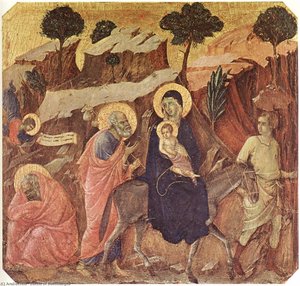
In Flight into Egypt , Duccio di Buoninsegna achieves a profound structural harmony that anchors this work within the top 25 artworks of his illustrious career. The composition is built upon a delicate, rhythmic balance; the central axis of the Holy Family on their donkey creates a stable, vertical anchor, while the diagonal movement of Joseph and the accompanying figures introduces a gentle, flowing energy. This geometric precision—a blend of Byzantine stability and Gothic grace—imbued with a sense of timeless perfection, ensures the piece remains visually captivating centuries later.
There is an unexpected resonance between Duccio’s deliberate use of space and the principles of modern minimalist design. By prioritizing essential forms and a focused color palette of earthy ochres and celestial golds over cluttered realism, the painting achieves a clean, uncluttered aesthetic that grounds contemporary interiors. For collectors seeking to integrate historical depth into a sophisticated home, this masterpiece offers a serene, meditative focal point, bridging the gap between 14th-century devotion and modern elegance.
Descent to Hell - Duccio di Buoninsegna
 Descent to Hell - Duccio di Buoninsegna
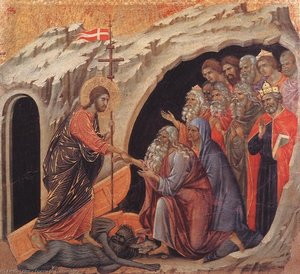
In the Descent to Hell , Duccio di Buoninsegna captures a moment of profound spiritual gravity that transcends the boundaries of the Trecento period. Within this intimate composition, there is a gaze that follows you—not with judgment, but with understanding . As Christ kneels within the shadows of Hades alongside the figure of Adam, the painting ceases to be merely a religious icon; it becomes a mirror reflecting our own shared human vulnerability and the hope for redemption.
The technical mastery of Duccio’s tempera technique creates a luminous depth, where the interplay of light and dark evokes the very essence of the underworld. The delicate drapery and the symbolic presence of the crosses guide the viewer through a narrative of suffering and salvation. To possess a reproduction of this masterpiece is to invite that contemplative stillness into your home. Imagine this profound emotional resonance in your space—not watching you, but reminding you : you are seen. You are part of this eternal story.
The Maestà Altarpiece, detail from the predella featu - Duccio di Buoninsegna
 The Maestà Altarpiece, detail from the predella featu - Duccio di Buoninsegna
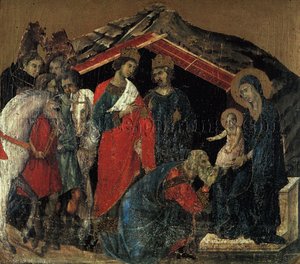
To gaze upon the Maestà Altarpiece predella details by Duccio di Buoninsegna is to witness a profound moment of intimacy captured within the grand theater of sacred history. In these small, precious panels, the monumental scale of the Sienese masterpiece dissolves into tender, human narratives. One can almost feel the warmth of the stable and the quiet reverence of the figures gathered around the Christ child, their red garments glowing with a vitality that defies the centuries. It is this ability to bridge the gap between the divine and the deeply personal that secures its place among the top 25 artworks of Duccio di Buoninsegna.
Duccio’s technical brilliance—using tempera on wood to achieve luminous glazes and delicate textures—creates a window into the soul of the Trecento. At Mus3ums.com, we strive to preserve this very essence. Our handmade oil reproductions capture the tactile depth of Duccio's brushwork and the vibrant, emotive palette of the Sienese School, allowing you to invite this timeless piece of Italian heritage into your own collection through a faithful, hand-painted tribute.
Madonna and Child on a throne - Duccio di Buoninsegna
 Madonna and Child on a throne - Duccio di Buoninsegna
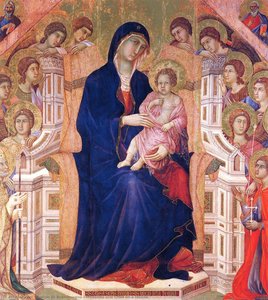
In Madonna and Child on a Throne , Duccio di Buoninsegna orchestrates a profound geometric harmony that anchors this work within the top 25 artworks of Duccio di Buoninsegna. The composition is built upon a stable, pyramidal structure, where the central throne provides a vertical axis that balances the surrounding celestial host. This architectural arrangement of angels and figures creates a rhythmic flow, guiding the eye from the delicate, gilded edges toward the tender intimacy of the Virgin’s gaze. There is a striking equilibrium here; the weight of the gold leaf and heavy drapery is offset by a lightness of spirit and an emerging sense of spatial depth.
This internal balance resonates unexpectedly with the principles of modern minimalist design, where clarity and essential form take precedence. The way Duccio uses structured lines to ground emotional complexity allows this masterpiece to integrate seamlessly into contemporary spaces, offering a sophisticated focal point that feels both ancient and eternally fresh. For collectors seeking to bring this era of Sienese grace into a modern home, our hand-painted oil reproductions capture every luminous layer and meticulous brushstroke of this sacred geometry.
Pilate washes his hands - Duccio di Buoninsegna
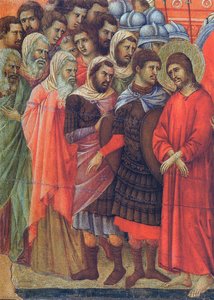 Pilate washes his hands - Duccio di Buoninsegna
To encounter “Pilate Washes His Hands” by Duccio di Buoninsegna is to witness a profound moment of psychological tension frozen in the luminous gold of the Trecento. As a vital component of the monumental Maestà , this panel secures its place among the top 25 artworks of Duccio through its masterful transition from Byzantine rigidity to a deeply human Proto-Renaissance narrative. The scene captures the heavy, somber atmosphere of judgment, where the act of washing hands serves as an eternal symbol of moral evasion.
Duccio employs tempera on panel to create a delicate interplay of light and shadow, imbuing the figures with a burgeoning naturalism that feels strikingly modern. The presence of sharp swords and a peripheral shield adds a metallic, structural tension to the composition, while the soft drapery and emotive faces evoke a sense of pathos . For the discerning collector, this piece offers more than historical significance; its rich textures and solemn beauty provide a sophisticated focal point for refined interiors, bringing the quiet prestige of Sienese history into a contemporary architectural setting.
Deposition - Duccio di Buoninsegna
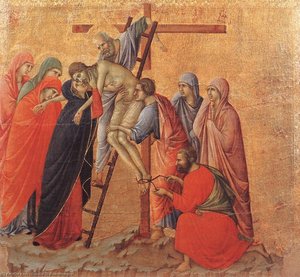 Deposition - Duccio di Buoninsegna
In the Deposition of 1308, Duccio di Buoninsegna captures a moment of profound, breathless stillness amidst the chaos of grief. As part of the monumental Maestà altarpiece, this work transcends mere biblical illustration to become a visceral study of human sorrow. The viewer is drawn into a tight, intimate circle of mourners, where the weight of Christ’s body is met by the heavy, flowing drapery of robes rendered in deep blues and somber reds. Duccio masterfully utilizes a rich gold leaf background that radiates a celestial light, contrasting sharply with the raw, earthly anguish etched upon the faces of the Virgin Mary and her companions.
The composition’s elegant linearity and the subtle interplay of light and shadow create an atmosphere of sacred solemnity. Bringing such a masterpiece into a contemporary home offers more than mere decoration; it provides a focal point for quiet reflection and historical connection. Whether through a large-scale oil reproduction or a meticulously crafted print, the Deposition serves as a powerful testament to the dawn of Italian naturalism, infusing any space with an enduring sense of grace and emotional depth.
The Nativity between Prophets Isaiah and Ezekiel - Duccio di Buoninsegna
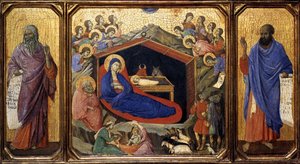 The Nativity between Prophets Isaiah and Ezekiel - Duccio di Buoninsegna
Owning The Nativity between Prophets Isaiah and Ezekiel by Duccio di Buoninsegna is not merely an acquisition; it is an inheritance of the Sienese soul. In this profound 1308 panel, Duccio orchestrates a celestial encounter where the rigid gold of Byzantine tradition begins to soften into human warmth. The scene unfolds with a breathtaking intimacy, as the tender contours of the Virgin Mary emerge through luminous tempera glazes, inviting the viewer into a sacred, tactile reality.
The composition is a masterclass in theological storytelling, placing the birth of Christ within a cosmic timeline flanked by the prophetic visions of Isaiah and Ezekiel. Every element, from the gentle tilt of an angel's head to the quiet presence of figures gathered around the manger, pulses with a nascent naturalism. As you contemplate this masterpiece, you are participating in a lineage of taste that transcends centuries. At Mus3ums.com, we bring this legacy to your private collection through meticulous, hand-painted oil reproductions. Our artists capture every delicate brushstroke and golden glow, ensuring that this pivotal moment of the Trecento period becomes a living, breathing presence on your walls.
Coronation of the Virgin, Szépmüveszéti Muzeum, Budap - Duccio di Buoninsegna
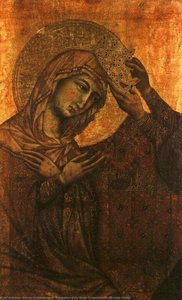 Coronation of the Virgin, Szépmüveszéti Muzeum, Budap - Duccio di Buoninsegna
In the quiet halls of the Szépmüveszéti Muzeum in Budapest, Duccio di Buoninsegna’s Coronation of the Virgin serves as a luminous window into the late thirteenth century. This masterpiece does not merely depict a religious event; it composes light as if writing a sacred sonata. As you gaze upon the moment Christ bestows the crown upon Mary, you witness the precise instant where the rigid, golden stillness of the Byzantine tradition begins to breathe with a newfound human warmth.
The visual language here is a profound dialogue between two worlds. The shimmering gold leaf evokes an eternal, celestial majesty, yet Duccio introduces a nascent naturalism through the serene dignity of Mary’s posture. This tension between opulent tradition and organic emotion is why this work remains a cornerstone of the Sienese School. For the discerning collector, bringing such a piece into a home means more than mere decoration; it is an invitation for this divine radiance to spill across your walls, turning a private space into a portal of historical inspiration and profound peace.
Conclusion
To walk through the legacy of Duccio di Buoninsegna is to witness the very moment the divine began to breathe with human warmth. His brushstrokes did more than merely decorate altarpieces; they bridged the gap between the celestial and the terrestrial, inviting us into a sacred space where gold leaf meets the soft, emotive reality of the human soul. These masterpieces are far more than relics of the Sienese School or static treasures of the fourteenth century; they are living presences that continue to pulse with a quiet, profound vitality, capable of transforming the atmosphere of any modern environment they inhabit.
At Mus3ums.com , we believe that such timelessness deserves to be felt within the walls of our own lives and professional spaces. For the interior designer curating a boutique hotel, the architect refining a private villa, or the collector seeking to anchor a room with historical gravity, Duccio’s work offers an unparalleled sense of grace and continuity. We serve as your creative partner in this endeavor, specializing in museum-quality, hand-painted oil reproductions that capture the tactile depth, the luminous pigments, and the spiritual resonance of these ancient icons.
Whether you are looking to commission a large-scale centerpiece for a grand hall or require professional digital mockups to visualize how a specific Madonna might interact with your unique color palette, our team is dedicated to bringing the majesty of art history into the contemporary architectural landscape. We invite you to explore the full collection of Duccio’s profound works and discover how these echoes of the past can become the defining artistic statements of your future projects.