Introduction
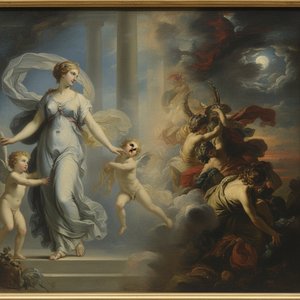
Emerging from the intellectual fervor of the late 18th century, French neoclassical painters sought to reclaim the grandeur of antiquity through a disciplined return to the ideals of ancient Greece and Rome. This movement arose as a profound reaction against the perceived frivolity of the Rococo style, favoring instead a visual language defined by clarity, structural order, and moral gravity. In the studios of Paris, artists moved away from the swirling, pastel-hued ornamentation of the previous era, turning instead toward the stoic balance and precise linear precision found in classical sculpture and the works of the Renaissance masters.
The cultural landscape of France during this period was one of intense transformation, where art became a vehicle for civic virtue and heroic storytelling. These painters did not merely depict scenes; they captured the essence of duty, sacrifice, and rationalism, often utilizing dramatic lighting and meticulously smooth surfaces to elevate their subjects. Their work reflected a society navigating the shift from the absolute monarchy to the revolutionary ideals of the Enlightenment, making their canvases powerful instruments of both aesthetic and political expression.
Today, the legacy of these masters remains vital, as their influence on the foundations of Western academic art cannot be overstated. The technical mastery of their composition and their ability to convey profound human emotion through controlled, elegant forms continue to serve as a benchmark for excellence in fine art. By examining the lives and techniques of these influential figures, we gain a deeper understanding of the visual discipline that shaped the modern era of painting.
The following selection explores the diverse facets of this movement, from the monumental historical compositions of Jacques-Louis David to the exquisite portraiture of Jean-Auguste-Dominique Ingres, offering a journey through the most significant voices of French Neoclassicism.
Jacques-Louis David
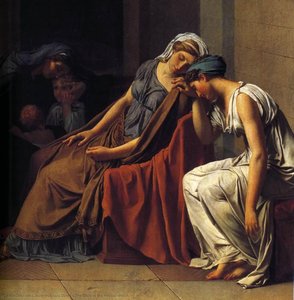 The Oath of the Horatii (detail) - Jacques-Louis David
As the preeminent figure of the late 18th-century French Neoclassical movement, Jacques-Louis David (1748–1825) orchestrated a profound aesthetic shift that redefined the visual language of a nation. He rose to prominence by replacing the frivolous, swirling ornamentation of the Rococo with a disciplined emphasis on order, moral clarity, and the stoic ideals of antiquity. His work serves as the definitive bridge between the structured hierarchies of the Ancien Régime and the radical, transformative energy of the French Revolution.
David’s mastery is most strikingly realized in his monumental masterpiece, The Oath of the Horatii. This work epitomizes the Neoclassical pursuit of civic duty and sacrifice, utilizing rigorous contours and a pyramidal composition to command the viewer's attention. Through precise anatomical rendering and a dramatic, staged clarity, he transformed historical narratives into powerful allegories of patriotism. His ability to navigate the turbulent shifts of his era—from the grandeur of the Napoleonic age to intense historical drama—ensured that his brushwork became the standard for academic excellence, influencing generations of artists who sought to capture the gravity of the human condition through the lens of classical reason.
Jean-Auguste-Dominique Ingres
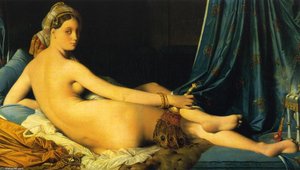
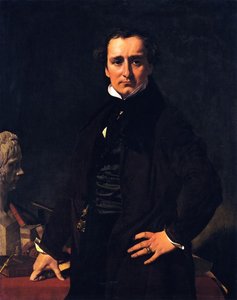
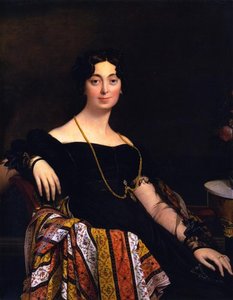
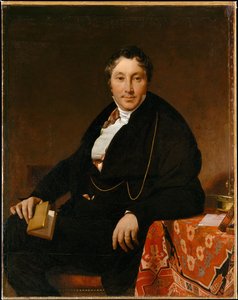
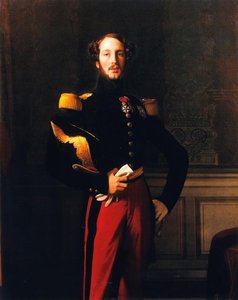
Jean-Auguste-Dominique Ingres (1780–1867) stands as a monumental figure of French Neoclassicism, a painter who dedicated his life to defending the purity of line and the discipline of drawing against the turbulent rise of Romanticism. Born in Montauban to a father who was both a painter and sculptor, Ingres received early training in the precision of form that would define his career. His work is instantly recognizable by its smooth, polished surfaces and an almost sculptural clarity of contour that eschews violent drama in favor of calm, idealized beauty.
A master of the academic tradition, Ingres utilized meticulous layering of oil paint to achieve a luminous, porcelain-like finish. His masterpiece, The Grande Odalisque (1814), exemplifies his unique approach to Neoclassical principles; while it adheres to the classical reclining nude, it introduces a dreamlike, melodic quality through the deliberate elongation of the human form. This subtle distortion emphasizes aesthetic grace over strict anatomical realism, bridging the gap between traditional order and a burgeoning, exotic sensuality. Through his focus on the perfection of the silhouette and the elegance of the curve, Ingres remains a cornerstone of the Neoclassical movement.
Élisabeth Louise Vigée Le Brun
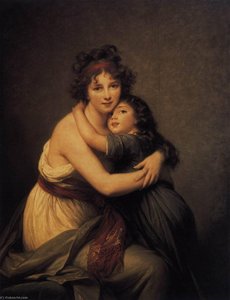 Self Portrait with Her Daughter, Julie - Élisabeth Louise Vigée Le Brun
A central figure in the transition from the late Rococo to the structured ideals of the new era, Élisabeth Louise Vigée Le Brun (1755–1842) brought a profound sense of grace and psychological depth to French portraiture. While her early training was shaped by her father, a portraitist and member of the Académie de Saint-Luc, her technical mastery was forged through the rigorous study of masters like Rubens and Van Dyck. Her ability to blend the soft, luminous textures of the previous era with the clear, dignified compositions characteristic of the Neoclassical movement allowed her to navigate the highest circles of the French court, most notably as a close confidante and painter to Marie Antoinette.
Her work is defined by a harmonious balance and a serene emotional resonance that aligns her with the Neoclassical pursuit of idealized beauty and clarity. In her 1789 masterpiece, Self Portrait with Her Daughter, Julie, this stylistic intersection is masterfully displayed. The painting captures a tender, intimate bond through a refined technique and a muted, earthy palette of creams and soft browns. By prioritizing the naturalism of form and the dignity of the subject, Vigée Le Brun helped define the visual language of an evolving French aesthetic.
Charles Meynier
 La France, sous les traits de Minerve, protégeant les arts - Charles Meynier
A central figure in the French neoclassical movement, Charles Meynier (1763–1832) embodied the era's commitment to classical order and allegorical grandeur. After an early apprenticeship under the engraver Pierre-Philippe Choffard, Meynier’s talent led him to study under François-André Vincent. His ascent within the academic hierarchy was cemented in 1789 when he secured second prize in the prestigious Prix de Rome, a feat that granted him membership in the Académie de France in Rome and solidified his standing among the leading painters of his generation.
Meynier’s work is characterized by a sophisticated ability to blend dramatic historical narratives with the restrained elegance typical of Neoclassicism. His versatility is evident in his diverse commissions, ranging from monumental designs for the Arc de Triomphe du Carrousel to significant military subjects. In his representative masterpiece, La France, sous les traits de Minerve, protégeant les arts, he utilizes a pyramidal composition and divine allegory to celebrate cultural resilience. By portraying Minerva presiding over the liberal arts, Meynier captures the movement's penchant for using Greco-Roman iconography to convey profound national ideals. His artistic legacy continued through his influence on subsequent masters, such as James Pradier, ensuring his place in the history of French art.
Louis Léopold Boilly
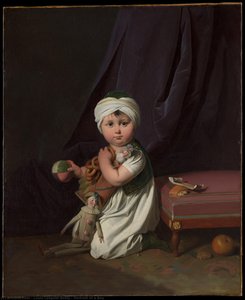 Portrait of a Boy - Louis Léopold Boilly
Louis Léopold Boilly (1761–1845) stands as a vital figure within the French neoclassical movement, distinguished by his ability to marry the movement's characteristic precision with a profound interest in the evolving social fabric of France. While many of his contemporaries focused on grand historical allegories, Boilly applied the neoclassical emphasis on clear outlines and meticulous detail to the intimate sphere of Parisian life. His early training in trompe-l’oeil under Dominique Doncre instilled in him a technical rigor that would define his career, allowing him to render textures and surfaces with an almost tactile accuracy.
His work often bridges the gap between formal portraiture and genre painting, capturing the burgeoning middle class with a sense of dignity and observational truth. In his 1805 masterpiece, Portrait of a Boy, Boilly demonstrates this stylistic duality. The painting showcases his mastery of detail through the boy's exotic Mamluk-inspired attire—reflecting the era's fascination with Napoleon's Egyptian campaign—and the careful arrangement of domestic objects. By applying the disciplined, structured approach of neoclassicism to these everyday scenes, Boilly elevated the depiction of contemporary life into a sophisticated art form.
Pierre-Paul Prud'hon
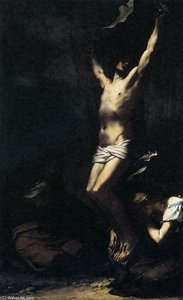 Crucifixion - Pierre-Paul Prud'hon
In his profound 1822 work, Crucifixion, Pierre-Paul Prud'hon demonstrates a breathtaking command of light and shadow that defines his unique position in French art. This masterpiece serves as a spiritual bridge, utilizing the disciplined grace of Neoclassicism to frame a scene of intense, emotive power. Through a masterful application of chiaroscuro, Prud'hon isolates the central figure against an abyss of dark, undefined space, creating a dramatic spotlight effect that forces an intimate encounter with the subject's vulnerability.
Born in Cluny in 1758, Prud'hon’s journey from the provinces to the École de Dessin in Dijon eventually led him to Rome in 1784. It was there that his style was deeply shaped by the study of classical art, imbuing his work with the idealized forms and elegant compositions essential to the Neoclassical movement. While his technical precision and devotion to classical balance align him with this era, his ability to infuse allegories and portraits with raw, Romantic sentiment distinguishes him from his contemporaries. Whether depicting the imperial elegance of Napoleon's court or the somber depths of religious sacrifice, his palette and technique remain a testament to the transition between order and emotion.
Jean-Bernard Restout
 ANANIE IMPOSANT LES MAINS A SAINT PAUL - Jean-Bernard Restout
Jean-Bernard Restout (1732–1797) stands as a significant figure in the transition toward the disciplined clarity of the French neoclassical movement. Born in Paris and trained within the esteemed tradition of the Académie de Rouen, Restout’s artistic journey was marked by a rigorous adherence to classical principles. His victory in the prestigious Prix de Rome in 1758 and his subsequent admission to the Académie Royale in 1769 underscore his mastery of the formal techniques that would define the era's aesthetic shift away from Rococo opulence toward a more restrained and balanced composition.
His work is characterized by a profound sense of elegance and a capacity for dramatic intensity. In his representative masterpiece, Ananie Impostant Les Mains à Saint Paul, Restout demonstrates a sophisticated command of light and shadow. The composition utilizes a divine, central beam of light to illuminate a pivotal biblical moment, blending emotional depth with the structural order essential to the neoclassical spirit. While his career was deeply intertwined with the political upheavals of the French Revolution, his artistic legacy remains rooted in this ability to marry classical architectural grandeur with a powerful, humanistic narrative.
Anne-Louis Girodet
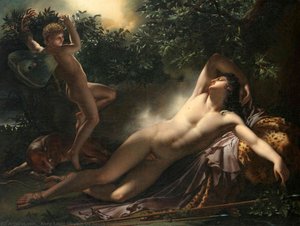 The Sleep of Endymion - Anne-Louis Girodet
Anne-Louis Girodet (1767–1824) stands as a transformative figure in French art, serving as a vital bridge between the disciplined rigor of Neoclassicism and the burgeoning emotionalism of Romanticism. A distinguished student of Jacques-Louis David, Girodet mastered the Neoclassical emphasis on precise composition and moral clarity, yet he infused his work with a unique, poetic sensibility that often transcended the strictures of his teacher's school. His ability to blend classical subject matter with a more sensual, atmospheric approach allowed him to evolve the movement's aesthetic toward a more evocative and mysterious territory.
This stylistic evolution is most profoundly captured in his 1793 masterpiece, The Sleep of Endymion. In this work, Girodet moves beyond the rigid perfection typically associated with Neoclassical ideals, opting instead for a soft, ethereal beauty. Through a masterful application of light and shadow, he creates a dreamlike tableau that feels both mythological and deeply intimate. The painting exemplifies his ability to utilize classical themes—in this case, the myth of the shepherd Endymion—to explore profound states of reverie and desire, marking him as a painter who respected the foundations of antiquity while paving the way for the Romantic era.
Jean-Antoine Houdon
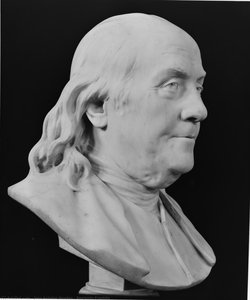 Benjamin Franklin - Jean-Antoine Houdon
While primarily celebrated as a sculptor, Jean-Antoine Houdon (1741–1828) is an essential figure in the French neoclassical movement due to his profound commitment to the era's core principles: clarity, anatomical precision, and the rejection of Rococo ornamentation. His work moved away from the frivolous curves of the previous age, favoring a directness that mirrored the intellectual rigor of the Enlightenment. Trained at the Académie Royale de Peinture et de Sculpture under masters such as Jean-Baptiste Lemoyne and Jean-Baptiste Pigalle, Houdon’s aesthetic was further refined by his studies in Italy after winning the prestigious Prix de Rome in 1761.
Houdon’s mastery lay in his ability to achieve a startling verisimilitude, capturing the psychological essence of the era's most influential thinkers. His Benjamin Franklin (1778) serves as a definitive example of this neoclassical approach, where the focus shifts from idealized grandeur to a truthful, dignified representation of character. By emphasizing the subtle textures of skin and the thoughtful nuances of expression, Houdon bridged the gap between classical idealism and modern realism, ensuring his subjects possessed a timeless, intellectual presence.
Jacques Grasset De Saint-Sauveur
 Costumes de Différents Pays, - Jacques Grasset De Saint-Sauveur
Jacques Grasset de Saint-Sauveur, also known as Labrousse, represents a specialized facet of the French Neoclassical movement through his meticulous documentation of global identity. While many of his contemporaries focused on Greco-Roman mythology, Saint-Sauveur applied the Neoclassical emphasis on clear, precise linework and structural order to the study of ethnography and fashion. His work reflects the era's Enlightenment-driven desire to categorize and understand the world through a lens of disciplined observation and formal elegance.
His technical mastery is most evident in his 1797 engraving, Costumes de Différents Pays. This work exemplifies the Neoclassical pursuit of detail and anatomical accuracy, utilizing the precision of the etching needle to render the textures of diverse cultural attire with remarkable clarity. In this piece, the artist captures a sophisticated balance between the intricate patterns of clothing and the atmospheric rendering of the surrounding environment. By elevating the study of costume to a high art form, Saint-Sauveur transformed fashion into a visual language of cultural narrative, bridging the gap between scientific documentation and the refined aesthetic sensibilities of late 18th-century France.
Conclusion
The legacy of French neoclassical painters lies in their ability to harmonize the emotional intensity of the human experience with the disciplined clarity of antiquity. From the heroic, dramatic compositions of Jacques-Louis David to the ethereal, soft-edged elegance of Pierre-Paul Prud'hon, these masters moved beyond mere imitation of the past to create a visual language of order, grace, and profound dignity. Whether through the precise portraiture of Ingres or the luminous, idealized beauty found in the works of Vigée Le Brun, this movement redefined the aesthetic standards of Europe, establishing a foundation of balance and structure that continues to resonate in the history of fine art.
For those looking to bring this timeless elegance into their own living spaces, Mus3ums.com offers a way to experience these masterpieces firsthand. Our skilled artists specialize in creating museum-quality, hand-painted oil reproductions that capture the authentic texture and soul of these historic works. We invite you to explore our full collection and find a piece of French history to live with in your home.