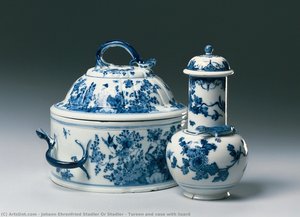
The Porcelain Virtuoso of Dresden
In the golden age of European ceramics, few names resonate with the delicate precision of Johann Ehrenfried Stadler. Born in Dresden, Germany, in 1701, Stadler emerged as a master of a highly specialized medium: hard-paste porcelain. His life and career were inextricably linked to the prestigious Meissen Manufactory, where he applied his painterly talents to the most exquisite surfaces of his era. Working during a period of immense innovation in ceramic technology, Stadler became a vital figure in the development of the Meissen aesthetic, translating the fluidity of fine art onto the rigid, luminous canvas of porcelain.
The artistry of Stadler is best understood through his mastery of enamels and gilt. His work often featured intricate scenes that demanded an extraordinary level of control over heat and pigment. One can observe his skill in pieces such as a sugar box and cover from approximately 1725, where he utilized a vibrant palette of iron red, purple, and gold to create captivating chinoiserie figures and delicate floral sprays known as "India flowers." His ability to weave complex narratives—such as the charmingly detailed scenes within shaped oval cartouances—demonstrates a sophisticated command over both composition and the technical challenges of firing enamels onto hard-paste porcelain.
A Legacy in Enamel and Gold
Stadler’s contributions extend beyond mere decoration; he helped define the visual language of the Royal Porcelain Collection. His hand is identifiable in works that were not only intended for private luxury but also served as diplomatic gifts of immense value. For instance, a bowl delivered to the factory in 1724 and presented by Augustus the Strong to the King of Sardinia serves as a testament to his importance. The attribution of such significant pieces to Stadler is often confirmed by subtle signatures, such as a meticulously painted lantern, which allows historians to trace his unmistakable touch through the annals of German ceramic history.
The enduring significance of his work is reflected in its presence within the world's most esteemed institutions. His delicate vases and ornamental objects continue to be studied for their technical brilliance and aesthetic grace. Through his dedication to the Meissen tradition, Stadler achieved a rare feat: he elevated the decorative arts to the level of fine painting, ensuring that every stroke of enamel and every application of gold contributed to a lasting legacy of German craftsmanship. His career, which concluded in 1741, remains a cornerstone in the study of eighteenth-century porcelain artistry.
Pitanja i odgovori
What aliases or alternate names does Johann Ehrenfried Stadler Or Stadler have?
Johann Ehrenfried Stadler Or Stadler appears under the alternate names Johann Ehrenfried Stadler.
Gde je i kada je rođen/a Johann Ehrenfried Stadler Or Stadler?
Johann Ehrenfried Stadler Or Stadler je rođen/a u gradu Dresden godine 1701.
U kom istorijskom periodu je stvarao/la Johann Ehrenfried Stadler Or Stadler?
Johann Ehrenfried Stadler Or Stadler je stvarala u periodu Early Modern. Ovaj period smešta umetnikov rad u istorijski kontekst.