The Legacy of Quentin Varin: A Master of Line and Form
In the quiet corridors of art history, certain names resonate with the delicate precision of a master’s touch, and Quentin Varin is one such figure. Emerging from the vibrant artistic landscape of France during the late Renaissance and early Baroque transition, Varin carved out a niche for himself as a skilled sculptor and engraver. Born around 1570, his life coincided with an era of profound transformation in European aesthetics, where the rigid structures of the past began to yield to more fluid, expressive forms. While often overshadowed by the grander narratives of the Baroque masters, Varin’s contribution lies in his meticulous ability to translate three-dimensional depth onto two-dimensional surfaces through the medium of engraving.
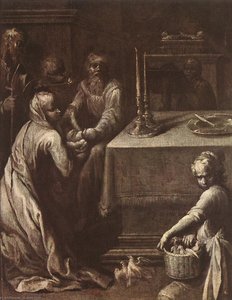
The artistry of Varin was deeply rooted in the technical rigor required of a sculptor. This background provided him with an innate understanding of volume, light, and shadow—elements that would become the hallmarks of his engravings. To observe a Varin print is to witness a dialogue between chiaroscoscuro and fine line; he possessed the rare ability to use simple incisions to suggest the weight of stone or the soft fold of fabric. His work served as a vital bridge, bringing the tactile permanence of sculpture to the more accessible and reproducible world of printmaking, allowing his vision to circulate far beyond the confines of a single studio.
Technical Mastery and Artistic Evolution
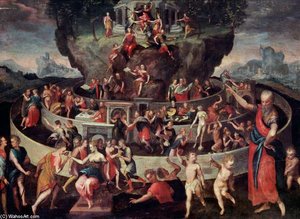
The development of Varin’s style was marked by an increasing sophistication in his use of the burin. As he refined his craft, his engravings moved away from mere documentation toward a more emotive and atmospheric quality. He mastered the art of varying line density to create a sense of movement and breath within his compositions. This technical evolution allowed him to tackle complex subjects, ranging from religious iconography to classical allegories, with a level of nuance that commanded respect among his contemporaries.
His achievements can be viewed through several key artistic lenses:
- The Sculptural Influence: His ability to imbue flat surfaces with a sense of physical mass and anatomical accuracy.
- Precision in Engraving: The use of intricate cross-hatching and varying line weights to simulate texture and light.
- Cultural Integration: His role in disseminating classical and religious themes through the widely distributable medium of print.
Ultimately, the historical significance of Quentin Varin rests in his role as a craftsman who elevated the engraver's art. He did not merely replicate images; he interpreted them through the lens of a sculptor, adding a layer of structural integrity and dramatic tension that enriched the visual language of 17th-century France. His work remains a testament to the enduring power of precision and the profound impact that a single, well-placed line can have on the perception of beauty.
Pitanja i odgovori
U kom istorijskom periodu je stvarao/la Quentin Varin?
Quentin Varin je radila u periodu Early Modern. Ovaj period smešta umetnikov rad u istorijski kontekst.
U kom gradu i državi je rođen/a Quentin Varin?
Quentin Varin je rođen/a u gradu Le Havre, u državi France.