


A Monument of Baroque Grandeur and Spiritual Light
In the beating heart of Paris’s Latin Quarter, where the historic streets of the 6th arrondissement whisper tales of ancient scholars and revolutionaries, stands the Church of Saint-Sulpice. It is not merely a place of worship but a colossal architectural triumph that commands the skyline with an imposing, almost unfinished majesty. As one approaches the Place Saint-Sulpice, the sheer scale of the edifice becomes overwhelming, rivaling even the legendary Notre Dame in its ambition. The façade, characterized by its massive towers and a sense of monumental weight, serves as a dramatic prelude to the treasures held within. This sacred landmark, with foundations reaching back to the 12th century, underwent a profound metamorphosis during the reign of Louis XV, emerging as a premier example of Baroque splendor infused with the burgeoning elegance of Neoclassical design.
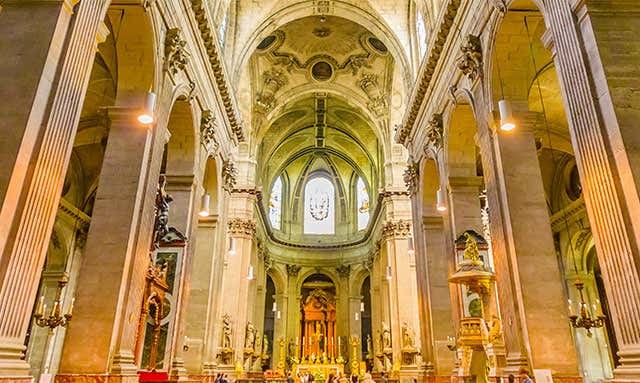
Stepping across its threshold, the visitor is immediately enveloped by an atmosphere of ethereal light and vast, soaring proportions. The interior of Saint-Sulpice is a masterclass in the use of space to evoke the divine. The nave stretches forward with a rhythmic solemnity, flanked by massive columns that support a ceiling designed to draw the eye upward toward the heavens. For the art lover and the historian alike, the church offers a profound journey through the evolution of French artistic technique. One cannot help but feel the weight of history in the quiet corners of the sacristy, where Louis XV-style wood panelling provides a warm, intimate contrast to the grander, more austere stone expanses of the main hall.
Masterpieces of Sculpture and the Romantic Vision
The true soul of Saint-Sulpice resides in its exquisite collection of sculptural works, which breathe life into the cold marble and stone. The emotive Baroque style is perhaps most powerfully realized in the tomb of Languet de Gergy, a breathtaking creation by René-Michel Slodtz. Through his masterful command of form and texture, Slodtz captures a sense of spiritual depth and profound human emotion that remains as poignant today as it was in the 18th century. This tradition of sculptural excellence is further enriched by the presence of Jean-Baptiste Pigalle’s work within the Chapel of the Virgin, where the delicate interplay of light and shadow highlights the grace of his figures.
Beyond the sculpted stone, the church serves as a sanctuary for the vibrant colors of the Romantic era. The Chapel of the Holy Angels houses a series of monumental frescoes by Eugène Delacroix, one of the titans of French painting. These works are not merely decorations but windows into a visionary world; Delacroix’s ability to manipulate light and movement within these sacred walls creates a sense of divine drama that continues to inspire artists and designers seeking to capture the sublime. To stand before these paintings is to witness the intersection of architectural permanence and the fleeting, passionate energy of Romanticism.
A Confluence of Science, Mystery, and Cultural Legacy
What truly distinguishes Saint-Sulpice from other Parisian landmarks is its unique role as a crossroads between the sacred and the scientific. Hidden within the floor of the church lies a fascinating astronomical curiosity: the gnomon. This meridian line, marked by an inlaid brass wire, functions as a solar sundial, allowing for the calculation of the equinoxes and the determination of Easter. This marriage of celestial mechanics and religious ritual lends the building an aura of intellectual mystery that has captivated minds for centuries.
This sense of intrigue was catapulted into the global consciousness by Dan Brown’s The Da Vinci Code , which utilized the church's architectural secrets and symbolic depth as a central plot element. While the fiction may stir the imagination, the reality of Saint-Sulpice is even more compelling. From the resonant, historic tones of the great Cavaillé-Coll organ that fills the air during liturgical celebrations to the quiet contemplation offered by its ancient crypts, the church remains a living monument. For collectors of history and admirers of fine art, Saint-Sulpice offers an unparalleled experience—a place where the echoes of the past meet the enduring beauty of human creativity.