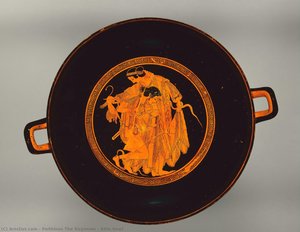
The Legacy of Peithinos the Sicyonian
In the golden age of Greek antiquity, few names resonate with the quiet authority of Peithinos the Sicyonian. A master whose hands shaped the very essence of the mid-5th century BC, Peithinos emerged from the storied city of Sicyon—a cradle of ceramic excellence in the Peloponnese—to leave an indelible mark on the Athenian artistic landscape. While the passage of millennia has obscured much of his personal biography, the fragments of his genius remain, whispering tales of a creator who bridged the gap between rigid tradition and the fluid grace of the burgeoning classical style. His life was a testament to the synthesis of regional craftsmanship and metropolitan innovation, as he brought the meticulous discipline of his Sicyonian roots to the prestigious intellectual circles of the Athenian Academy.
The artistry of Peithinos is most profoundly felt in his mastery of the red-figure technique, a revolutionary method that allowed for unprecedented anatomical detail and narrative depth. Unlike the earlier black-figure style, which relied on silhouette and incised lines, Peithinos utilized the red-figure approach to breathe life into clay. By leaving the figures in the natural color of the clay and painting the background in a deep, lustrous black, he achieved a sense of three-dimensionality that was nothing short of transformative. His work often captured the tension of mythological drama and the serene elegance of the human form, characterized by a delicate balance of muscular definition and flowing drapery that suggested movement even in stillness.
Artistic Evolution and the Athenian Influence
The development of Peithinos’s style is a journey from the structured echoes of Doric tradition toward a more experimental and expressive aesthetic. It is believed that his early training was steeped in the robust, somewhat heavier stylistic conventions prevalent in Sicyon, where the focus remained on strength and structural integrity. However, upon his ascent within the Athenian Academy, Peithinos encountered a world of intense artistic discourse and competition. This environment acted as a crucible, refining his skills and encouraging him to push the boundaries of what could be achieved with slip and clay.
His achievements can be viewed through several key artistic milestones:
- The Integration of Form: He successfully merged the heavy, grounded aesthetics of Peloponnesian art with the lighter, more fluid Athenian sensibilities.
- Narrative Sophistication: Through his use of red-figure painting, he introduced a level of psychological nuance to mythological scenes, allowing viewers to perceive emotion through subtle gestures.
- Technical Precision: His ability to manipulate fine lines allowed for the depiction of intricate patterns in clothing and the delicate musculature of the human anatomy.
Ultimately, the historical significance of Peithinos the Sicyonian lies in his role as a transitional figure. He was not merely a craftsman following established norms, but an innovator who embraced the changing tides of Greek art. His work serves as a vital link in the evolution of classical sculpture and vase painting, embodying the moment when ancient art moved from the symbolic toward the profoundly human. To study the works attributed to Peithinos is to witness the dawn of a new era of classical beauty, where every curve and line tells a story of a civilization at its creative zenith.