A Visionary Behind the Lens: The Legacy of Govinda Shrinivas Welling
In the quiet, historical corridors of early 20th-century Indian photography, few names resonate with as much spiritual and cultural weight as Govinda Shrinivas Welling. Born in 1892 in Belagavi, India, Welling emerged during a transformative era defined by the intersection of Victorian colonial influence and a profound resurgence of Eastern philosophical inquiry. His life and work serve as a vital bridge between the documented reality of the period and the ethereal essence of the subjects he captured. While much of his personal history remains shrouded in the soft focus of time, his artistic identity is inextricably linked to the mastery of light and the preservation of a monumental moment in Indian spiritual history.
Welling’s photographic sensibility was shaped by a unique dual heritage. Having received his education in England, he was immersed in the rigorous Western traditions of classical composition and the technical advancements of the era. This exposure to European aesthetic standards allowed him to approach photography with a sophisticated eye for balance and tonal depth. Yet, this Western training was harmoniously blended with an intimate understanding of Eastern philosophies. The result was a style that did not merely record a likeness but sought to capture the atman, or the inner soul, of his subjects, imbuing his portraits with a sense of profound stillness and contemplative grace.
The Immortal Encounter: Capturing Swami Vivekananda
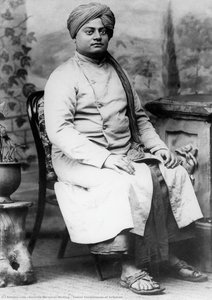
The zenith of Welling’s career—and perhaps the most significant contribution to the visual archive of India—is his 1926-documented portrait of Swami Vivekananda. The story behind this image is as much a part of its legend as the photograph itself. During Vivekananda’s visit to Belgaum in 1892, the great spiritual leader was initially hesitant to be captured by the camera. It took the persistent efforts of Haripada Mitra, one of Swamiji's hosts, to navigate this "long-drawn tussle" and secure consent for the portrait. When the shutter finally clicked, it froze a moment of immense historical importance: the serene countenance of a man who would soon disseminate the wisdom of Vedanta to the entire world.
In this celebrated work, Welling’s technical prowess is on full display. Utilizing the traditional albumen printing processes characteristic of the late 19th century, he achieved a remarkable clarity and a rich, sepia-toned depth that lends the image an eternal quality. The composition avoids the mere clinical documentation of a sitter; instead, it captures the "eyes flashing like lightning" and the meditative aura described by those who met Vivekananda. Through his lens, Welling transformed a fleeting encounter into a permanent icon of spiritual strength, making the photograph a cornerstone of Indian photographic heritage.
Technique, Studio, and Enduring Significance
Welling’s professional life was anchored in the vibrant commercial landscape of Belgaum. Operating through the studio known as S. Mahadev & Son, his work contributed to the burgeoning tradition of portraiture that documented the cultural fabric of colonial India. His technical approach prioritized a sense of solemnity and introspection, often employing carefully considered compositions that utilized light to create an atmosphere of reverence. The very existence of his studio's legacy—even as the physical business eventually closed in 1970—speaks to the lasting impact of the visual records he helped create.
The historical significance of Govinda Shrinivas Welling extends far beyond the borders of Belgaum. His work stands as a testament to a period when photography began to function as a powerful tool for cultural preservation and spiritual storytelling. By capturing the likenesses of influential figures and the landscapes of his homeland, Welling provided a visual vocabulary for an era of intense intellectual and spiritual transition. Today, his contributions are revered not just as technical achievements in early photography, but as soulful windows into the heart of a nation finding its voice on the global stage.