A Visionary of the Salon: The Life and Art of Pauline Auzou
In the vibrant, often turbulent landscape of late eighteenth-century France, a remarkable talent emerged from the heart of Paris to claim her place within the prestigious halls of the Paris Salon. Born Jeanne-Marie-Catherine Desmarquets in 1775, the woman who would become known as Pauline Auzou possessed a tenacity that defied the rigid gender constraints of her era. While the formal academies of the time were largely a male preserve, Auzou navigated the complexities of the art world with grace and profound skill. Her journey was one of both personal transformation and artistic evolution, moving from the intimate studies of classical figures to the grand, politically charged canvases of the Napoleonic age.
Auzou’s artistic foundation was laid in the atelier of Jean-Baptiste Regnault, a master whose influence helped shape her early command of form and light. During these formative years, she demonstrated an extraordinary courage by engaging in the study of male and female nudes—a practice often deemed inappropriate for women of her station. This boldness allowed her to develop a technical mastery that would later define her career. Influenced by the delicate sensibilities of Marguerite Gérard and the precise draftsmanship of Jean-Auguste-Dominique Ingres, Auzou’s work began to reflect a unique synthesis of Neoclassical rigor and a more intimate, emotive touch.
Mastery of Genre and the Napoleonic Era
As her career progressed, Auzou became a celebrated figure within the Neoclassical and Troubadour movements. She possessed a rare ability to capture the zeitgeist of her time, moving seamlessly between historical narratives and contemporary genre scenes. Her talent for portraiture earned her the patronage of the highest echelons of French society, including the Duchesse de Berry and Empress Josephine. Perhaps most significantly, Auzou was entrusted with documenting the very heart of the French Empire; she received substantial commissions to create paintings of Napoleon Bonaparte and his wife, Marie Louise, Duchess of Parma. These works were not merely portraits but essential pieces of a government-mandated visual history, capturing the grandeur and the shifting political tides of the era.
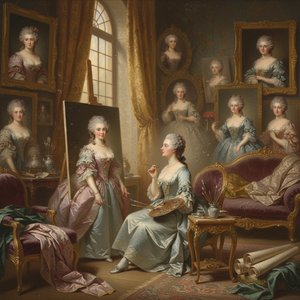
Beyond her grand historical compositions, Auzou found immense success in the realm of genre painting. In an age where women artists often found their greatest opportunities in depicting domesticity, she utilized this space to infuse her work with a distinctive feminine perspective. Her paintings frequently portrayed women in serene, contemplative settings—reading, playing music, or engaged in quiet domestic tasks. Through these scenes, she achieved a level of psychological depth and atmospheric beauty that resonated deeply with the public, making her a mainstay of the Paris Salon for decades.
Legacy and Artistic Significance
The legacy of Pauline Auzou is one of resilience and profound contribution to the French school of painting. She did not merely exist within the margins of art history; she actively expanded them. Her ability to balance the disciplined requirements of Neoclassicism with the sentimental charm of the Troubadour style allowed her to bridge the gap between different artistic sensibilities. Even as she navigated the personal complexities of life—including marriage to the stationer Charles-Marie Auzou and the responsibilities of motherhood—her creative output remained a testament to her dedication to her craft.
Today, when we look upon her works, we see more than just beautiful imagery; we see the triumph of an artist who refused to be sidelined. Her contributions can be summarized through several key pillars of her career:
- Technical Versatility: Her mastery ranged from delicate black and white chalk studies to large-scale oil paintings on canvas.
- Historical Documentation: She played a vital role in the visual construction of the Napoleonic legend through her commissioned portraits.
- Breaking Barriers: By pursuing rigorous anatomical studies and exhibiting at the Salon, she paved the way for future generations of women artists.
- Stylistic Synthesis: Her work remains a beautiful intersection of Neoclassical structure and the intimate storytelling of the Troubadour style.
Pauline Auzou passed away in Paris in 1835, leaving behind a body of work that continues to captivate with its elegance, strength, and enduring historical importance.
Soru ve Cevaplar
Pauline Auzou hangi şehir ve ülkede doğmuştur?
Pauline Auzou, Paris, France doğumludur.
Pauline Auzou nerede ve ne zaman doğdu?
Pauline Auzou, 1775 yılında Paris şehrinde doğdu.
Pauline Auzou hangi dönem sanatçısıdır?
Pauline Auzou, 19th Century döneminde eserlerini vermiştir. Bu dönem, sanatçının çalışmalarını tarihsel bir bağlama oturtur.