Origins and History of Berkshire Museum
Established in 1903, the Berkshire Museum emerged from the vision of Zenas Crane. He sought to create an institution that mirrored the breadth of the American Museum of Natural History, the Smithsonian, and the Metropolitan Museum of Art. This foundation allowed for a unique convergence of disciplines within a single site in Pittsfield, Massachusetts, United States.
The museum has maintained a significant connection to the Smithsonian since 2013. This association reinforces its position as a repository for diverse objects, ranging from fine art to natural history specimens. The building itself, a century-old structure, has undergone significant transformations, including extensive renovations to the second floor in 2021 to preserve the collections for future generations.
Diverse Collections and Museum Departments
The museum houses more than 40,000 objects, spanning the intersections of art, history, and natural science. Within the galleries, one finds an ancient Egyptian mummy alongside Babylonian art. These artifacts exist in conversation with a vast array of fine art. The collection includes works by Gilbert Stuart, Rembrandt Peale, John Singleton Copley, and Thomas Sully. Later movements are represented through the presence of Paul Cézanne, Pierre Auguste Renoir, and John Singer Sargent. Modern and contemporary perspectives are held through the works of Norman Rockwell, Andy Warhol, Red Grooms, Robert Rauschenberg, Ellsworth Kelly, and Nancy Graves. The collection also features pieces by Gregory Crewdson, Peter Garfield, Morgan Bulkeley, Stephen Hannock, and Tom Patti.
Natural history is a central pillar of the institution. The museum maintains an aquarium containing hundreds of live specimens, including native and exotic fish, reptiles, amphibians, and insects. Beyond the biological specimens, the museum preserves significant historical equipment. This includes the North Pole expedition gear used by Robert E. Peary and Matthew Henson, such as Henson's whole-body fur suit and his sledge. Landscape traditions are represented by the presence of works by Albert Bierstadt and Frederic Edwin Church.
Masterpieces of the Collection
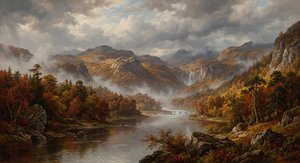
The presence of the Hudson River School is felt through works that capture the specific light and topography of the American landscape. Albert Bierstadt offers two distinct perspectives: On the Hudson River near Irvington, 1866 and Connecticut River Valley, Claremont, New Hampshire, 1865. These paintings occupy the space with a quiet authority. Nearby, Asher Brown Durand’s Thomas Cole, 1837 provides a focused study of a central figure in American art history.
The collection also extends into different eras and geographies. Pieter de Hooch’s A Musical Company of Four Figures with a Small Boy Dancing, 1682 brings a sense of domestic stillness to the halls. In contrast, Edwin Lord Weeks presents Indian Prince, Palace of Agra, a work that shifts the viewer's attention toward the intricate details of distant architecture and culture. Each piece exists as a physical encounter with a specific moment or place, held within the quiet rooms of the museum.