

Introduction
The landscape of nineteenth-century Russian art underwent a profound transformation as the rigid structures of Neoclassicism gave way to the turbulent, emotive currents of the Romantic era. This movement sought to transcend mere imitation of classical ideals, choosing instead to explore the depths of human passion, the sublime power of untamed nature, and the dramatic tension between the individual and the infinite. In the vast expanses of the Russian Empire, this artistic shift manifested as a powerful dialogue between the soul and the external world, where light and shadow were used not just to define form, but to evoke profound psychological states.
During this period, the cultural fabric of Russia was expanding, fueled by a burgeoning national identity and a fascination with both historical grandeur and the wild, unpredictable elements of the natural world. Artists began to move away from the static perfection of the academy, embracing instead the sublime—that overwhelming sense of awe and terror inspired by stormy seas, rugged mountains, and the fleeting nuances of twilight. This era was defined by a shift toward subjectivity, where the brushstroke became a vehicle for personal expression and the canvas a stage for the sublime struggles of the human spirit.
Today, these works remain vital, offering a window into a period of intense intellectual and emotional awakening. The mastery of light and the dramatic compositions of this era continue to resonate, providing a timeless aesthetic that speaks to the enduring complexity of the human experience. By examining the lives and legacies of these masters, we gain a deeper understanding of how art can capture the ephemeral essence of a moment and the eternal weight of emotion.
The following selection explores the diverse expressions of this movement, tracing the evolution of the Romantic spirit through the works of ten essential figures who defined the era's visual language.
Karl Bryullov
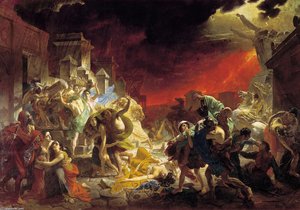 The Last Day of Pompeii - Karl Bryullov
In his monumental masterpiece, The Last Day of Pompeii, Karl Bryullov captures the terrifying eruption of Mount Vesuvius with a cinematic intensity that defines the Romantic spirit. This work, executed between 1830 and 1833, serves as a profound testament to his ability to blend neoclassical anatomical precision with the raw, chaotic emotion central to the Romantic movement. Bryullov’s Russian heritage and his deep immersion in the Italian art scene allowed him to synthesize a unique style, where the structured grace of the Renaissance meets the turbulent, sublime power of nature.
A true titan of Russian Romanticism, Bryullov moved beyond rigid academicism to explore the dramatic tension between human fragility and cosmic upheaval. His canvases often feature sweeping historical narratives and intense chiaroscuro, utilizing light and shadow to heighten the emotional stakes of his scenes. Whether depicting the frantic panic of a city in ruin or the solemnity of historical figures, his palette and composition emphasize movement and tragedy. Through his mastery of oil on canvas, Bryullov transformed historical catastrophes into visceral experiences, securing his legacy as a painter who prioritized the profound impact of feeling and the sublime over mere order.
Konstantin Makovsky
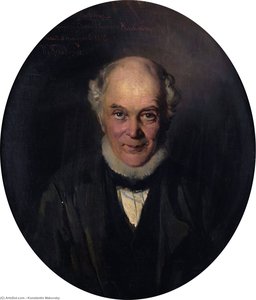 Egor Ivanovich Makovsky - Konstantin Makovsky
Konstantin Makovsky stands as a pivotal figure in the evolution of Russian art, bridging the gap between academic tradition and the emotive depth of the Romantic movement. Born in Moscow in 1839 into a family of immense artistic sensibility, he was deeply influenced by the creative atmosphere fostered by his father, Egor Ivanovich Makovsky. His formal training at the Moscow School of Painting, Sculpture, and Architecture, and later the Imperial Academy of Arts in Saint Petersburg, allowed him to absorb the lessons of masters like Karl Bryullov and Vasily Tropinin. It was from Bryullov that Makovsky inherited a penchant for decorative effects and a romanticized approach to historical narrative, which would define his later, vibrant genre scenes.
Makovsky’s work is characterized by a profound sense of nostalgia and a fascination with Russian customs and historical drama. His ability to infuse realistic detail with a romanticized, almost theatrical atmosphere is evident in his early developmental works, such as the portrait Egor Ivanovich Makovsky (1859). By blending the emotional intensity of Romanticism with a meticulous attention to costume and social ritual, he captured the soul of a changing Russia, ensuring his place among the most celebrated painters of his era.
Vasily Andreevich Tropinin
 Portrait of the Merchant Alexander Sapozhnikov - Vasily Andreevich Tropinin
In the 1826 Portrait of the Merchant Alexander Sapozhnikov, the sitter is presented with a heavy, quiet dignity that exemplifies the psychological depth of the era. The subject is captured in a three-quarter view, his steady gaze and somber expression emerging from a background of atmospheric, muted tones. Through a masterful use of chiaroscuro, light brushes the contours of his face and the voluminous texture of his beard, creating a sense of living warmth and substantiality. The palette is restrained, relying on deep browns and ochres to emphasize the character and presence of the man.
Vasily Andreevich Tropinin (1776–1857) stands as a cornerstone of Russian Romanticism, a movement defined by its focus on raw emotion and the inner life of the individual. His journey from a serf in the village of Korpovo to a celebrated master at the Imperial Academy of Arts imbues his work with a unique, empathetic tenderness. Having transitioned from an apprenticeship as a confectioner to the tutelage of Sergei Petrovich Schukin, Tropinin developed a distinctly Russian voice. He moved beyond mere likeness to capture the quiet resilience and spiritual depth of his subjects, transforming everyday human experiences into profound emotional studies.
Orest Kiprensky
 Portrait of Count Grigory Kushelev (1754-1833) - Orest Kiprensky
Orest Kiprensky stands as a pivotal figure among Russian Romantic painters, distinguished by his profound ability to transcend mere physical likeness to capture the psychological essence of his subjects. His journey from an unconventional upbringing near Saint Petersburg to the prestigious Imperial Academy of Arts—where he won a gold medal for his historical mastery—set the stage for a career defined by emotional depth. His extensive travels through Europe, particularly his years in Rome and Naples, infused his work with a sensitivity that moved beyond the rigid structures of Neoclassicism toward the soulful intensity of the Romantic era.
In his Portrait of Count Grigory Kushelev, Kiprensky exemplifies this stylistic transition. Through a masterful use of chiaroscuro, he directs the viewer's gaze toward the sitter's face, using light to illuminate the wisdom etched into his features against a somber, dark background. The painting is a study in contrasts: the organic softness of the skin against the rigid, metallic glint of state decorations. By emphasizing the inner character and the weight of social standing through dramatic lighting and texture, Kiprensky solidified his legacy as a master of the Romantic spirit.
Alexey Bogolyubov
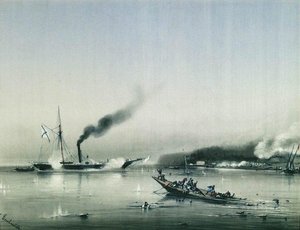 The Kolkhida Sreamship - Alexey Bogolyubov
Alexey Bogolyubov stands as a vital figure in the Russian Romantic tradition, specifically through his ability to capture the sublime and untamable essence of the maritime world. His work bridges the emotional intensity of Romanticism with a burgeoning sense of realism, a duality born from his unique life path. Before dedicating himself to the canvas, Bogolyubov served in the Imperial Russian Navy, an experience that provided him with an intimate, firsthand understanding of the sea's overwhelming power. This deep reverence for the ocean allowed him to move beyond mere technical depiction, instead imbuing his landscapes with the atmospheric tension and dramatic spirit central to the Romantic movement.
His masterpiece, The Kolkhida Steamship (1854), serves as a profound testament to this stylistic intersection. In this work, the artist explores the raw, chaotic energy of a naval engagement, utilizing the dramatic interplay of light and shadow to evoke a sense of awe. By focusing on the struggle between man-made vessels and the vast, unpredictable elements, Bogolyubov captures the quintessential Romantic fascination with the overwhelming force of nature. His mastery of the seascape, influenced by the likes of Ayvazovsky, ensures that each wave and gust of wind carries a palpable, emotional weight.
Pyotr Zakharov-Chechenets
 Portrait of the Merchant Ivan Zhadimerovsky - Pyotr Zakharov-Chechenets
Pyotr Zakharov-Chechenets represents a poignant facet of Russian Romanticism, where the movement's focus on individual character and emotional depth meets the disciplined precision of academic portraiture. His life, marked by a dramatic origin in the Caucasus and an upbringing within the household of Major-General Pyotr Yermolov, infused his work with a certain somber gravity. His style is defined by a masterful command of chiaroscuro and a meticulous attention to the tactile reality of his subjects, from the crispness of a linen collar to the heavy weight of military or merchant textiles.
In his Portrait of the Merchant Ivan Zhadimerovsky, we see the essence of his Romantic sensibility. Rather than relying on grandiosity, he captures a profound sense of stillness and quiet dignity. The subject emerges from a dark, undifferentiated background, his features sculpted by a soft, descending light that creates a sense of physical mass and psychological presence. His brushwork is deliberate and fine, utilizing smooth transitions to model skin and textured strokes to define fabric. This ability to ground the sitter in a tangible, intimate reality, while emphasizing the internal composure of the individual, marks him as a significant voice in the Romantic tradition of the Russian Empire.
Grigory Gagarin
 Mingrelian Prince - Grigory Gagarin
In his evocative work <Mingrelian Prince, Grigory Gagarin captures the profound dignity and exotic allure that defined the Romantic era. A member of the noble Rurikid princely family, Gagarin’s artistic sensibility was shaped through private instruction under the legendary Karl Briullov. His life as a diplomat and administrator allowed him to traverse diverse territories, a journey that deeply informed his contribution to Russian Romanticism. Rather than adhering to the rigid constraints of classical order, Gagarin embraced the movement's fascination with the sublime, the individual, and the untamed spirit of distant lands.
Gagarin’s oeuvre is characterized by a deep preoccupation with the diverse cultures of the Caucasus. His portraits, such as those of a <Circassian woman> or a <Georgian man>, move beyond mere likeness to explore the emotional essence and cultural identity of his subjects. Through a masterful command of light and shadow, he rendered ethnic groups with a sensitivity that prioritized atmospheric feeling over clinical precision. His ability to translate the rugged beauty of the mountains and the intense character of their people into oil on canvas makes him a vital voice in the Romantic tradition, bridging the gap between high-society portraiture and the passionate exploration of regional identity.
Maxim Vorobiev
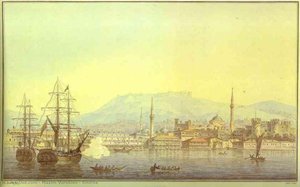 Smirna - Maxim Vorobiev
In his 1820 watercolor Smirna, Maxim Vorobiev captures a breathtaking maritime vista where the rugged citadel of a Mediterranean harbor meets the soft, hazy expanse of the sea. The composition is a delicate dance of vertical masts and horizontal horizons, rendered with a precision that evokes the vastness of the world beyond the Russian borders. Through layered washes and a muted palette of earthy browns, deep blues, and soft grays, Vorobiev achieves a profound sense of atmospheric perspective, allowing the distant mountains to dissolve into a dreamlike light.
Vorobiev’s place within the Russian Romanticism movement is defined by this very ability to infuse landscape with a sense of nostalgic wonder and the sublime power of nature. His work transcends mere topographical documentation; instead, he captures the emotional essence of exotic locales, from the shores of Italy to the historic landscapes of Palestine. Trained under masters like Fyodor Alekseyev and the architect Jean-François Thomas de Thomon, his style blends meticulous architectural detail with a Romantic sensitivity to light and mood. Whether documenting the historic heartlands of Russia or the bustling harbors of the East, Vorobiev’s art remains a poignant testament to the era's fascination with travel, memory, and the infinite beauty of the natural world.
Alexander Varnek
 Portrait of a Young Woman in a Dark-Red Dress - Alexander Varnek
Alexander Varnek stands as a distinguished figure among Russian Romantic painters, a master of the psychological portrait who navigated the rigid social structures of St. Petersburg with profound grace. Trained at the Imperial Academy of Arts under the guidance of Dmitry Levitzky and Stepan Shchukin, Varnek’s technical foundation was further refined during his travels across Europe between 1801 and 1809. His work embodies the Romantic movement through its intense focus on individual character and the emotional resonance found in quiet, contemplative moments, rather than through grand historical spectacle.
Varnek’s artistry is defined by a disciplined pursuit of resemblance and a sophisticated command of light. In his Portrait of a Young Woman in a Dark-Red Dress (1841), he utilizes a dramatic chiaroscuro effect to pull the subject from a somber, indistinct background. The painting showcases the tactile richness of heavy crimson fabric and the luminous quality of skin, creating an intimate atmosphere that prioritizes the subject's inner presence over superficial ornament. By capturing the subtle interplay of shadow and light, Varnek transformed the formal portraiture of the era into a deeply evocative study of human stillness and dignity.
Fyodor Bronnikov
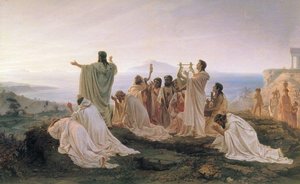 A Hymn to the Rising Sun - Fyodor Bronnikov
Fyodor Bronnikov (1827–1902) occupies a unique position within the Russian Romantic movement, bridging the gap between meticulous academic realism and the profound emotionality characteristic of the era. While many of his contemporaries focused on the grandiosity of historical epics, Bronnikov’s contribution to Romanticism lies in his ability to imbue intimate, domestic scenes with a palpable sense of psychological depth and spiritual atmosphere. He moved beyond mere documentation, using light and color to transform quiet, everyday moments into evocative narrative experiences.
His mastery of the genre is evident in his ability to navigate both the serene and the dramatic. In works such as Dressing the Bride, he orchestrates light to create a sense of sacred intimacy, whereas in The Masquerade, he explores the darker, more chaotic tensions of the human condition. His representative work, A Hymn to the Rising Sun (1869), exemplifies this Romantic sensibility through its spiritual intensity. The composition utilizes a pyramidal arrangement of figures to create a sense of divine hierarchy, set against a rugged landscape bathed in the soft, diffused light of dawn. Through this interplay of light and human devotion, Bronnikov captures the sublime essence of the Romantic spirit.
Conclusion
The legacy of these Russian Romantic painters lies in their ability to capture the profound tension between the human soul and the vast, often untamed forces of nature and history. From the dramatic, emotive brushwork of Bryullov to the intimate, psychological depth found in the portraits of Tropinin, these artists moved beyond mere representation to explore the sublime. Whether through the sweeping maritime vistas of Bogolyubov or the evocative, atmospheric scenes of Makovsky, each master contributed a unique layer to a movement defined by passion, movement, and the celebration of individual feeling. Their collective work serves as a window into a transformative era of art history, where the rigid structures of the past gave way to the raw intensity of the human experience.
At Mus3ums.com, we invite you to bring this era of passion into your own living space. You can explore our full collection to find the perfect piece for your home. Our master artists specialize in creating museum-quality, hand-painted oil reproductions that preserve the tactile texture and emotional depth of these original masterpieces, allowing you to live with the sublime every day.