A Life Between Two Lands
Born in the quiet landscape of Allerum, Sweden, on September 28, 1816, Johan Knutson was an artist whose soul belonged as much to the Finnish wilderness as to his Swedish roots. His journey into the heart of fine art began with rigorous training in Copenhagen and later within the prestigious lithography department at the Royal Swedish Academy of Fine Arts. This technical foundation provided him with a precision that would define his early career, yet it was his move to Finland in 1840 that truly ignited his creative spirit. Settling for much of his life in Porvoo, Knutson became more than just a visitor; he became a vital thread in the cultural fabric of the Finnish nation, weaving together the traditions of his birth and the landscapes of his adopted home.
Knutson’s early years in Finland were marked by a vibrant, almost mischievous engagement with the pulse of society. In the bustling streets of Helsinki, he captured the essence of urban life through humorous graphic sheets and caricatures of high society. These works, though occasionally met with the stern disapproval of authorities—including a ban on his satirical publications by the Police Commissioner—revealed an artist deeply attuned to the human comedy. This period of observation was not merely about humor; it was an exploration of identity and the shifting social dynamics of a nation finding its voice.
The Poetry of Landscape and Light
As his career matured, Knutson’s focus drifted from the satirical streets toward the serene and the sublime. He found profound inspiration in the literary landscape of his time, forming a close bond with the national poet Johan Ludvig Runeberg. The rhythmic beauty of Runeberg’s poetry seemed to find its visual counterpart in Knutson’s evolving style. This era saw him move toward more idealized depictions of the Finnish people and their environment, a movement that sought to capture the romantic essence of the Nordic spirit.
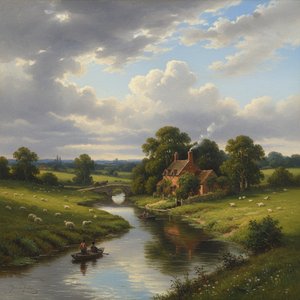
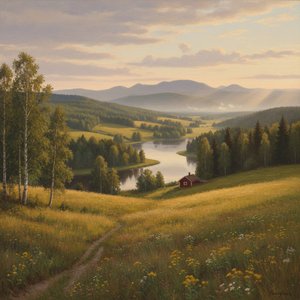
His technical development was further enriched by the influence of the Düsseldorf school of Romantics, particularly through his connection with the Swedish painter Marcus Larson. Under this influence, Knutson’s palette and subject matter underwent a dramatic transformation. He began to master the interplay of light and shadow, creating evocative moonlit views, dramatic seascapes, and tranquil depictions of the archipelago. His later works, focusing on idyllic bays and the quiet majesty of nature, demonstrate a profound ability to evoke emotion through atmosphere alone.
Legacy in Ink and Oil
The historical significance of Johan Knutson lies in his role as both an illustrator of national identity and a master of the landscape. His contributions to monumental works such as Finland framstäldt i teckningar (Finland Depicted in Drawings), alongside text by Zachris Topelius, helped create a visual vocabulary for the Finnish landscape that resonated with generations. Through his meticulous lithographs and sweeping oil paintings, he documented a world in transition.
Today, the enduring impact of his work can be traced through several prestigious institutions, ensuring that his vision of the North remains preserved:
- The National Museum of Finland, which holds key pieces of his historical importance.
- The Turku Art Museum and Tampere Art Museum, showcasing his mastery of the landscape genre.
- The Porvoo Museum, where his connection to the local community and his role as a drawing teacher are celebrated.
- The Helsinki City Museum, preserving his early, spirited depictions of urban life.
Knutson passed away in Helsinki in 1899, leaving behind a legacy that transcends borders. He remains a pivotal figure who bridged the gap between Swedish academic training and Finnish national romanticism, turning the simple observation of nature into a profound celebration of light, land, and legend.
问答详情
Johan Knutson 的创作时期属于哪个历史阶段?
Johan Knutson 的创作活跃于 19th Century 时期,这一时期确立了艺术家在艺术史上的地位。
Johan Knutson 是否还有其他别名或曾用名?
Johan Knutson 也被称为 J. Knutson, 约翰·克努特松。
Johan Knutson 出生于哪个国家和城市?
Johan Knutson 出生于 Sweden 的 Allerum parish。