
Introduction
In the grand halls of nineteenth-century Paris, a distinct and highly disciplined aesthetic emerged to define the pinnacle of European fine art. This was the era of the French academic painters, a group of masters whose work was shaped by the rigorous standards of the Académie des Beaux-Arts. Their art was characterized by a pursuit of perfection: a seamless, polished finish where the brushstrokes of the artist often vanished beneath layers of glaze, leaving only the illusion of flawless skin, shimmering silk, or dramatic historical landscapes. These artists did not merely paint; they constructed idealized realities through a mastery of anatomy, perspective, and light.
During this period, the French art establishment prioritized subjects that elevated the human spirit—mythological allegories, biblical narratives, and grand historical events. This movement represented the cultural heartbeat of France, serving as the official visual language for the state and the aristocracy. Through the prestigious Salon exhibitions, these painters established a standard of excellence that commanded global respect, blending technical precision with a profound sense of drama and grace.
Today, the legacy of these masters remains vital for anyone seeking to understand the foundations of Western realism. Their influence can be seen in the very way we perceive beauty and classical composition. The works of these artists continue to captivate modern audiences, offering a window into a world of elegance and meticulous craftsmanship that stands in stark contrast to the rapid, often fleeting nature of contemporary visual culture.
To understand the breadth of this movement, one must look to the individual masters who defined its various facets. From the ethereal portraiture of William-Adolphe Bouguereau to the meticulous historical scenes of Jean-Léon Gérôme, the following ten painters represent the zenith of French academic excellence.
William-Adolphe Bouguereau
 Lamour and Psyche Children - William-Adolphe Bouguereau
Born in La Rochelle in 1825, William-Adolphe Bouguereau emerged as a titan of the French academic tradition. His journey from the coastal life of his youth to the rigorous halls of the École des Beaux-Arts shaped a career defined by unparalleled technical mastery. Under the guidance of François-Edouard Picquenot, he refined the anatomical precision and classical discipline that would become his hallmark, cementing his status as a premier figure among French academic painters.
Bouguereau’s work is characterized by a pursuit of idealized beauty, where the human form is elevated through meticulous realism. His ability to render skin with a luminous, translucent quality allows his subjects to appear as if bathed in a celestial glow. In Lamour and Psyche Children, this technique reaches a tender peak. The painting depicts Eros and Psyché as young children in an intimate, ethereal embrace, utilizing a soft, cloud-like background to emphasize their innocence. By employing a sophisticated three-level perspective reminiscent of the Renaissance, Bouguereau bridged the gap between classical antiquity and the 19th-century salon, creating scenes that are both structurally ordered and deeply romantic in their emotional resonance.
Jean-Léon Gérôme
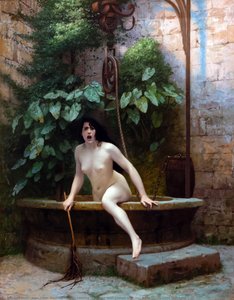
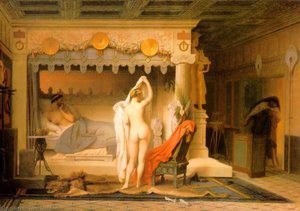
In his evocative work Truth Coming from the Well Armed with Her Whip to Chastise Mankind, Jean-Léon Gérôme explores the intersection of allegory and classical form. This 1896 oil on canvas, currently held at the Musée Anne de Beaujeu, utilizes the figure of a nude woman emerging from a well to personify the concept of the "naked truth," a theme rooted in the philosophy of Democritus. Gérôme’s mastery of the human form and his ability to imbue historical or allegorical subjects with dramatic tension define his place as a central figure in the French Academic Art movement.
Born in 1824, Gérôme’s technical precision was forged in the studios of Paul Delaroche and Charles Gleyre, and refined through his studies at the École des Beaux-Arts. His early travels through Italy, particularly his time spent among the ruins of Pompeii and the halls of the Vatican, provided the visual vocabulary for his signature style: a highly polished, meticulous realism. As a staunch defender of academic traditions, he specialized in both grand historical scenes and exotic Orientalist landscapes, characterized by a controlled palette and an uncompromising commitment to the rigorous standards of the 19th-century French academies.
Alexandre Cabanel
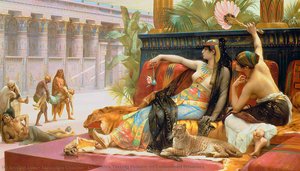 Cleopatra Testing Poisons on Condemned Prisoners - Alexandre Cabanel
Alexandre Cabanel stands as a quintessential figure of the French Academic Art movement, a master of the highly polished realism and idealized beauty that defined the 19th-century academies. His work is instantly recognizable by its seamless, almost invisible brushwork and a luminous, porcelain-like quality applied to the human form. He possessed a rare ability to blend sensual grace with a rigorous, disciplined technique, creating figures that seem to glow from within a soft, atmospheric light.
Born in 1823 in Montpellier, Cabanel’s journey from the son of a carpenter to a titan of the Paris art world was fueled by immense talent and formal rigor. After studying under Charles Matet, he entered the École des Beaux-Arts under François-Édouard Picot, eventually winning the prestigious Prix de Rome in 1845. His years at the Villa Medici in Rome deeply ingrained the classical ideals of antiquity into his aesthetic. In his monumental 1887 work, Cleopatra Testing Poisons on Condemned Prisoners, this academic training reaches a dramatic zenith. The painting showcases his mastery of Orientalist themes, utilizing a grand, theatrical composition and rich, deep tones to depict a scene of opulent power and fatal curiosity, perfectly embodying the polished grandeur of the Academic tradition.
Jules Lefebvre
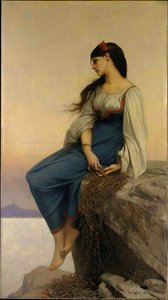 Graziella - Jules Lefebvre
Jules Lefebvre stands as a luminous figure in nineteenth-century French art, embodying the very essence of the Academic Art movement through his disciplined mastery and devotion to classical excellence. After moving to Paris at sixteen to study at the École nationale supérieure des Beaux-Arts under Léon Cogniet, Lefebvre’s ascent was solidified by winning the prestigious Prix de Rome in 1861. This achievement marked him as a successor to the rigorous traditions of French academicism, characterized by a highly polished finish and a profound reverence for the idealized human form.
His brush possessed a rare ability to render skin with a translucent, glowing quality, a hallmark of the academic style that sought to elevate its subjects through harmonious color and soft light. This is masterfully demonstrated in his 1878 work, Graziella. In this evocative composition, Lefebvre translates literary narrative into visual poetry, depicting a Neapolitan fisherman's daughter mending a net amidst a rugged, rocky shoreline. As she gazes toward the distant silhouette of Mount Vesuvius, the painting showcases his signature ability to blend meticulous anatomical precision with an ethereal, reflective grace, securing his legacy as a master of academic elegance.
Thomas Couture
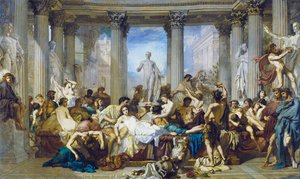 The Romans of the Decadence - Thomas Couture
Thomas Couture (1815–1879) stands as a transformative figure within the French Academic tradition, a master who navigated the tension between the rigid standards of the École des Beaux-Arts and the burgeoning spirit of Realism. His inclusion in the Academic movement is defined by his profound command of history painting—the era's most prestigious genre—and his ability to utilize classical themes to deliver potent social critiques. Rather than merely illustrating the past, Couture used the polished, highly finished techniques of the academy to explore the complexities of human morality.
His most significant contribution to the era is the monumental The Romans of the Decadence (1847). In this work, Couture employs a dramatic, chiaroscuro-driven palette, using rich, dark tones to accentuate the opulent textures of silk and the cold marble of classical ruins. A viewer can recognize his hand through this masterful control of light and shadow, which creates a sense of theatrical unrest. The composition, reminiscent of the Renaissance masters, captures a scene of moral dissolution, using the grandeur of ancient Rome to mirror the social anxieties of 19th-century France. His legacy is further cemented by his role as a pivotal teacher, most notably guiding the early development of Édouard Manet.
Jean-Louis Ernest Meissonier
 Departure of the Volunteers - Jean-Louis Ernest Meissonier
Born in Lyon in 1815, Jean-Louis Ernest Meissonier defied his father's wishes for a career in business to pursue the rigorous training of the French art academies. His path to becoming a titan of the 19th century was shaped by a profound study of the Dutch masters at the Louvre, whose meticulous approach to genre scenes deeply informed his own technique. This dedication to precision is what firmly places him within the French Academic Art movement; his work exemplifies the highly polished, carefully finished realism and technical excellence demanded by the official schools of the era.
Meissonier became a master of miniature realism, capable of reconstructing entire historical worlds with microscopic accuracy. In his work <Departure of the Volunteers>, this talent is directed toward the quiet, heavy atmosphere of military life. Rather than focusing on the grandiosity of battle, he captures a moment of transition, depicting soldiers in a restless knot of preparation. Through his precise handling of light and texture, he transforms a simple vignette of men gathering their belongings into a dramatic study of anticipation, bridging the gap between intimate genre painting and grand historical narrative.
Léon Bonnat
 Portrait of the count of Montalivet - Léon Bonnat
Léon Bonnat (1833–1922) stands as a formidable figure within the French Academic Art movement, distinguished by a rigorous commitment to the polished realism and psychological intensity characteristic of the 19th-century French academies. His technical mastery was forged through a diverse European education, beginning with his training under Madrazo in Madrid and later refining his skills in Paris under Paul Delaroche and Léon Cogniet. A pivotal period in Rome allowed him to absorb the dramatic chiaroscuro of the Old Masters, a stylistic choice that would define his career as a premier portraitist.
Bonnat’s work is defined by a stark naturalism and a profound ability to capture the internal life of his subjects. In his Portrait of the count of Montalivet (1878), this academic precision is on full display. The subject is rendered with a quiet gravity, seated in a forest green upholstered armchair that anchors the composition against a dark, atmospheric background. Through the masterful use of focused, directed lighting, Bonnat pulls the sitter from the shadows, emphasizing the stoic expression and social weight of the individual. His ability to balance formal, high-society portraiture with the dramatic lighting of the Spanish masters ensures his place among the most significant academic painters of his era.
Hugues Merle
 Children Playing in a Park - Hugues Merle
Hugues Merle (1822–1881) stands as a quintessential figure of the French Academic movement, distinguished by his ability to infuse meticulous realism with profound sentimental narrative. Trained under the esteemed Léon Cogniet in Paris, Merle mastered the rigorous draftsmanship and polished finish required by the official academies of the 19th century. His work is characterized by a graceful, soft light that illuminates his subjects, typically focusing on the tender, moral, and virtuous aspects of domestic life. A visitor can immediately recognize a Merle through his exquisite rendering of skin tones and the delicate, almost ethereal quality of his light, which elevates ordinary scenes into moments of quiet grace.
In his 1860 work, Children Playing in a Park, this Academic precision is on full display. The painting captures a serene afternoon where nine children are scattered across a lush, verdant meadow. Through careful observation of form and color, Merle renders the textures of the grass and the gentle movement of birds in the sky, creating a composition that celebrates the unhurried innocence of youth. His mastery of the genre lies in this ability to balance technical perfection with an emotional resonance that affirms the beauty of the everyday.
Guillaume Seignac
 Diana, the Huntress - Guillaume Seignac
In Diana, the Huntress, the viewer is met with a scene of profound mythic stillness, where the goddess is captured in a moment of quiet observation. Her gaze, directed toward an unseen point in the sky, creates a sense of suspended motion against a serene landscape of soft trees and reflective water. This work exemplifies the technical precision that defined the career of Guillaume Seignac (1870–1924), a painter who embodied the highest standards of the French academic tradition.
Seignac’s mastery was forged at the prestigious Académie Julian in Paris, where he studied under titans such as Gabriel Ferrier, Tony Robert-Fleury, and the legendary William-Adolphe Bouguereau. It was from these masters that he inherited a rigorous devotion to anatomical precision and the idealization of the human form. His work is characterized by an ethereal quality, particularly in his ability to render diaphanous drapery and the delicate interplay of light upon skin. By blending the meticulous execution required by the great academies with a poetic sensitivity to texture, Seignac transformed classical themes into luminous studies of grace and poise.
Émile Munier
 the rescue - Émile Munier
Émile Munier (1840–1895) remains a quintessential figure of the late 19th-century French academic art scene, distinguished by his ability to infuse the rigorous standards of the Academy with a profound sense of romanticism. His technical mastery was forged under the tutelage of Abel Lucas at the Gobelins Manufactory, where he developed the precise draftsmanship essential to the academic tradition. Munier’s work is characterized by a soft, ethereal quality and a focus on the innocence of childhood, a stylistic direction heavily influenced by the legendary William-Adolphe Bouguereau. His ability to render delicate textures and luminous skin tones places him firmly within the movement's pursuit of idealized, polished realism.
In his evocative work, The Rescue (c. 1894), Munier demonstrates this mastery through a celestial composition. The painting depicts four children at the water's edge, their forms bathed in a gentle light that emphasizes a sense of divine protection. By introducing angelic figures into a scene of earthly play, Munier elevates a simple moment of childhood into a study of grace and security. This seamless blend of technical precision and sentimental beauty defines his contribution to the French academic canon.
Conclusion
The legacy of these French academic painters lies in their unparalleled technical mastery and their commitment to the rigorous standards of the 19th-century salons. From the ethereal, luminous skin tones of Cabanel and Bouguereau to the meticulous, historical precision of Gérôme and Meissonier, these artists defined an era of visual perfection. Whether through the idealized beauty of mythological figures or the dramatic realism of contemporary scenes, they elevated the art of painting to a level of polished sophistication that remains a benchmark for academic excellence. Each master contributed a unique facet to this grand tradition, ensuring that the pursuit of beauty, form, and narrative depth would endure through the centuries.
For those seeking to bring this era of French elegance into a modern setting, our full collection offers a curated selection of these timeless masterpieces. We invite you to experience the tactile depth and vibrant soul of these works through our museum-quality, hand-painted oil reproductions, meticulously crafted by expert artists to preserve the legacy of the French Academy in your own home.