
Introduction
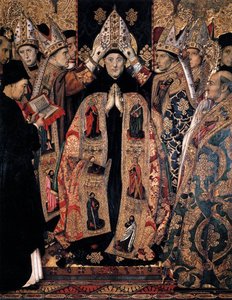
The 15th century in the Iberian Peninsula marked a transformative era where the rigid structures of the Middle Ages began to dissolve into the luminous complexity of the early Renaissance. This period was defined by a profound cultural convergence, as painters across the territories of Spain navigated the intersection of International Gothic elegance and the burgeoning naturalism flowing from the Low Countries and Italy. It was a time of intense religious devotion and the rise of powerful merchant classes, both of which demanded a new kind of visual storytelling—one that combined spiritual transcendence with an increasingly acute observation of the physical world.
What unites these masters is their ability to harmonize diverse influences. Whether through the delicate, rhythmic lines of the Gothic tradition or the heavy, sculptural presence of early oil techniques, these artists captured a society in transition. Their works served as windows into a world of profound symbolism, where every pigment and shadow carried theological or social weight. Today, these painters remain vital to our understanding of Western art history, representing the foundational shift toward the human-centric perspective that would eventually define the High Renaissance.
To understand the visual soul of this era, one must examine the diverse hands that shaped it. The following selection explores ten essential figures—from the meticulous detail of Bartolomé Bermejo to the expressive compositions of Pedro Berruguete—offering a journey through the textures, colors, and evolving techniques that defined 15th century Spanish painting.
Pedro Berruguete
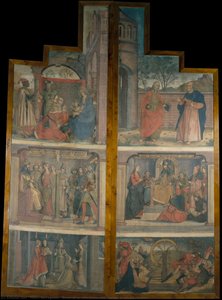
The Doors of an altarpiece with scenes of saint Catherine serves as a profound testament to the technical mastery of Pedro Berruguete, a central figure among 15th century Spanish painters. Executed around 1495 using tempera and gold leaf on cloth, this work features six narrative panels that detail the life of Saint Catherine of Alexandria. Through a sophisticated palette of deep reds, blues, and rich golds, Berruguete orchestrates a visual dialogue between stylized Gothic figures and the emerging spatial logic of the Renaissance.
As a pivotal artist of the 15th century in Spain, Berruguete acted as a vital bridge between the solemnity of the Gothic tradition and the humanist innovations of the Italian Renaissance. His time spent in the vibrant artistic circles of Urbino allowed him to infuse Castilian religious imagery with a new sense of light and architectural depth. His signature style—a synthesis of Flemish precision and Italianate perspective—is evident in his celebrated retablos and religious commissions. Beyond his own brushwork, his legacy continued through his son, the renowned sculptor Alonso Berruguete, cementing his position as a foundational architect of the Spanish Renaissance.
Bartolomé Bermejo
 Ferdinand I of Castile welcoming Saint Dominic of Silos - Bartolomé Bermejo
Bartolomé Bermejo stands as a transformative force in the history of 15th century Spanish painters, acting as a vital bridge between the Gothic tradition and the burgeoning Early Renaissance. His presence in the Iberian Peninsula, particularly through his prolific activity in Valencia, Zaragoza, and Barcelona, introduced a level of technical sophistication that redefined local artistic standards. By masterfully assimilating Flemish oil glazing techniques, Bermejo brought a luminous, tactile realism to Spain that was previously unseen, allowing him to capture the very essence of light and material.
His 1478 masterpiece, Ferdinand I of Castile welcoming Saint Dominic of Silos, serves as a profound testament to this stylistic evolution. In this work, the air feels heavy with the weight of velvet and the stillness of a formal greeting. The artist employs meticulous observation to render the metallic luster of a crown and the sharp, precise lines of royal brocade against the quietude of a holy man. Through thin, transparent layers of oil, Bermejo achieves a sculptural quality in the skin and a deep, glowing richness in the garments, creating a scene where secular power and spiritual gravity meet in a moment of exquisite, dramatic clarity.
Jaume Huguet
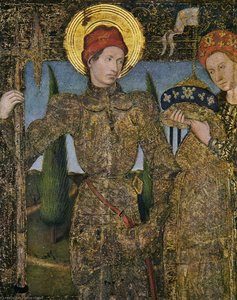 Triptych of Saint George - Jaume Huguet
A central figure of the 15th century Spanish painters, Jaume Huguet (1445–1492) stands as the preeminent master of the Catalan Gothic style. His artistic evolution, shaped by an early apprenticeship under his uncle Pere Huguet, allowed him to bridge the gap between traditional Gothic formalism and the burgeoning naturalism of the era. By integrating the meticulous Flemish influences encountered in the workshops of Zaragoza and Tarragona with the luminous traditions of Barcelona, Huguet developed a unique visual language characterized by spiritual depth and tactile precision.
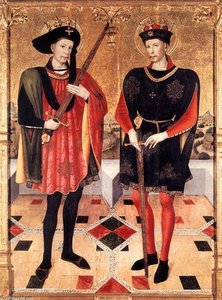
His 1459 Triptych of Saint George serves as a profound testament to this mastery. In this work, the artist employs egg tempera and gold leaf to create a realm where the celestial and earthly converge. The composition utilizes strong, defining linear outlines and elongated forms reminiscent of Byzantine iconography, yet it is infused with a subtle sense of emerging Renaissance realism. Through the heavy, luxurious folds of liturgical drapery and the shimmering textures of the sacred figures, Huguet captures a sense of divine grandeur, making him an indispensable voice in the history of 15th-century Spanish art."
Juan Rexach
 Saint Anthony Abbot - Juan Rexach
In his notable work Saint Anthony Abbot, created around 1450, we encounter the profound spiritual gravity that defines the 15th century Spanish painters. This piece, currently preserved in the Museo del Prado, serves as a vital testament to the artist's place within the Valencian Gothic tradition. Rather than pursuing the emerging naturalism of the era, the composition utilizes a shallow, decorative space and a rigid, formal structure that emphasizes the clarity of the subject's silhouette.
Juan Rexach, active during the mid-to-late 15th century, was a master of symbolic legibility. His technique often employed tempera, resulting in surfaces etched with a delicate web of age. In Saint Anthony Abbot, the palette is dominated by muted clay tones, ochre, and deep browns, creating a sense of quiet stillness. The iconography is meticulously rendered, featuring a green book, a bell, and a staff—each a silent signifier of the saint's ascetic journey. Through these heavy textures and symbolic objects, Rexach captured the mystical essence of the period, transforming a wooden panel into a vessel for intense, meditative devotion.
Gonzalo Pérez
 The Virgin and Child - Gonzalo Pérez
A visitor recognizing the hand of Gonzalo Pérez, also known as Gonçal Peris Sarrià, will immediately sense the structured, liturgical stillness characteristic of the late Gothic style. His works are defined by a profound spiritual hierarchy, where figures are rendered with a solemn grace and a focus on symbolic clarity rather than anatomical realism. The color palette often relies on the dramatic tension between deep, light-absorbing blues and the warm, radiant glow of ochre and gold, creating a mystical atmosphere that anchors the viewer in prayerful contemplation.
Operating from Valencia during the first half of the 1400s, Pérez was a vital figure in the Spanish artistic landscape of the 15th century. His prolific workshop met the heavy devotional demands of religious institutions across the peninsula, leaving a lasting legacy in cities like Cuenca, Murcia, and Burgo de Osma. His representative work, The Virgin and Child (1410), exemplifies this mastery. In this piece, the Virgin is draped in a mantle of dark blue that contrasts sharply against a glowing, red-toned backdrop, her presence marked by a large, patterned golden halo that catches the light, elevating the scene from a mere portrait to a sacred encounter.
Diego de la Cruz
 Christ between the Virgin and Saint John - Diego de la Cruz
A figure of profound historical rediscovery, Diego de la Cruz represents the sophisticated stylistic intersection of the late 15th century. Active primarily between 1482 and 1500 within the territories of Burgos, his presence in Castile marks him as a vital contributor to the Spanish artistic landscape of this era. Though his name was largely erased from collective memory until a rigorous academic resurgence in 1966, his technical mastery remains undeniable. Likely trained within the influential workshop of Gil de Siloé, his work embodies the Hispano-Flemish Gothic style, blending local traditions with the meticulous observational realism of the Burgundian Netherlands.
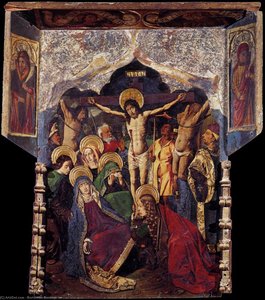
His representative masterpiece, Christ between the Virgin and Saint John, serves as a testament to his disciplined approach to the human form. In this work, he moves beyond mere decoration to achieve a quasi-scientific rendering of anatomy, capturing the tension of limbs and the hollows of ribs with startling precision. Through a controlled application of light and the use of lacquered pigments to create vitreous reds, he achieves a sculptural depth in drapery that bridges the gap between Gothic tradition and an emerging Renaissance realism. His ability to render reflected light on shaded surfaces elevates his work from simple iconography to a profound study of physical and emotional weight.
Miguel Alcañiz the Elder
 Saint Giles with Christ Triumphant over Satan and the Mission of the Apostles - Miguel Alcañiz the Elder
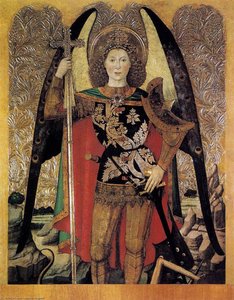
The 1408 altarpiece panel, Saint Giles with Christ Triumphant over Satan and the Mission of the Apostles, serves as a profound testament to the spiritual intensity of the International Gothic style. In this work, the artist utilizes a vertical, compartmentalized composition to navigate the viewer through celestial and earthly realms. A shimmering, gilded background creates a sacred atmosphere, contrasting sharply with the dark monastic habit of Saint Giles and the muted tones of the rocky landscapes where the apostles gather. This mastery of light and divine hierarchy defines the visual language of the era.
As a central figure of the Valencian school, Miguel Alcañiz the Elder represents the evolution of Spanish painting during the 15th century. His identity was long shrouded in mystery, once attributed to the anonymous Maestro de Gil y Pujades, but modern scholarship has reclaimed his name. His professional journey, spanning from Valencia to Barcelona between 1408 and 1447, highlights the mobility of skilled craftsmen navigating the Mediterranean's major urban centers. Through his documented presence in these territories, he helped shape the artistic landscape of the Iberian Peninsula, leaving a legacy of works that bridge the gap between late medieval devotion and the burgeoning Renaissance.
Guerau Gener
 Saint Dominic Guzmán and Four Saints - Guerau Gener
Guerau Gener stands as a significant figure in the transition of Iberian art, bridging the late medieval traditions with the evolving aesthetics of the early 15th century. As a painter active in Spain during the dawn of the 1400s, his work embodies the spiritual intensity and decorative richness characteristic of the era. His mastery is particularly evident in his religious commissions, such as his celebrated depictions of the Resurrection of Christ, which showcase a profound ability to evoke mystical devotion through formal composition.
His 1405 panel painting, Saint Dominic Guzmán and Four Saints, serves as a quintessential example of his contribution to this period. The work utilizes tempera on a gold ground, a hallmark of the late Gothic style prevalent in 15th-century Spanish workshops. The composition features Saint Dominic Guzmán in a frontal, hierarchical arrangement, his white tunic and voluminous black cloak providing a stark, dramatic contrast against a radiant gold leaf background. This use of light and color—specifically the interplay between the white habit and the crimson accents in the side panels—creates a sense of divine presence. Through the inclusion of symbolic attributes like the white lilies and the blue-bound book, Gener captures the spiritual essence of the late medieval period.
Maestro Bartolomé
 The Virgin Nursing the Child - Maestro Bartolomé
The works of Maestro Bartolomé (c. 1440–1510) embody the quiet, devotional movement of the Spanish Renaissance. A master of the late 15th century, his presence in art history is defined by a profound ability to capture sacred intimacy through the meticulous application of oil and mixed methods on panel. His style is characterized by a soft, organic approach to form, where light does not merely strike a surface but seems to glow from within, smoothing the curves of skin and the heavy folds of drapery.
In his representative work, The Virgin Nursing the Child (c. 1490), this technique reaches a pinnacle of serene beauty. The composition features a striking contrast between a deep crimson cloak and a dark bodice, all set against an opulent, textured expanse of gold leaf that pushes the figures into the immediate foreground. This use of gilded backgrounds and layered pigments is a hallmark of his era, placing him firmly among the elite painters of 15th-century Spain. Whether through the delicate textures of a maternal embrace or the solemnity of his religious iconography, his brushwork remains a steady, spiritual presence that has survived through the centuries in prestigious collections like the Museo del Prado.
Francisco de Osona
 Pontius Pilate Washing his Hands - Francisco de Osona
In the evocative work Pontius Pilate Washing his Hands, the tension of a pivotal biblical moment is captured through a meticulous study of light and liquid. A golden vessel tilts, spilling water over hands in a gesture of profound psychological drama, while the heavy folds of velvet garments and rigid architectural pillars create a sense of theatrical depth. This piece, dated to approximately 1500, exemplifies the technical precision and narrative intensity that defined the Valencian school during this era.
Francisco de Osona (c. 1465–1514) stands as a vital figure among 15th century Spanish painters, serving as a bridge between the symbolic textures of the Middle Ages and the luminous clarity of the High Renaissance. Operating from the vibrant workshop of Valencia, he worked in close collaboration with his father, Rodrigo de Osona the Elder. While their hands often moved in unison across complex altarpieces, Francisco’s individual spirit emerged through a receptivity to the rhythmic, harmonious ideals of the Italian Quattrocento. His ability to infuse traditional Spanish gravity with a burgeoning sense of grace and modern elegance allowed him to help lay the very foundations of Spanish classicism.
Conclusion
The masters of the 15th century in Spain represent a pivotal era where the solemnity of the Gothic tradition began to embrace the burgeoning naturalism of the Renaissance. From the intricate, luminous details of Bartolomé Bermejo to the expressive, narrative power found in the works of Pedro Berruguete, these artists collectively defined a visual language of profound devotion and technical mastery. Whether through the delicate brushwork of Jaume Huguet or the structural compositions of the Osona family, this group of painters transformed the Iberian Peninsula into a vibrant center of artistic innovation, bridging the gap between medieval symbolism and a new, human-centered perspective.
At Mus3ums.com, we invite you to bring this historical grandeur into your own living space. Our artisans specialize in creating museum-quality, hand-painted oil reproductions that capture the authentic texture and soul of these masterpieces. By choosing a custom commission, you can own a piece of this golden age, rendered with the same passion and precision as the originals. Explore our full collection to find the perfect window into the past and transform your home with the timeless elegance of Spanish art history.


