

Introduction
The 17th century in Spain marked a profound era of artistic transformation, defined by the dramatic interplay of light and shadow known as tenebrism and the emotional intensity of the Baroque movement. During this period, the Iberian Peninsula became a central hub for a visual language that balanced profound religious devotion with a newfound, striking realism. These artists moved away from the idealized forms of the Renaissance, choosing instead to capture the raw, tactile essence of their subjects, from the weathered skin of a saint to the regal dignity of a royal courtier.
This golden age was shaped by a complex cultural landscape where the Catholic Counter-Reformation demanded art that could stir the soul, while the Spanish monarchy sought to project power and permanence through grand portraiture. The resulting works were not merely decorations but psychological studies that explored the human condition with unprecedented depth. The mastery of chiaroscuro—the sharp contrast between darkness and light—allowed these painters to create a sense of three-dimensional space and dramatic tension that continues to captivate viewers centuries later.
Today, the legacy of these masters remains vital, influencing everything from modern cinematography to contemporary realism. Their ability to find the divine in the mundane and the monumental in the everyday ensures their place in the permanent canon of Western art. In the following sections, we examine ten essential figures of this era, including the psychological depth of Diego Velázquez, the spiritual intensity of Francisco de Zurbarán, and the emotive brushwork of Bartolomé Esteban Murillo, each representing a unique facet of Spain's magnificent artistic heritage.
Francisco de Zurbarán
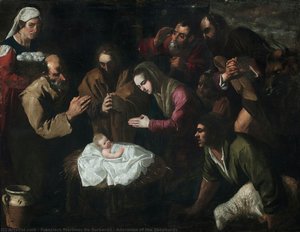 Adoration of the Shepherds - Francisco de Zurbarán
A central figure of the Spanish Golden Age, Francisco de Zurbarán (1598–1664) epitomizes the spiritual intensity of 17th century Spanish painters. Born in Fuente de Cantos and trained in the vibrant artistic hub of Seville under Pedro Díaz de Villanueva, he developed a profound ability to translate religious fervor into visual form. His work is defined by a masterful command of tenebrism, using dramatic contrasts between deep shadow and piercing light to create a sense of divine presence and tactile reality.
This mastery is vividly realized in his 1640 work, Adoration of the Shepherds. In this profound composition, Zurbarán eschews grandiosity for an intimate, hallowed atmosphere. Through the surgical application of chiaroscuro, he sculpts the rugged textures of the shepherds' garments and the weathered expressions of the onlookers out of an enveloping darkness. The light does not merely illuminate; it directs the viewer’s devotion toward the miracle of the Nativity, turning a humble scene into a meditative encounter with the sacred. His ability to capture such profound stillness and material presence remains a hallmark of his legacy within the Baroque era.
Diego Velázquez
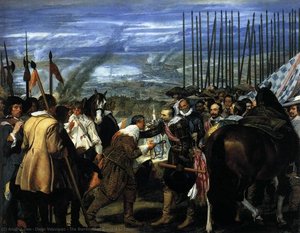 The Surrender of Breda (Las Lanzas) - Diego Velázquez
Born in Seville in 1599, Diego Velázquez stands as the preeminent figure among 17th century Spanish painters, a master whose brushwork defined the Golden Age of Spanish art. His journey began under the guidance of Francisco Pacheco, whose mentorship in Seville provided the technical foundation in proportion and drawing that would later allow him to revolutionize Baroque realism. A pivotal moment in his career occurred in 1622 when he moved to Madrid, a transition that led to a lifelong, prestigious relationship with the Spanish Royal Court and King Philip IV.
His technical mastery is epitomized in his monumental work, The Surrender of Breda (1634). In this masterpiece, Velázquez moves beyond mere historical documentation to capture a profound sense of dignity and grace amidst the aftermath of conflict. Through his signature alla prima technique, he utilizes loose, vibrant brushstrokes and a sophisticated, muted palette of ochres and grays to evoke texture and atmosphere. By prioritizing the essence of form and the subtle interplay of light over rigid, meticulous detail, he achieved a level of psychological depth and visual immediacy that remains unparalleled in the history of 17th century Spanish art.
Bartolomé Esteban Murillo
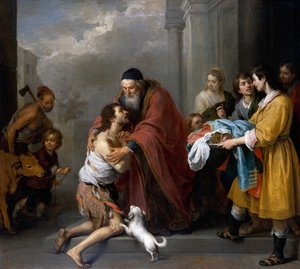 Return of the Prodigal Son - Bartolomé Esteban Murillo
A central figure of the Spanish Baroque, Bartolomé Esteban Murillo (1617–1682) transformed the visual language of 17th-century Spain through his unique ability to blend intense realism with a soft, luminous grace. Born in Seville and orphaned at a young age, he was raised by his sister and stepfather, eventually entering the workshop of his uncle and godfather, Juan del Castillo. This early training provided the technical foundation that allowed him to evolve from a practitioner of somber, heavy realism into a master of a more idealized, vaporous style. His later works are celebrated for their delicate glazes and a sense of light that appears to emanate from within the canvas itself.
His mastery of emotional storytelling is epitomized in the 1670 masterpiece, Return of the Prodigal Son. This oil on canvas captures a profound moment of redemption and paternal love, utilizing dramatic light and shadow to focus the viewer's attention on the kneeling son and his welcoming father. Through such works, Murillo defined the spiritual and emotional landscape of the 17th century, moving beyond mere depiction to capture the very essence of human vulnerability and divine mercy.
Juan de Valdés Leal
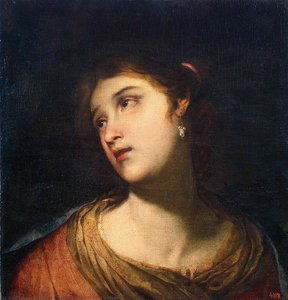 Head of a Woman - Juan de Valdés Leal
A central figure of the Spanish Baroque, Juan de Valdés Leal (1622–1690) represents the intense, dramatic spiritualism that defined 17th century Spanish painters. Born in Seville, his artistic journey was shaped by his formative years in Córdoba, where he studied under Antonio del Castillo. This technical foundation allowed him to evolve into a versatile master of painting, sculpture, and architecture. His professional life was deeply intertwined with his family; his wife, Isabella Carasquilla, was a painter herself, fostering a household of profound creative energy that influenced the next generation of artists.
Valdés Leal’s work is characterized by a rejection of gentle radiance in favor of a visceral, theatrical engagement with mortality. He utilized dramatic chiaroscuro to explore the concept of vanitas, confronting the viewer with the fleeting nature of existence through somber, monumental compositions. His 1658 masterpiece, Head of a Woman, serves as a profound example of this psychological depth. In this work, he moves beyond mere likeness to create a meditation on contemplation, using light and shadow to capture the subtle, intense mysteries of the human spirit. His ability to dissolve the boundaries between the earthly and the divine remains a hallmark of his contribution to the Golden Age.
Jusepe de Ribera
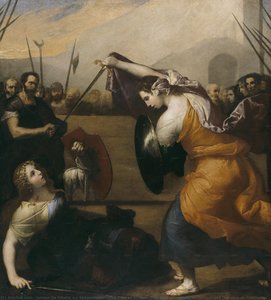 The Duel of Women (The Duel of Isabella de Carazzi and Diambra de Pettinella) - Jusepe de Ribera
A towering figure of the Baroque era, Jusepe de Ribera—famously known as Lo Spagnoletto—stands as a vital pillar among 17th century Spanish painters. Though his career flourished in Naples, his Valencian origins and his profound impact on the Spanish Golden Age cement his status within this illustrious group. Ribera’s work serves as a bridge between the visceral tenebrism of Caravaggio and a more classical, refined sensibility, positioning him alongside contemporaries like Velázquez and Zurbarán as a master of the era's dramatic intensity.
His canvases are characterized by an unflinching realism and a masterful command of light and shadow. In his monumental 1636 work, The Duel of Women (The Duel of Isabella de Carazzi and Diambra de Pettinella), Ribera captures a moment of explosive kinetic energy. Through a sophisticated use of chiaroscuro, he orchestrates a chaotic battlefield where the clash of steel and the tension of social rivalry are rendered with startling physical presence. His ability to depict the raw complexity of the human condition—from the agony of martyrdoms to the fierce pride of combat—ensures his legacy as a master of the Baroque's most profound emotional depths.
Antonio Del Castillo Y Saavedra
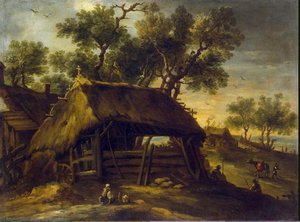 Landscape with Huts - Antonio Del Castillo Y Saavedra
A prominent figure of the Spanish Baroque, Antonio Del Castillo Y Saavedra (1616–1668) represents the profound artistic evolution occurring in Spain during the 17th century. Born in Córdoba, his journey through the era's most influential circles saw him refine his craft under the guidance of his father, Agustín, and later under the mentorship of the legendary Francisco de Zurbarán in Seville. This lineage connects him directly to the masters of the Golden Age, as he also studied under his uncle, Juan del Castillo, a teacher to other giants of the period.
His work is defined by a remarkable versatility that spans religious iconography, poetry, and sculpture. In his representative masterpiece, Landscape with Huts (1650), Castillo moves beyond the purely devotional to capture the atmospheric essence of the Spanish countryside. The painting utilizes a sophisticated command of light and shadow to depict a tranquil, rural scene, showcasing the emotional depth and textural sensitivity that characterized the high Baroque style. Whether through his vibrant frescoes in the Church of Santa Marina or his intimate oil studies, Castillo remains a vital voice in the 17th-century Spanish canon.
Juan Carreño de Miranda
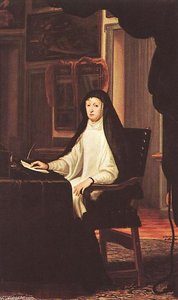 Queen Mariana de Austria as a Widow - Juan Carreño de Miranda
A central figure of the Spanish Baroque, Juan Carreño de Miranda (1614–1685) represents the evolution of courtly portraiture during the 17th century. Born in Avilés and later moving to Madrid, his artistic trajectory was profoundly shaped by the influence of Diego Velázquez. This connection allowed Carreño de Miranda to master the sophisticated interplay of light and dignity that defined the Spanish Golden Age, eventually leading to his appointment as a significant painter for the royal court.
His technical command is perhaps most poignantly realized in his 1669 work, Queen Mariana de Austria as a Widow. This oil on canvas serves as a profound study of character and atmosphere, moving beyond mere likeness to capture a sense of spiritual resignation. Through a masterful use of light and texture, he renders the heavy folds of a nun's habit and the quiet solemnity of the subject's surroundings with exceptional realism. By blending the grand scale of royal commissions with an intimate, reflective emotionality, Carreño de Miranda solidified his legacy as a master of 17th-century Spanish art, capturing the transition from worldly power to quiet, religious devotion.
Claudio Coello
 Virgin and Child Adored by St Louis, King of France - Claudio Coello
Claudio Coello (1642–1693) stands as a pivotal figure of the 17th century Spanish school, serving as a bridge between the height of the Baroque and the emerging sensibilities of the next era. Born in Madrid, he was the son of the Portuguese sculptor Faustino Coello, a lineage that likely informed his profound understanding of form. After training under Francisco Rizi, Coello’s artistic vision was irrevocably transformed by his access to the royal collections, where he studied the rich palettes and dynamic compositions of masters like Rubens and Van Dyck.
A visitor can recognize a Coello masterpiece by its theatrical, stage-like compositions and a sophisticated use of light that creates a sense of divine presence. His work is characterized by an opulent richness, utilizing deep reds and golds to convey both regal splendor and intense spiritual devotion. This is masterfully demonstrated in his 1668 work, Virgin and Child Adored by St Louis, King of France. In this monumental piece, Coello employs a dramatic chiaroscuro to bathe the infant Jesus in an ethereal glow, surrounding the central figures with meticulously detailed attendants and angels. His ability to blend courtly elegance with profound religious narrative marks him as one of the last great masters of the Spanish Golden Age.
Juan de Arellano
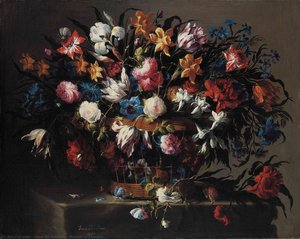 Basket of Flowers - Juan de Arellano
A central figure in the Spanish Baroque, Juan de Arellano (1614–1676) carved a unique niche within the 17th century Spanish painters' landscape by turning away from grand religious narratives to embrace the silent, exquisite language of botany. While many of his contemporaries in Madrid focused on intense martyrdoms, Arellano sought the ephemeral grace of nature. His artistry represents a sophisticated fusion of Spanish sensibility and the lush, ornamental traditions of the Flemish and Italian schools, a hallmark of the era's artistic exchange.
His technical mastery is most vividly realized in his 1671 masterpiece, Basket of Flowers. In this work, Arellano demonstrates an almost scientific precision, utilizing chiaroscuro to create a dramatic interplay between velvety shadows and luminous highlights. This technique breathes life into every petal, elevating a simple arrangement into a profound meditation on beauty and texture. By absorbing the meticulous detail of masters like Daniel Seghers, Arellano transformed the still life into a high art form, ensuring his legacy as a premier specialist of the Spanish Golden Age.
Alonso Cano
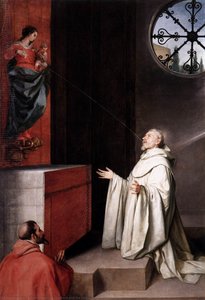 St. Bernard and the Virgin - Alonso Cano
In St. Bernard and the Virgin, created around 1650, the viewer is drawn into a profound moment of spiritual revelation. The composition centers on the radiant Virgin Mary cradling the Christ Child, while St. Bernard is captured in a state of intense supplication. This work exemplifies the dramatic interplay of light and shadow characteristic of the era, where divine illumination contrasts with natural light to heighten the sense of religious ecstasy.
A true Renaissance Man of the Spanish Golden Age, Alonso Cano (1601–1667) stands as a singular figure among 17th century Spanish painters due to his rare ability to master painting, sculpture, and architecture. Born in Granada, his artistic foundation was built under his father, Miguel Cano, and later refined through the prestigious lineages of Juan del Castillo and Francisco Pacheco. His sculptural training under Juan Martínez Montañés infused his visual works with a remarkable anatomical grace and emotional resonance. Whether through the monumental presence of his religious carvings or the luminous, tenebristic depth of his canvases, Cano’s oeuvre remains defined by an extraordinary capacity to capture the divine within the human form, making him a cornerstone of the Baroque movement in Spain."
Conclusion
The masters of the 17th century defined a golden era of Spanish art, weaving together profound religious devotion, dramatic chiaroscuro, and a sophisticated realism that captured the very essence of the human condition. From the intense, spiritual austerity of Zurbarán and the psychological depth of Velázquez to the soft, lyrical grace of Murillo, these artists collectively shaped a visual language that remains unparalleled in its emotional weight and technical mastery. Whether through the gritty naturalism of Ribera or the grand, courtly compositions of Coello, this group transformed the canvas into a window of profound light and shadow.
At Mus3ums.com, we invite you to bring this legacy of Spanish grandeur into your own living space. Our artisans specialize in creating museum-quality, hand-painted oil reproductions that honor the specific brushwork and tonal richness of these historical masters. You can explore our full collection to find the perfect piece and experience the timeless beauty of these masterpieces through a tangible, textured work of art.