
Introduction
The 18th century in the German-speaking lands was a period of profound artistic transition, bridging the ornate exuberance of the Baroque with the emotional depth of Romanticism. As the Holy Roman Empire underwent significant cultural shifts, painters from this era captured a world in flux, moving from the structured elegance of courtly portraiture to the sublime, untamed power of nature. This era was defined by a tension between the rationalism of the Enlightenment and a growing fascination with the spiritual and the infinite, a duality that allowed for an extraordinary diversity in subject matter and technique.
During this century, German-born artists and those working within its territories mastered a wide array of genres, from the meticulous precision of landscape studies to the dramatic intensity of religious and mythological scenes. Their work reflects a sophisticated understanding of light and atmosphere, often used to evoke a sense of awe or to document the changing social hierarchies of the time. Whether through the delicate brushwork of Rococo elegance or the precursor movements toward the dramatic landscapes of the following century, these artists established a visual language that was both deeply regional and internationally influential.
Today, these painters remain vital to our understanding of European art history, serving as the essential link between the classical traditions of the past and the modern sensibilities of the future. Their ability to translate the human experience—from the intimate details of a portrait to the vastness of a mountain range—continues to resonate with contemporary viewers. The following selection highlights ten masters of this transformative period, including figures such as Caspar David Friedrich, Johann Zoffany, and Jacob Philipp Hackert, whose legacies continue to shape the way we perceive the intersection of nature, emotion, and light.
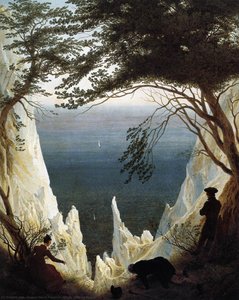
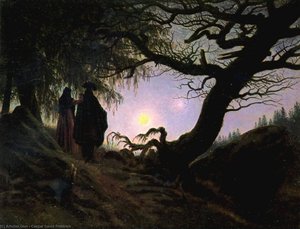
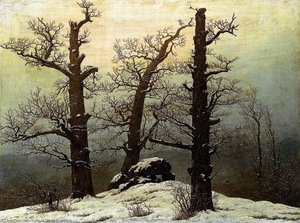
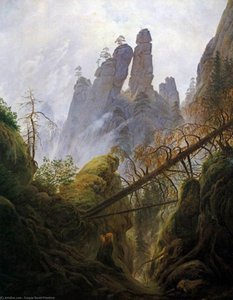
Caspar David Friedrich
 The Monk by the Sea - Caspar David Friedrich
In The Monk by the Sea, a solitary figure in dark robes stands upon a low dune, facing a vast, tripartite expanse of sea, mist, and an overwhelming sky. This composition, executed in oil on canvas, exemplifies the profound sense of isolation and the sublime that defines the artist's vision. Born in the German port city of Greifswald in 1774, Caspar David Friedrich emerged from the late 18th-century German tradition to become a master of Romanticism. His early years, marked by personal loss, fostered a deep sensitivity to mortality that would permeate his entire oeuvre.
Friedrich’s technique moved beyond mere topographical detail, instead using the landscape as a vessel for the human soul. He frequently employed Rückenfiguren—figures seen from behind—to invite viewers into a state of quiet contemplation. His palette, often composed of muted indigos, charcoal grays, and desaturated whites, emphasizes the tension between the smallness of human presence and the infinite power of nature. Whether depicting the swirling mists of a mountain peak or a chilling Arctic wasteland, his work captures the internal weather of the human spirit through atmospheric perspective and symbolic depth.
Ludolf Bakhuizen
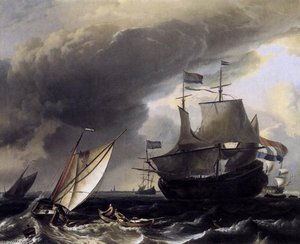 Dutch Vessels on the Sea at Amsterdam - Ludolf Bakhuizen
Born in Emden, Germany, in 1630, Ludolf Bakhuizen stands as a vital link in the lineage of German-born masters who shaped the maritime traditions of the era. Although he achieved his greatest fame in Amsterdam, his German origins and his presence in the artistic landscape during the transition into the 18th century place him within this significant group of painters. Having studied under esteemed masters such as Allart van Everdingen and Hendrik Dubbels, Bakhuizen eventually rose to become the preeminent maritime painter of the Dutch Golden Age, particularly after the departure of Van de Velde to England.
His work is defined by an intense, visceral realism, often achieved by venturing into the open sea by boat to observe the elements firsthand. His representative masterpiece, Dutch Vessels on the Sea at Amsterdam (1708), exemplifies this dedication. In this work, he captures the raw, turbulent energy of the North Sea, utilizing expressive brushstrokes to render the swirling masses of water and the vulnerability of merchant ships. His ability to translate the atmospheric tension of a storm into a cohesive composition remains a testament to his technical mastery of light and motion.
Godfrey Kneller
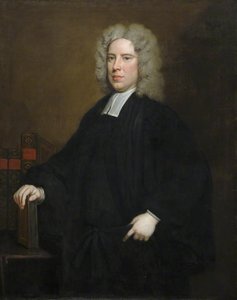 Edward Tenison - Godfrey Kneller
Born in Lübeck, Germany, as Gottfried Kniller, this master artist represents the profound influence of German training on the European Baroque. After emigrating to England, he became the preeminent portraitist of the late Stuart and Georgian eras, serving as court painter to monarchs such as Charles II and George I. His work is instantly recognizable by its sophisticated use of chiaroscuro, where a dramatic interplay of light and shadow lends a palpable sense of dimensionality to the subject. His brushwork is characterized by a meticulous precision, capable of rendering the complex textures of silk, skin, and hair with remarkable psychological depth.
A quintessential example of his skill is Edward Tenison, painted circa 1720. In this portrait of the Bishop of Ossory, Kneller employs a serene composition and a dignified pose to embody the ideals of piety and erudition. The painting showcases his ability to capture not just a physical likeness, but the very gravitas of his sitters. Whether through his famous Kit-Cat portraits or his formal ecclesiastical commissions, his legacy remains a cornerstone of 18th-century portraiture, bridging his German origins with the grand manner of the British court.
Johann Zoffany
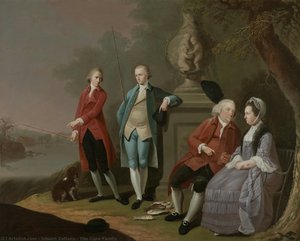 The Cope Family - Johann Zoffany
Born in Freiburg in 1733, Johann Zoffany stands as a significant figure among 18th century German painters due to his foundational training in the German tradition before his international ascent. His early artistic development began with an apprenticeship in sculpture and subsequent studies under Martin Speer in Regensburg, establishing a technical precision that would later define his career. This German upbringing provided the essential groundwork for his later travels to Rome, where he entered the studio of Agostino Masucci, blending his native training with the elegance of the Italian tradition.
Zoffany is most celebrated for his mastery of the "conversation piece," a genre of informal group portraiture that captures the subtle psychological nuances of social gatherings. His ability to depict interpersonal dynamics and the complexities of human interaction allowed him to rise to prominence, eventually earning the patronage of King George III and the Austrian imperial family. His representative work, The Cope Family (1775), serves as a quintessential example of this style. In this meticulously composed oil on canvas, Zoffany moves beyond simple likeness to create a theatrical tableau of aristocratic life, utilizing a rich, opulent setting to reflect the social hierarchies and refined elegance of the era.
Johann Heinrich Wilhelm Tischbein
 Goethe in the Roman Campagna - Johann Heinrich Wilhelm Tischbein
A hallmark of Johann Heinrich Wilhelm Tischbein’s artistry is the seamless integration of human intellect with the grandeur of classical landscapes. As a prominent figure of the 18th century German school, Tischbein’s work is defined by a refined Neoclassical elegance, characterized by polished surfaces and a meticulous approach to light and shadow. His ability to capture the psychological depth of his subjects while placing them within an orderly, rhythmic composition allows his paintings to transcend simple portraiture, turning them into meditations on the Enlightenment.
Born in Haina in 1751, he was trained by his father, Johann Heinrich Tischbein the Elder, a significant influence that helped shape his mastery of the genre. His most celebrated achievement, Goethe in the Roman Campagna (1787), exemplifies his skill in blending portraiture with the sweeping vistas of Italy. In this work, he captures the essence of the renowned writer Johann Wolfgang von Goethe, using a balanced grace to link the subject to the timeless beauty of the Roman landscape. Whether depicting mythological scenes like Ajax and Cassandra or the atmospheric vistas of his travels, Tischbein’s legacy remains a vital link between the classical traditions of the 18th century and the emerging Romantic sensibilities of the era."
Georg Friedrich Schmidt
 Self-Portrait with Spider - Georg Friedrich Schmidt
Born in Wandlitz in 1712, Georg Friedrich Schmidt stands as a quintessential figure among 18th century German painters, embodying the refined elegance of the Rococo movement. His artistic journey, which saw him transition from a family trade in cloth-making to the prestigious Prussian Academy of Arts, reflects the era's shift toward specialized academic excellence. Schmidt’s mastery was particularly evident in his ability to navigate both the delicate medium of pastel and the precise technicality of etching and engraving.
A visitor can recognize Schmidt’s hand through his sophisticated use of light and a remarkable ability to capture subtle human expressions. His work often possesses a reflective, almost introspective quality, characterized by a delicate balance of grace and technical precision. This is most profoundly demonstrated in his 1758 masterpiece, Self-Portrait with Spider. This work showcases his technical brilliance through intricate linework and a masterful command of tonal range, using hatching and cross-hatching to create depth. Whether through his portraits of Frederick the Great or his intimate etchings, Schmidt’s legacy remains rooted in the sophisticated aesthetic sensibilities that defined German art during the 1700s.
Jacob Philipp Hackert
 Great Cascades at Tivoli - Jacob Philipp Hackert
Born in Prenzlau in 1737, Jacob Philipp Hackert stands as a preeminent figure among 18th century German painters, specifically noted for his ability to synthesize classical structure with the dramatic atmosphere of the Grand Tour. His artistic foundation was laid by his father, a portraitist and animal painter, and further refined through formal training at the Prussian Academy of Arts in Berlin starting in 1758. This rigorous academic background allowed him to transition from the decorative murals of his early career in Stockholm to the sophisticated landscape traditions of Europe.
Hackert’s style was profoundly shaped by his time in Paris, where he absorbed the atmospheric sensibilities of Claude Joseph Vernet. His ability to capture the sublime qualities of the Mediterranean landscape made him a favorite of the era, eventually serving as a court artist to Ferdinand I. His masterpiece, “Great Cascades at Tivoli” (1783), exemplifies this expertise. In this work, he employs a masterful pyramidal composition and atmospheric perspective to transform a rugged waterfall into a structured, symphonic vision of nature. Through his precise brushwork and command of light, Hackert bridged the gap between the disciplined classicism of the early century and the burgeoning emotional depth of the Romantic movement.
Bernhard Rode
 The Empress of China Culling Mulberry Leaves - Bernhard Rode
A central figure of the Prussian Enlightenment, Bernhard Rode (1725–1797) stands as a quintessential representative of 18th century German painters. His career, which spanned the most transformative decades of the century, was shaped by a rigorous international education. After initial training in Berlin, Rode refined his technique in Paris and later underwent a profound stylistic evolution during several years spent studying the Old Masters in Rome and Venice. This synthesis of French elegance and Italian grandeur allowed him to become a dominant force in Berlin's artistic landscape, eventually serving as the director of the Berlin Academy of the Arts from 1783 until his death.
Rode was a master of diverse genres, ranging from intricate engravings to grand historical and mythological frescoes. His work often navigated the graceful sensibilities of the Rococo while maintaining the intellectual depth required by the era's philosophical circles. In his 1773 work, The Empress of China Culling Mulberry Leaves, we see this mastery in action. The painting captures a moment of refined social interaction and aristocratic leisure, utilizing soft, diffused light and meticulous brushwork to depict the ritual of silk cultivation. Through such compositions, Rode elevated the depiction of courtly life into a sophisticated visual language.
Christian Wilhelm Ernst Dietrich
 Adoration of the Shepherds - Christian Wilhelm Ernst Dietrich
Born in Weimar in 1712, Christian Wilhelm Ernst Dietrich stands as a virtuoso of the 18th century German school, a painter who mastered the art of stylistic transformation. Rather than forging a singular new path, he became a bridge between eras, traveling through the great artistic hubs of Italy and the Netherlands to absorb the souls of the masters. His talent was so profound that by age eighteen, he had already secured the patronage of King Augustus II, a testament to his ability to inhabit the dramatic languages of the past.
In his 1760 work, Adoration of the Shepherds, this technical mimicry reaches a spiritual peak. The painting is a masterclass in chiaroscuro, utilizing deep, heavy shadows to frame a sudden, piercing radiance. The light emanating from the infant Christ creates a sacred circle, illuminating the textures of coarse peasant clothing and soft straw with tangible precision. Through this work, Dietrich demonstrates why he is a central figure among 18th century German painters: he possessed the rare ability to weave the rustic, earthy textures of Dutch genre scenes with the dramatic, light-drenched intensity of the Baroque, creating a profound sense of stillness and divine presence.
Franz Anton Maulbertsch
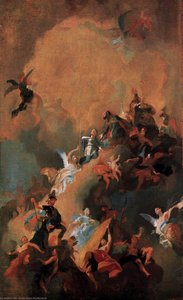 Apotheosis of a Hungarian Saint - Franz Anton Maulbertsch
Born in the German lakeside town of Langenargen in 1724, Franz Anton Maulbertsch stands as a luminous bridge between the dramatic grandeur of the late Baroque and the airy elegance of the Rococo. His career, which spanned the 18th century, was shaped by rigorous training at the Academy of Vienna and a transformative apprenticeship under Paul Troger. This foundation allowed him to master a sense of theatricality that he later infused with the vibrant, light-drenched sensibilities of Venetian masters like Tiepolo and Piazzetta.
Maulbertsch's mastery of illusionistic space and celestial movement is epitomized in his 1773 masterpiece, Apotheosis of a Hungarian Saint. This monumental fresco, created for the St Ladislaus Chapel, showcases his ability to command a swirling panorama of angels and saints through a rich, opulent palette of golds, reds, and deep browns. His technique often utilized a palpable impasto, lending a tactile, rhythmic energy to his religious compositions. By blending Austrian traditions with a sophisticated Venetian approach to color, Maulbertsch secured his legacy as a premier figure among 18th century German painters, known for transforming sacred spaces into breathtaking, light-filled visions of the divine.
Conclusion
The 18th century was a transformative era for German art, a period where the rigid structures of the Baroque began to soften into the emotional depth of Romanticism and the refined elegance of Neoclassicism. From the dramatic, atmospheric landscapes of Caspar David Friedrich to the meticulous portraiture and grand historical compositions of artists like Johann Zoffany and Johann Heinrich Wilhelm Tischbein, these masters collectively defined a visual language of profound introspection and technical mastery. Whether capturing the sublime power of nature or the intricate social hierarchies of the Enlightenment, these painters left an indelible mark on the history of European art.
At Mus3ums.com, we invite you to bring this legacy of German excellence into your own living space. Our artisans specialize in creating museum-quality, hand-painted oil reproductions that capture the authentic texture, brushwork, and soul of these historical masterpieces. By choosing a custom commission or a fine art reproduction, you can experience the timeless beauty of these 18th-century works through a tactile, high-fidelity medium that honors the original artist's vision. Explore our full collection and find the perfect piece to transform your home into a private gallery.


