

Introduction
The 19th century in Germany was a period of profound transformation, where the landscape of European art shifted from the structured elegance of Neoclassicism toward the raw emotion of Romanticism and the experimental spirit of Impressionism. As the German-speaking lands moved through political unification and industrialization, artists sought to capture the tension between the sublime power of nature and the evolving complexities of the human psyche. This era produced a diverse spectrum of visual languages, ranging from the misty, spiritual landscapes of the early century to the bold, psychological explorations of the fin de siècle.
What unites these masters is a deep preoccupation with the essence of the subject, whether it be the vastness of a mountain range or the intimate nuances of a portrait. These painters did not merely document their surroundings; they interpreted them through a lens of intense subjectivity. From the dramatic, atmospheric compositions that defined the Romantic movement to the more structured, light-driven approaches of later decades, their work reflects a culture in constant dialogue with its own identity and the changing world around it.
Today, these artists remain vital because they pioneered the visual vocabulary of modern emotion. Their ability to translate the intangible—be it awe, melancholy, or social tension—into pigment and brushstroke continues to resonate in contemporary aesthetics. By examining the lives and legacies of these ten significant figures, we trace the evolution of a movement that fundamentally altered the course of Western art history.
Caspar David Friedrich
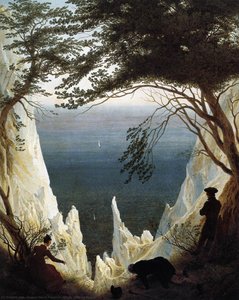
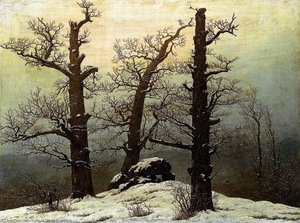
A central figure of the 19th century German painters, Caspar David Friedrich (1774–1840) transformed the landscape into a profound vessel for spiritual and emotional inquiry. His work is instantly recognizable by its atmospheric depth and the use of Rückenfiguren—solitary figures seen from behind—which serve as proxies for the viewer to contemplate the vastness of nature. Moving away from mere topographical accuracy, Friedrich utilized a palette of muted blues, grays, and earthy browns to capture the "internal weather" of the human soul, often emphasizing the sublime tension between humanity and the infinite.
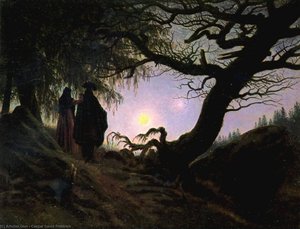
Born in the Baltic port of Greifswald, his artistic sensibility was shaped by early personal loss and a dual interest in art and theology. His technical mastery was refined through training under his brother, Christian, and later in Copenhagen, where he integrated landscape traditions with a deeply mystical perspective. His 1824 masterpiece, Man and Woman Contemplating the Moon, exemplifies this approach. Through meticulous detail and a monochromatic, moonlit glow, the work invites a sense of quiet reflection, perfectly embodying the Romantic era's fascination with the intersection of the natural world and the divine.
Albert Bierstadt
 Rocky Mountains - Albert Bierstadt
Born in Solingen in 1830, Albert Bierstadt represents a vital link between European academic rigor and the American Romantic tradition. Although his career flourished in the United States, his artistic foundation was deeply rooted in his German heritage. He returned to the continent in 1853 to undergo formal training at the prestigious Düsseldorf School, where he refined his command of light and natural detail under the guidance of Worthington Whittredge. This rigorous German training allowed him to master the technical precision required to capture the sublime landscapes of the New World.
His ability to translate vast, untamed wilderness into dramatic compositions is perfectly encapsulated in his 1863 masterpiece, Rocky Mountains. This work showcases the luminous, layered oil technique he perfected, using light to evoke an ethereal, almost spiritual atmosphere. By combining the meticulousness of the Düsseldorf School with the expansive spirit of the Hudson River School, Bierstadt transformed the American West into a theater of grandeur. His expeditions through Colorado and Wyoming provided the raw inspiration for these vistas, ensuring that his depictions of the frontier were both geographically grounded and poetically elevated.
Franz Xaver Winterhalter
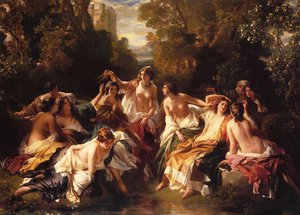 Florinda - Franz Xaver Winterhalter
Born in the Black Forest village of Menzenschwand in 1805, Franz Xaver Winterhalter emerged from a family of practical laborers to become a preeminent figure among 19th century German painters. His journey from the rural landscapes of his youth to the academic rigor of the Munich Academy of Arts allowed him to refine a technical precision that would eventually captivate the highest echelons of European royalty. A master of Academic Realism, Winterhalter’s work is instantly recognizable by its luminous skin tones, the fluid rendering of luxurious fabrics, and a sophisticated command of light and shadow that breathes life into his subjects.
His ability to balance formal elegance with a sense of romantic vitality is perfectly exemplified in his 1853 masterpiece, Florinda. In this enchanting scene, he moves beyond the rigid constraints of court portraiture to capture a joyful, harmonious gathering set against a lush, verdant backdrop. Through a palette of warm golds and deep greens, Winterhalter demonstrates why he was the preferred chronicler of the 19th-century aristocracy, blending technical mastery with an effortless, graceful movement that defines the era's aesthetic.
Franz von Stuck
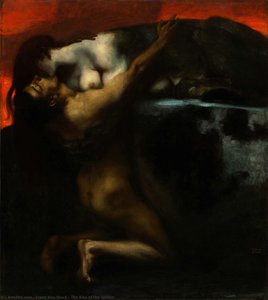 The Kiss of the Sphinx - Franz von Stuck
A central figure of the late 19th century German art scene, Franz von Stuck emerged from Bavaria to become a titan of the Munich Secession. His career, which spanned the transition from academic tradition to modernism, was shaped by his studies at the Munich Academy of Fine Arts, where the haunting mythological visions of Arnold Böcklin left an indelible mark on his psyche. Stuck’s presence in the 19th-century German landscape was defined by his ability to bridge the gap between classical precision and the dark, evocative depths of Symbolism.
His ascent to prominence was marked by a mastery of both painting and sculpture, often exploring the tension between beauty and the subconscious. His representative masterpiece, "The Kiss of the Sphinx" (1895), exemplifies this preoccupation. In this work, Stuck utilizes a somber, dramatic palette to depict a primal, mythic encounter, capturing the psychological tremors of an era fascinated by the femme fatale and the unknown. Through works like this, Stuck solidified his reputation as a "Prince of Art," moving beyond mere representation to explore the eternal struggle between human instinct and the metaphysical realm.
Max Liebermann
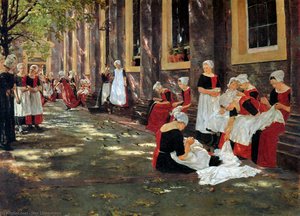 Free hour at Amsterdam orphanage - Max Liebermann
Max Liebermann (1847–1935) stands as a transformative figure among 19th century German painters, serving as a vital bridge between traditional realism and the burgeoning Impressionist movement. Born in Berlin, his intellectual journey through the University of Berlin eventually gave way to a profound artistic calling. His formative years in Weimar, Paris, and the Netherlands allowed him to absorb the radical energy of French Impressionism, which he masterfully adapted to a distinctly German sensibility. Rather than merely replicating Parisian trends, Liebermann infused his work with a sense of observational depth and a commitment to portraying the dignity of modern life.
His representative work, Free hour at Amsterdam orphanage (1876), exemplifies this masterful transition. In this piece, Liebermann moves away from rigid academicism toward a more fluid, naturalistic approach. The composition captures a fleeting moment of communal existence, utilizing loose, visible brushstrokes that imbue the courtyard with movement. Through a sophisticated interplay of light and earthy tones, he elevates a scene of everyday social interaction into a profound study of light and human connection, cementing his legacy as a pioneer of German modernism.
Franz von Lenbach
 Prince Otto von Bismarck - Franz von Lenbach
A central figure in the 19th century German art scene, Franz von Lenbach rose from humble Bavarian origins to become the celebrated Malerfürst, or Painter Prince. His career trajectory, moving from the son of a mason to a professor at the Weimar Saxon Grand Ducal Art School, epitomizes the social and artistic shifts occurring in Germany during this era. Trained at the Academy of Fine Arts in Munich under masters like Karl von Piloty, Lenbach developed a sophisticated command of academic realism that allowed him to become the preeminent chronicler of his time.
Lenbach’s mastery of the Venetian technique and his ability to capture the psychological essence of the elite solidified his reputation among the most influential painters from Germany in the 19th century. His work often utilized dramatic chiaroscuro to isolate his subjects, imbuing them with a sense of historical weight and authority. This is masterfully demonstrated in his 1896 work, Prince Otto von Bismarck. In this somber, monochromatic study, Lenbach employs a wide range of grayscale tones and visible, tactile brushwork to render the statesman’s features. Through the interplay of light and deep shadow, he transforms a formal portrait into a profound exploration of character and gravity.
Walter Sickert
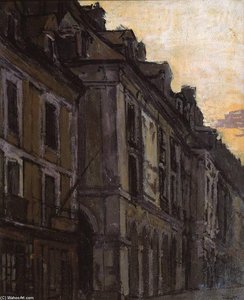 Les Arcades de la Poissonnerie, Dieppe - Walter Sickert
Born in Munich in 1860, Walter Sickert represents a fascinating intersection of European identities, belonging to this group of 19th century German painters by virtue of his German birth and early formative years. Although he became a central figure in the British avant-garde, his roots in Munich provided the foundational context for a life spent navigating the boundaries between established tradition and modernism. His early exposure to the theatrical world, having briefly worked as an actor, infused his later canvases with a unique sense of psychological drama and staged composition.
A pivotal moment in his development was his mentorship under James Abbott McNeill Whistler, which instilled in him a mastery of tonal studies and a preference for painting alla prima. This technical precision is vividly evident in his 1900 work, Les Arcades de la Poissonnerie, Dieppe. In this piece, Sickert moves away from mere documentation to capture a melancholic, urban atmosphere. Through a muted palette of ochres and grays, he emphasizes the rugged, working-class architecture of the harbor, utilizing flattened perspectives and strong vertical lines to transform a simple cityscape into a profound study of light and shadow.
Paula Modersohn-Becker
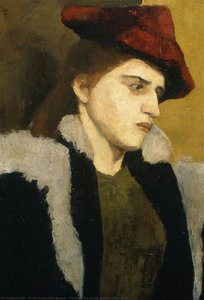 Portrait of a young woman with red hat - Paula Modersohn-Becker
Born in Dresden in 1876, Paula Modersohn-Becker stands as a vital link in the evolution of German art, bridging the late 19th-century traditions with the radical shifts of the early 20th century. Her inclusion in the canon of 19th-century German painters is defined by her formative years and her departure from academic constraints during this era. While she began her journey under the influence of Impressionism, her time in the Worpswede artists' colony allowed her to transcend mere observation, moving toward a profound, subjective Expressionism.
Her 1900 masterpiece, Portrait of a young woman with red hat, serves as a testament to this psychological depth. In this work, she moves beyond the superficiality of a standard likeness to capture an intense, internal reality. The striking red hat acts as a focal point against a muted background, emphasizing the subject's direct and captivating gaze. This ability to portray the inner life of her subjects, particularly women, marked her as a pioneer who transformed the emotional landscape of German painting through unflinching honesty and stylistic innovation.
Max Klinger
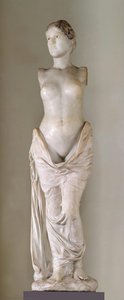 Amphitrite - Max Klinger
A central figure in the evolution of German art during the 19th century, Max Klinger (1857–1920) bridged the gap between the meticulous observation of Realism and the psychological depths of Symbolism. Born in Leipzig and trained at the Academy of Fine Arts in Karlsruhe under Karl Gussow, Klinger moved beyond mere visual representation to explore the subconscious, dreams, and human anxiety. His work is instantly recognizable by its narrative complexity and a profound sense of melancholy, often utilizing the precision of printmaking to evoke intense emotional weight.
Klinger’s mastery of the symbolic language is epitomized in his evocative etchings, such as the 1881 series Paraphrase on the Finding of a Glove, where everyday objects are transformed into potent relics of memory and longing. His ability to blend naturalism with the ethereal allowed him to transcend the rigid academic traditions of his era. This pursuit of essence over mere appearance is beautifully captured in his 1898 work, Amphitrite. In this piece, he utilizes a fragmented, almost unfinished aesthetic to suggest fluidity and transformation, capturing the primordial mystery of the sea goddess through a subtle, naturalistic treatment of form.
Carl Spitzweg
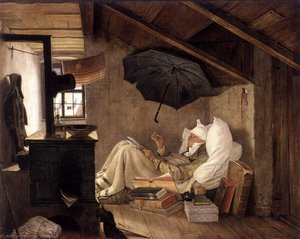 The Poor Poet - Carl Spitzweg
Born in 1808 in the Bavarian village of Unterpfaffenhofen, Carl Spitzweg emerged as a defining figure of the 19th century German painters. His journey to artistic mastery was unconventional; he initially trained as an apprentice pharmacist, a path dictated by his father. However, a period of illness allowed a latent passion for painting to flourish. After gaining financial independence in 1833, he abandoned pharmacy to pursue a self-taught career, a decision that allowed him to bypass rigid academic constraints and develop a highly personal, observational style.
Spitzweg became a leading representative of the Biedermeier era, a movement characterized by its focus on the intimate, the domestic, and the gentle humor of everyday life. His works often capture nostalgic, quiet moments with a meticulous attention to detail and a sense of charming irony. His masterpiece, The Poor Poet (1839), serves as a quintessential example of his talent. In this evocative scene, he uses fine brushwork and soft, diffuse lighting to depict an elderly man lost in contemplation within a rustic interior. Through such works, Spitzweg transformed the mundane into something profoundly human and enduringly delightful.
Conclusion
The 19th century was a transformative era for German art, a period where the profound spiritualism of Caspar David Friedrich met the dramatic landscapes of Albert Bierstadt and the refined elegance of Franz Xaver Winterhalter. From the symbolic intensity of Max Klinger to the pioneering modernism of Paula Modersohn-Becker, these artists collectively navigated the shift from Romanticism to Impressionism and beyond, leaving an indelible mark on the visual language of Europe. Whether through the meticulous detail of Carl Spitzweg or the bold, psychological depth of Franz von Stuck, this group of masters redefined how we perceive nature, identity, and the human condition.
At Mus3ums.com, we invite you to bring this rich historical legacy into your own living space. You can explore our full collection to find your favorite masterpiece. Our skilled artists specialize in creating museum-quality, hand-painted oil reproductions that capture the authentic texture and soul of these iconic works, allowing you to live with the beauty of German art history every day.


