

Introduction
The 19th century marked a profound era of identity formation for the United States, a period where the visual language of a burgeoning nation began to find its own unique voice. As the country expanded from its coastal origins toward a vast, untamed wilderness, painters were tasked with capturing the spirit of a landscape that was both physically changing and culturally evolving. This era saw a transition from the formal, structured traditions of European portraiture toward a more visceral, emotive engagement with light, nature, and the human condition.
Throughout this century, American art moved through significant shifts, from the meticulous documentation of early settlers and the dramatic tension of the wilderness to the sophisticated, atmospheric experiments of Impressionism. Artists began to move away from strictly academic constraints, embracing the play of light on water, the rugged textures of the frontier, and the intimate psychological depths of their subjects. This evolution was not merely a change in technique, but a reflection of a society navigating the complexities of industrialization, westward expansion, and the search for a distinct national aesthetic.
Today, these works remain vital because they capture the very essence of a transformative age. They offer a window into how a culture perceives its own growth, its struggles, and its beauty. The mastery displayed by these creators continues to influence contemporary perspectives on composition and color, proving that their vision transcends the era in which they lived. By examining the lives and legacies of these masters, we gain a deeper understanding of the foundational movements that shaped the modern art world.
The following selection highlights ten essential figures who defined this period, ranging from the pioneers of landscape and portraiture to the innovators who brought a new sense of light and movement to the American canvas.
Titian Peale
 Moose in Maine - Titian Peale
In his 1851 work Moose in Maine, Titian Ramsay Peale II demonstrates a profound engagement with classical aesthetics, bridging the gap between scientific documentation and fine art. This piece serves as a remarkable testament to how the High Renaissance ideals of the Venetian masters influenced the burgeoning landscape traditions of mid-nineteenth century America. Peale, a central figure in the 19th century American art scene, utilized his unique position as a naturalist and explorer to elevate wildlife painting through meticulous observation.
Born in 1799 in Philadelphia, Peale was part of a significant artistic dynasty, the son of Charles Willson Peale. His career was defined by a refusal to settle into a single discipline, moving seamlessly between the structured demands of the studio and the unpredictable terrain of scientific expeditions. His technique is characterized by a rich, earthy palette of browns and greens, applied with a precision that captures the textured fur of his subjects and the subtle reflections of a river scene. By prioritizing the structural reality of the natural world over mere abstraction, Peale’s work remains a vital link in the evolution of American realism.
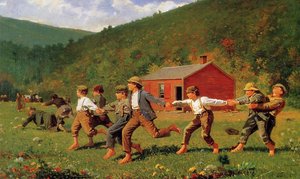
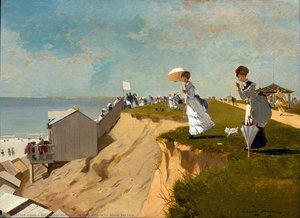
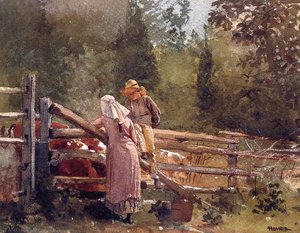
Winslow Homer
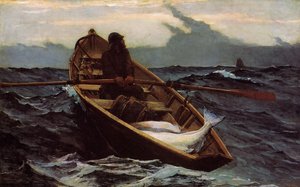 The Fog Warning - Winslow Homer
Born in 1836, Winslow Homer emerged as a titan of American Realism, a movement that defined the visual identity of the 19th century United States. His journey began in Massachusetts, where the delicate watercolor techniques of his mother, Henrietta Maria Benson, first taught him to observe the subtle nuances of color. This early training, combined with a disciplined apprenticeship in lithography, forged a painter capable of capturing both the precision of commercial art and the raw, visceral power of nature.
Homer’s work often explores the profound tension between human resilience and the overwhelming forces of the natural world. In his 1885 masterpiece, The Fog Warning, he moves away from idyllic landscapes to confront the somber reality of maritime life. Through expressive, textured brushwork and a muted palette of grays and deep tones, he captures a moment of intense dramatic tension as a fisherman navigates a precarious sea. This focus on the struggle for survival against the elements marks him as a quintessential 19th century American painter, transforming the everyday hardships of coastal life into a monumental meditation on the human spirit.
James McNeill Whistler
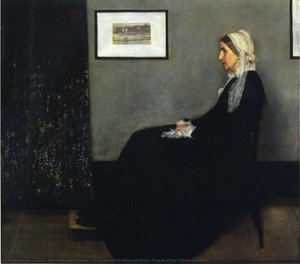 Arrangement in Grey and Black. Portrait of the Painter's Mother - James McNeill Whistler
Born in Massachusetts in 1834, James McNeill Whistler represents a sophisticated evolution within the lineage of 19th century American painters. His journey from the rigid discipline of West Point to the experimental studios of Paris allowed him to transcend traditional American realism. After studying under Gleyre and absorbing the influence of the Barbizon School, Whistler became a leading figure of the Aesthetic Movement, prioritizing harmony and mood over mere narrative.
His masterpiece, Arrangement in Grey and Black. Portrait of the Painter's Mother (1871), serves as a profound testament to this philosophy. Rather than a conventional biographical portrait, the work is a study in Tonalism, utilizing a restrained palette to emphasize geometric balance and atmospheric depth. The asymmetrical composition and the interplay of subtle shades demonstrate his belief that art should be an arrangement of color and form rather than a literal transcription of reality. Through this work, Whistler moved beyond the descriptive traditions of his era, establishing a legacy of contemplative beauty that remains a cornerstone of 19th century American art history.
William Merritt Chase
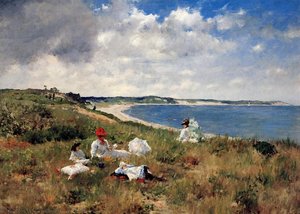 Idle Hours - William Merritt Chase
A pivotal figure in the evolution of American Impressionism, William Merritt Chase (1849–1916) represents the technical sophistication and stylistic shifts defining 19th century United States painters. His journey from the practical discipline of his early years in Indiana to the rigorous academic environments of New York and Munich allowed him to bridge the gap between traditional realism and modern light-drenched aesthetics. After receiving foundational instruction from local artists like Jacob Cox, Chase refined his draftsmanship at the National Academy of Design under Joseph Oriel Eaton and Lemuel Wilmarth, a student of Jean-Léon Gérôme. This academic pedigree provided the essential structure that he would later infuse with the vibrant, expressive energy characteristic of the Impressionist movement.
His mastery of color and light is profoundly captured in his 1894 work, Idle Hours. This serene landscape, currently held at the Amon Carter Museum of American Art, depicts a tranquil moment of leisure on the shores of Long Island. Through a harmonious composition of earthy greens and soft coastal blues, Chase demonstrates the ability to transform a simple afternoon by the sea into a profound study of atmosphere and light, cementing his legacy among the premier masters of his era.
Mary Cassatt
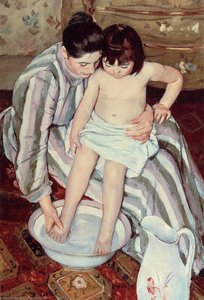 The Child's Bath - Mary Cassatt
Born in Pennsylvania in 1844, Mary Cassatt stands as a pivotal figure among 19th century American painters, bridging the gap between rigorous academic training and the revolutionary Impressionist movement. Her journey from the Pennsylvania Academy of the Fine Arts to the studios of Paris saw her studying under masters like Jean-Léon Gérôme, a discipline that grounded her later stylistic innovations. Unlike many of her contemporaries, Cassatt’s work is defined by a profound, sensitive exploration of the private spheres of women and children, elevating domesticity to the level of high art.
Her masterpiece, The Child's Bath (1893), exemplifies her ability to capture the fleeting nuances of light and intimacy. Through a sophisticated use of loose brushwork and a harmonious color palette, she moves beyond mere representation to convey the emotional essence of maternal care. This focus on the quiet, everyday moments of life distinguishes her from the grand historical narratives favored by many of her peers, cementing her legacy as a master of the Impressionist aesthetic. Her technical precision, honed through years of studying the Old Masters in the Louvre, allows her to render texture and form with a modern, vibrant immediacy.
Childe Hassam
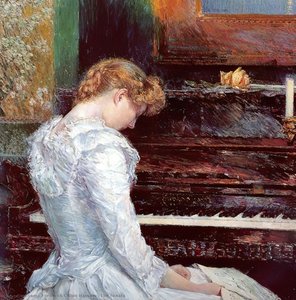 The Sonata - Childe Hassam
Born in 1859 in Dorchester, Massachusetts, Childe Hassam emerged as a pivotal figure among 19th century American painters. His journey began not in a formal academy, but through the disciplined rigor of commercial art, working as a draftsman and illustrator from the age of seventeen. This early professional necessity instilled in him a profound mastery of line and composition, which he would later evolve into a sophisticated painterly language. As a leading light of American Impressionism, Hassam’s work captures the vibrant energy of a nation in transition, moving from the structured demands of illustration toward a luminous, expressive style that defined the era.
His ability to translate the shifting light of urban and coastal landscapes makes his oeuvre essential to the 19th century American canon. A masterful example of this is his 1893 work, The Sonata. In this oil on canvas, Hassam moves beyond mere representation to capture a moment of profound serenity. The painting depicts a young woman at a grand piano, her poised fingers and introspective gaze creating an atmosphere of quiet elegance. Through his delicate handling of light and color, Hassam transformed the ordinary textures of domestic life into enduring, atmospheric masterpieces.
George Catlin
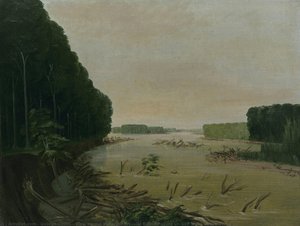 View on the Missouri, Alluvial Banks Falling in, 600 Miles above St. Louis - George Catlin
George Catlin stands as a monumental figure among 19th century American painters, driven by a profound impulse to document a frontier in transition. Born in 1796, Catlin initially trained in law at Litchfield Law School, but his true vocation lay in the vast, untamed landscapes of the American West. His life's work was defined by five extensive expeditions during the 1830s, where he navigated the Missouri River to engage with the Mandan, Sioux, Blackfeet, and Choctaw nations. This commitment to recording indigenous life and landscapes resulted in the massive Indian Gallery, a collection of over 500 works that serves as a vital visual record of the 19th century.
His representative work, View on the Missouri, Alluvial Banks Falling in, 600 Miles above St. Louis, exemplifies his ability to capture the sublime power of the frontier. Painted in 1832, this landscape reflects the Romantic movement's emphasis on emotional resonance and the dramatic interplay of nature. Through his meticulous observation and confident brushwork, Catlin transformed the raw geography of the Missouri River into a poignant, serene vision of a world on the brink of irrevocable change.
John Singleton Copley
 Portrait of William Murray - John Singleton Copley
John Singleton Copley stands as a foundational figure for 19th century American painters, bridging the gap between colonial craftsmanship and the sophisticated portraiture that would define the early American era. Born in 1738 in the maritime hub of Boston, Copley’s technical mastery was forged through a rigorous, self-imposed discipline. Eschewing traditional European academies, he spent years meticulously copying engravings to master the nuances of light and form, eventually becoming the premier portraitist for the colonial elite. His ability to translate material wealth and social hierarchy into visual authority set a standard for the generations of American artists that followed him into the 19th century.
His Portrait of William Murray serves as a profound testament to this technical precision. In this 1783 oil painting, Copley captures the Scottish politician with the gravity of his legal office. The sitter is draped in heavy, textured robes that anchor him within his high station, while scattered documents and a bust of Alexander Pope in the shadows build a sense of intellectual stature. Through a masterful command of texture and light, Copley transforms a formal commission into a quiet, reflective study of power and jurisprudence.
Thomas Eakins
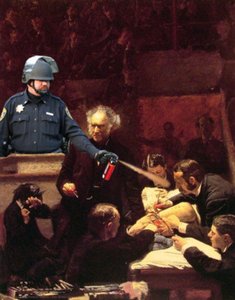 The Gross Clinic - Thomas Eakins
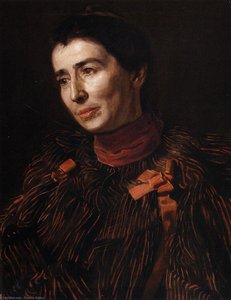
A cornerstone of 19th century American painting, Thomas Eakins brought a rigorous, scientific discipline to the canvas that redefined the boundaries of realism. Born in Philadelphia in 1844, his approach was deeply influenced by his father’s precision as a calligrapher and his formal training at the Pennsylvania Academy of the Fine Arts. Eakins’ work is instantly recognizable by its unflinching structural truth, eschewing idealized beauty in favor of anatomical accuracy and psychological depth. His brushwork is purposeful, often utilizing dramatic lighting and a somber, monochromatic palette to heighten the tension within his compositions.
His masterpiece, The Gross Clinic (1875), serves as a profound testament to this commitment. In this intense oil-on-canvas work, Eakins captures a surgical procedure at Jefferson Medical College with such anatomical precision that it functions as both a dramatic narrative and a historical document of 19th-century medicine. Whether portraying figures like Walt Whitman or documenting the visceral reality of surgery, Eakins’ legacy remains tied to his pursuit of the tangible, making him a pivotal figure in the evolution of American art during this transformative century.
Charles Marion Russell
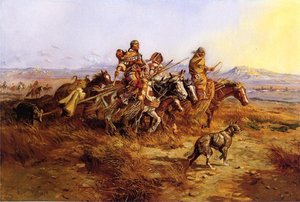 Indian Women Moving - Charles Marion Russell
Born in 1864, Charles Marion Russell stands as a quintessential figure among 19th century American painters due to his profound immersion in the frontier life that defined the era. His artistic journey did not begin in a formal academy, but through the raw, unyielding reality of the Montana Territory. After leaving school at sixteen, he spent over a decade working as a cowboy and night herder in the Judith Basin, absorbing the rhythms of the wilderness and the mechanics of horsemanship directly from the land.
This lived experience allowed him to transcend mere documentation, moving toward a Romantic style that captured the sublime essence of the West. His 1898 masterpiece, Indian Women Moving, exemplifies this ability to blend realism with emotional resonance. The work depicts a group of Native American women traversing a sun-drenched prairie, where the composition creates a dynamic interplay between the vast horizon and the graceful movement of the travelers. Through a palette of warm ochres and radiant yellows, Russell utilizes chiaroscuro to evoke the amber light of a setting sun, immortalizing a vanishing way of life with a sense of quiet, melancholic prestige.
Conclusion
The 19th century was a transformative era for American art, a period where the visual language of a growing nation evolved from the formal portraiture of Copley to the atmospheric, light-drenched landscapes of Homer and the sophisticated Impressionism of Cassatt and Hassam. These artists collectively captured the soul of a changing landscape, whether through the rugged realism of Eakins, the evocative tonalism of Whistler, or the spirited depictions of the American West by Russell. From the delicate nuances of domestic life to the grand, sweeping vistas of the natural world, these masters established a distinct aesthetic identity that continues to resonate across generations.
At Mus3ums.com, we invite you to bring this rich heritage into your own living space. Our artisans specialize in creating museum-quality, hand-painted oil reproductions that honor the specific brushwork and textural depth of these legendary masters. Whether you are looking to add a touch of Impressionist light or a dramatic landscape to your home, you can explore our full collection and find a piece that speaks to your personal aesthetic. Transform your walls with the timeless beauty of these American icons through our bespoke, handmade artistry.


