



Introduction
The 19th century in Belgium was a period of profound artistic metamorphosis, fueled by the nation's rapid industrialization and a complex cultural identity emerging from its geopolitical shifts. As the century progressed, Belgian painters moved away from rigid academic traditions to embrace the shifting light of Impressionism, the psychological depth of Symbolism, and the vibrant textures of Neo-Impressionism. This era was defined by a unique tension between the meticulous realism of the early decades and the radical, experimental spirit that sought to capture the fleeting essence of modern life.
What unites these masters is a shared commitment to technical excellence paired with a restless desire to redefine the boundaries of vision. From the luminous, social scenes of Alfred Stevens to the haunting, dreamlike landscapes of Fernand Khnopff, the Belgian school offered a diverse response to a changing world. These artists did not merely observe their surroundings; they reimagined them through a lens of intense emotionality and structural precision, creating a visual language that bridged the gap between the classical past and the avant-garde future.
Today, these painters remain vital because they represent the very pulse of modern art's evolution. Their works continue to resonate in contemporary galleries, offering a profound exploration of light, shadow, and the human psyche. By examining the lives and legacies of ten pivotal figures—including the expressive James Ensor and the meticulous Theo van Rysselberghe—we gain a deeper understanding of how this small nation shaped the trajectory of European art history.
James Ensor
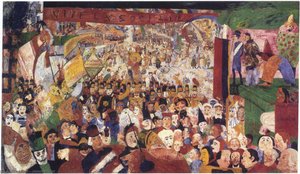 Entry of Christ Into Brussels - James Ensor
Born in Ostend in 1860, James Ensor stands as a transformative figure among 19th century Belgian painters. His artistic identity was forged at the intersection of his English and Belgian heritage, shaped largely by the peculiar objects—shells and carnival masks—found in his parents' souvenir shop. After receiving foundational training from local painters, he refined his technique at the Académie Royale des Beaux-Arts in Brussels, though his vision always drifted toward the unconventional.
While his early works like Russian Music adhered to a somber, realistic framework, Ensor eventually broke away from these traditional constraints to become a pioneer of Expressionism. His mature style is defined by a psychological friction that captures the grotesque and the sublime. His masterpiece, Entry of Christ Into Brussels (1888), exemplifies this radical shift. In this monumental work, he parodies a sacred event by transforming it into a chaotic, vibrant carnival procession. Through a dense composition of masked figures and a vivid, almost jarring palette, Ensor explores the tension between the sacred and the profane, leaving a haunting legacy that redefined the boundaries of Belgian art during this era.
Theo van Rysselberghe
 Darío de Regoyos playing the guitar - Theo van Rysselberghe
Born in Ghent in 1862, Theo van Rysselberghe stands as a transformative figure among 19th century Belgian painters. His artistic evolution represents a profound shift in the Belgian landscape, moving from the somber, meticulous realism taught at the Academy of Ghent and the Académie Royale des Beaux-Arts in Brussels toward the luminous energy of Neo-Impressionism. A key member of the influential group Les XX, van Rysselberghe bridged the gap between traditional Belgian academicism and the radical light-studies of the avant-garde.
His travels to Morocco between 1882 and 1888 served as a vital catalyst, replacing the subdued tones of his youth with a vibrant, sun-drenched palette. This period of intense light and exotic color fundamentally altered his approach to form and atmosphere. In his representative work, Darío de Regoyos playing the guitar, we witness this mastery of light and shadow. The piece captures a moment of profound musical devotion, utilizing a controlled, almost chiaroscuro-like focus to illuminate the musician against a heavy, dark background. Through loose, gestural brushwork and a sophisticated understanding of color, van Rysselberghe’s work captures the very essence of light, cementing his legacy as a pioneer of Belgian modernism."
Alfred Stevens
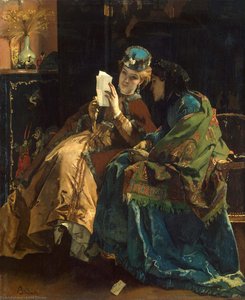 Pleasant Letter - Alfred Stevens
Born in Brussels in 1823, Alfred Stevens stands as a preeminent figure among 19th century Belgian painters, having transitioned from the Académie Royale des Beaux-Arts to the vibrant artistic epicenter of Paris. His work is instantly recognizable through its elegant realism and a sophisticated command of light that captures the essence of la vie moderne. Stevens moved away from the rigid constraints of historical and mythological themes, choosing instead to document the refined social rituals and fashionable interiors of contemporary society.
His technical mastery is deeply rooted in the traditions of the Dutch Golden Age, particularly in his ability to render textures and domestic intimacy with psychological depth. In his representative work, Pleasant Letter (circa 1860-67), he elevates a quiet moment of domesticity into a profound study of social grace. Through a delicate balance of color and light, he portrays women with an exquisite sense of poise, often surrounded by luxurious objects that reflect the era's changing tastes. Whether depicting the high-society elegance of a Parisian salon or the subtle nuances of a private interior, Stevens' brushwork remains a testament to his ability to harmonize naturalism with a romantic, atmospheric sensibility.
Charles Leickert
 Urban Landscape - Charles Leickert
Born in Brussels in 1816, Charles Leickert stands as a significant figure among 19th century Belgian painters, despite much of his professional life being spent in the Netherlands. His artistic foundation was laid in The Hague, where he studied under the guidance of esteemed landscape masters such as Bartholomeus van Hove, Wijnand Nuijen, and Andreas Schelfhout. This rigorous training allowed him to develop a specialized expertise in capturing the atmospheric nuances of winter, a theme that would define his legacy.
Leickert’s work is characterized by a romanticized approach to nature, often utilizing a delicate palette of pale blues and luminous, rosy pinks to evoke the crispness of a frozen landscape. His 1856 masterpiece, Urban Landscape, exemplifies this ability to blend serenity with life. In this work, the river serves as a silver ribbon through the city, where the stillness of the water meets the gentle, rhythmic movement of skaters on the ice. Through expressive brushstrokes and a mastery of light and shadow, Leickert transformed snowy streets and icy vistas into immersive, sensory experiences, securing his place as a premier chronicler of the winter season during the 19th century."
Frank Brangwyn
 Le roi au chantier (tapestry design) - Frank Brangwyn
Born in Bruges, Belgium, in 1867, Frank Brangwyn represents the international reach of 19th-century Belgian talent. Although his career became deeply intertwined with the British Arts and Crafts movement, his origins in the Belgian tradition of craftsmanship and design provided the essential foundation for his prolific output. A viewer can recognize a Brangwyn work by its immense sense of scale and rhythmic composition, often characterized by a bold, vibrant use of color and a fascination with the interplay of light and shadow.
His artistic evolution moved from the dramatic, atmospheric maritime scenes that earned him acclaim at the Paris Salon to expansive Orientalist visions inspired by his travels through North Africa and the Middle East. His representative work, Le roi au chantier (1896), exemplifies this mastery. This tapestry design captures a bustling workshop filled with industrious figures, blending a sense of organized labor with a rich, decorative sensibility. Whether depicting the toil of the working class or the exoticism of distant lands, Brangwyn’s work is defined by a powerful, graphic energy and a profound respect for the integration of fine art into the fabric of daily life."
Pieter Van der Ouderaa
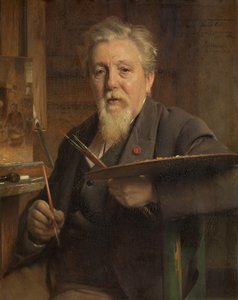 The Painter Jan David Col - Pieter Van der Ouderaa
A central figure in the 19th century Belgian art scene, Pieter Van der Ouderaa embodied the academic rigor and historical grandeur that defined his era. Born in Antwerp in 1841, his journey began at the Royal Academy of Fine Arts, where he refined his technical mastery under the guidance of esteemed mentors such as Nicaise de Keyser and Jozef Van Lerius. His artistic evolution was deeply shaped by his travels; a government-funded residency in Italy allowed him to study the divine compositions of Raphael, while subsequent journeys through Algiers and Spain expanded his visual vocabulary beyond the European tradition.
His mastery of the human form and light is profoundly captured in his 1897 work, The Painter Jan David Col. This evocative portrait serves as a testament to his ability to blend realism with a sense of dignified stillness. Through a sophisticated use of oil paint, Van der Ouderaa sculpts the subject with a soft, directional light that emphasizes the textures of skin and fabric. The composition creates an intimate, reflective atmosphere, transforming a quiet studio moment into a profound study of the artist's craft and the weight of a life dedicated to visual storytelling.
Alfred William Finch
 Orchard at La Louvière - Alfred William Finch
Born in 1854 to British parents in Brussels, Alfred William (Willy) Finch represents a fascinating cultural intersection within the 19th century Belgian art scene. His background allowed him to blend the structural rigidity of British art with the expressive, avant-garde movements emerging in continental Europe. As a prominent figure in Belgian art history, Finch was a founding member of Les XX, a revolutionary group of painters and designers who sought to challenge the traditional academic standards of the era.
Finch is most distinguished by his mastery of Neo-Impressionism, specifically the Pointillist technique. His work, such as the 1890 landscape Orchard at La Louvière, demonstrates a profound commitment to this scientific approach to color. In this piece, he eschews traditional brushwork in favor of thousands of meticulous dots, a method inspired by Georges Seurat. The result is a shimmering, ethereal atmosphere where light and shadow dance through a rhythmic arrangement of verdant foliage. By utilizing this precise application of color, Finch helped redefine the visual language of Belgian painting, moving away from classical realism toward a more vibrant, optical experience of the natural world.
Charles van Beveren
 Ecce Homo - Charles van Beveren
Born in Mechlin in 1809, Charles van Beveren represents the profound talent emerging from the Belgian academic tradition during the 19th century. His artistic foundation was built through rigorous training at the academy of his native city and subsequently in Antwerp, establishing him as a significant figure among 19th century Belgian painters. His career was marked by a nomadic, cosmopolitan spirit; after settling in Amsterdam in 1830, his travels through Paris and the Italian cities of Rome and beyond deeply informed his stylistic evolution.
Van Beveren was a versatile master of Romanticism, excelling in history painting, genre scenes, and portraiture. His technical prowess is vividly captured in his 1847 work, Ecce Homo. This piece exemplifies his command of academic realism and the dramatic use of chiaroscuro. Through a somber palette of deep umbers and blacks, he employs directional lighting to illuminate the subject, utilizing tactile impasto on the white drapery to create a striking contrast against the shadows. His ability to blend anatomical precision with emotional depth earned him prestigious recognition, including being elected a correspondent of the Royal Institute of the Netherlands, a testament to his enduring legacy in the 19th-century art world.
Fernand Khnopff
 Roses and Japanese Fan - Fernand Khnopff
A central figure of the Belgian Symbolist movement, Fernand Khnopff (1858–1921) transitioned from a background in law to become a master of the subconscious. Born in Grevelingen, Belgium, his artistic identity was forged at the Académie Royale des Beaux-Arts in Brussels under the guidance of Xavier Mellery. His style evolved through significant exposure to the works of Ingres and Delacroix during his time in Paris, allowing him to develop a signature aesthetic that fused meticulous realism with an ethereal, often unsettling, dreamscape. As a prominent Belgian painter of the 19th century, Khnopff moved beyond mere representation to explore the psychological depths of his subjects.
His work is characterized by a profound sense of introspection and the feminine mystique, often featuring enigmatic women caught in moments of quiet isolation. In his 1885 masterpiece, Roses and Japanese Fan, he demonstrates his ability to transform a composition into a meditation on memory and desire. Through a sophisticated use of muted palettes and a tension between the tangible and the abstract, Khnopff’s canvases serve as portals into the silent, haunting currents of the human psyche.
Charles Verlat
 Een beer overvalt een houthakker, genaamd 'Strijd op leven en dood' - Charles Verlat
A central figure in the evolution of 19th century Belgian painting, Charles Verlat (1824–1890) embodied the era's transition from the dramatic fervor of Romanticism to the grounded precision of Realism. Born in Antwerp and trained at the Antwerp Academy under masters like Gustave Wappers, Verlat’s journey took him from the historical narratives of the Belgian Romantic school to the sophisticated studios of Paris. His ability to master diverse media—from etching to watercolor—and his stylistic shift toward the realism of Gustave Courbet established him as a versatile force in the Belgian art scene. His influence was so profound that he eventually served as the director of the Antwerp Academy, where he encountered a young Vincent van Gogh.
His mastery of the animalier genre is vividly captured in his 1874 work, Een beer overvalt een houthakker, genaamd 'Strijd op leven en dood'. This dramatic composition utilizes sharp diagonal tension to depict a life-and-death struggle between a lunging bear and a woodsman, with a vulnerable young girl caught in the center. Through expressive brushwork and a palette of deep forest greens and earthy ochres, Verlat creates a claustrophobic, high-contrast scene that exemplifies the intense emotionality and technical rigor characteristic of 19th century Belgian art."
Conclusion
The 19th century Belgian masters represent a profound evolution in European art, bridging the gap between traditional academicism and the radical shifts of modernism. From the haunting, symbolic depths of Fernand Khnopff to the vibrant, light-filled experiments of Theo van Rysselberghe, these artists collectively redefined how color, emotion, and social reality could be captured on canvas. Whether through the expressive, mask-like intensity of James Ensor or the elegant, atmospheric portraiture of Alfred Stevens, this era provided a diverse visual language that continues to resonate with contemporary sensibilities.
At Mus3ums.com, we invite you to bring these historical legacies into your own living space. Our artisans specialize in creating museum-quality, hand-painted oil reproductions that preserve the tactile soul and visible brushstrokes of these Belgian masters. You can explore our full collection to find the perfect piece and transform your home with the enduring beauty of 19th-century Belgian art.


