Introduction
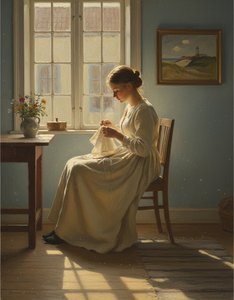
The 19th century in Denmark marked a profound era of artistic awakening, characterized by a shift from formal academicism toward a deeply intimate observation of light, landscape, and the human condition. As the nation navigated a period of significant cultural transformation, its painters moved away from the rigid constraints of the past to embrace the nuances of the everyday. This movement was fueled by a desire to capture the unique essence of the Nordic atmosphere, from the soft, ethereal light of the Danish coast to the quiet, contemplative stillness of domestic interiors.
What unites these masters is a shared devotion to a refined realism and a poetic sensibility. Whether through the dramatic storytelling of early romanticism or the subtle, atmospheric precision of later naturalist movements, these artists sought to translate the soul of their surroundings onto canvas. They were not merely documenting scenery; they were interpreting the very texture of Danish life, often finding profound beauty in the mundane and the melancholic.
Today, the works of these artists remain vital, offering a window into a world that balances technical mastery with deep emotional resonance. Their ability to manipulate light and shadow continues to influence contemporary perspectives on composition and mood. By exploring the lives and legacies of ten essential figures—including the luminous works of Vilhelm Hammershøi, the coastal narratives of Michael Ancher, and the foundational precision of Christoffer Wilhelm Eckersberg—one gains a comprehensive understanding of the visual language that defined a golden age of Nordic art.
Vilhelm Hammershøi
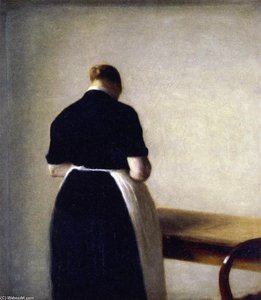 Figure of a Woman - Vilhelm Hammershøi
Born in Copenhagen in 1864, Vilhelm Hammershøi stands as a singular figure among 19th century Danish painters. While his contemporaries often explored the vibrant landscapes and national romanticism prevalent in Denmark during this era, Hammershøi carved a path toward a profound, psychological interiority. His work is defined by an almost palpable silence, transforming domestic settings into stages for quiet contemplation and atmospheric exploration.
A master of light and shadow, he utilized a muted palette of soft grays, pale creams, and dusty ochres to render light as a tangible, atmospheric element. In his 1888 work, Figure of a Woman, we see this technical brilliance firsthand. The painting captures a solitary female figure in a moment of stillness, using a restrained composition to explore the dignity of the everyday. Through the subtle interplay of light and the subject's meditative posture, Hammershøi elevates a simple domestic scene into a meditation on presence and absence.
His ability to manipulate receding perspectives and tonal range allowed him to move beyond mere genre painting, influencing the trajectory of modern art through his unique, symbolic approach to the interior space.
Wilhelm Marstrand
 Portrait of Otto Marstrand's two daughters and their nanny - Wilhelm Marstrand
In Portrait of Otto Marstrand's two daughters and their nanny (1857), Wilhelm Marstrand captures a tender, structured domestic scene set against the sunlit greenery of Frederiksberg Gardens. The composition centers on the nanny, Justina Antoine, whose serious gaze and vibrant red shawl anchor the foreground, while the young daughters, Emily Othilia and Annie Lætitia, flank her in a delicate arrangement. In the soft, sketch-like background, the rest of the family strolls through the park, creating a hierarchy of focus that emphasizes this intimate, quiet moment of connection.
A defining figure of the 19th century Danish art movement, Marstrand’s career spanned from his early studies in Copenhagen under Christian Waagepetersen to a transformative four-year residency in Italy between 1836 and 1840. This period infused his work with a Mediterranean warmth, seen in vibrant pieces like Italian Festival. His mastery of genre painting allowed him to document both the bustling energy of Copenhagen’s streets and the refined elegance of middle-class society. As a professor at the Royal Danish Academy, his influence extended through his students, including Michael Ancher and Carl Bloch, cementing his legacy as a cornerstone of Danish Golden Age painting.
Michael Ancher
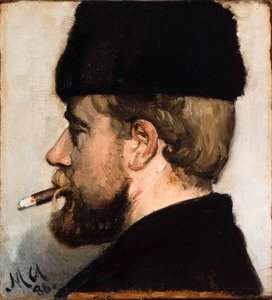 Jens Vige - Michael Ancher
A hallmark of Michael Ancher’s oeuvre is the profound, unvarnished realism he brought to the rugged landscapes of Jutland. A central figure of the 19th-century Danish art scene, Ancher’s work is instantly recognizable by its intimate focus on the fishing communities of Skagen. His brushwork avoids the polished idealism of the Romantic era, opting instead for a tactile precision that captures the coarse textures of heavy wool, weathered skin, and the salt-sprayed atmosphere of the North Sea. His palette often leans into deep, earthy tones that reflect the somber dignity of a life lived in harmony with the elements.
In his 1890 masterpiece, Jens Vige, Ancher achieves a cinematic intensity through masterful light and shadow. The painting presents a contemplative study of a fisherman, whose steady, piercing gaze and rugged features serve as a testament to the resilience required by the coastal life. By choosing to prioritize the lived experience of his subjects over the strict formalities of the Royal Danish Academy, Ancher became the definitive voice of the Skagen Painters, immortalizing the quiet strength and social fabric of 19th-century Danish maritime culture.
Carl Bloch
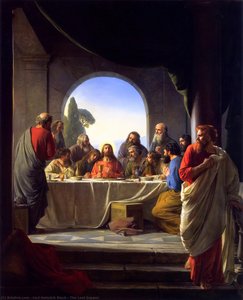 The Last Supper - Carl Bloch
A central figure among 19th century Danish painters, Carl Bloch (1834–1890) brought a profound sense of drama and psychological depth to the Nordic art scene. Although his parents initially envisioned a life for him at sea, Bloch’s devotion to the canvas led him to the Royal Danish Academy of Art, where he studied under Wilhelm Marstrand. This foundational training in Copenhagen eventually blossomed into a sophisticated realism that would define his legacy.
His artistic maturation was deeply influenced by a transformative period in Italy between 1859 and 1866. It was there that he encountered the works of Rembrandt, absorbing the Dutch master's mastery of chiaroscuro—the dramatic interplay of light and shadow. This technique became a hallmark of his style, allowing him to imbue religious and everyday subjects with immense emotional gravity. His 1876 masterpiece, The Last Supper, serves as a quintessential example of this skill. In this composition, light enters from a side window to sculpt the faces and heavy drapery of the disciples, creating a sense of volume and solemnity. Through his ability to blend meticulous realism with spiritual intensity, Bloch remains a cornerstone of 19th-century Danish art history.
Anna Ancher
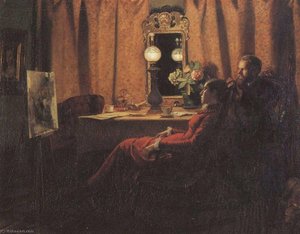 Dansk Dagens arbejde bedømmes English Appraising the Day's Work - Anna Ancher
In her evocative 1883 work, Dansk Dagens arbejde bedømmes (Appraising the Day's Work), Anna Ancher captures a profound sense of domestic stillness through a masterful interplay of light and shadow. As a central figure of the 19th century Danish painters, Ancher brought an unparalleled intimacy to the Skagen movement, moving beyond mere observation to embody the very soul of the Jutland coast. Born in 1859 in the fishing village of Skagen, her perspective was shaped by a life lived amidst the region's bracing winds and ethereal Nordic light.
Her technique represents a sophisticated fusion of Impressionistic refinement and Symbolism. While her training at the Vilhelm Kyhn College in Copenhagen and her studies in Paris under Pierre Puvis de Chavannes provided a rigorous foundation, her true genius lay in her ability to translate the quiet rhythms of everyday life into luminous compositions. Her palette often reflects the serene, diffused light of Skagen summers, utilizing loose, expressive brushstrokes to define textures of fabric and stone. Through her sensitive observation of interior spaces and genre scenes, Ancher transformed the mundane into the monumental, securing her legacy as a vital voice in 19th-century Scandinavian art."
Harald Slott-Møller
 Georg Brandes at the University in Copenhagen - Harald Slott-Møller
In the 1889 oil on canvas titled Georg Brandes at the University in Copenhagen, Harald Slott-Møller captures a moment of profound intellectual presence. This portrait of the influential professor serves as a visual record of the intellectual energy that defined the late nineteenth century in Denmark. Through a composition of dramatic simplicity, the artist utilizes a dark, rectangular backdrop and sharp lighting to focus entirely on the subject, situating him within the academic sphere of the University.
Born in Copenhagen in 1864, Slott-Møller emerged as a vital figure among 19th century Danish painters, having studied at the Royal Danish Academy of Fine Arts under the guidance of Peder Severin Krøyer. His artistic evolution is marked by a significant shift toward Symbolism, moving from the naturalism of his early years toward more evocative, stylized compositions. This transition is evident in his ability to blend golden, luminous hues with intricate detail, a technique seen in his later works like Primavera. Beyond the canvas, his creative reach extended to ceramics, where he collaborated with the Faience factory Aluminia. His legacy as a leading craftsman and a founding member of Den Frie Udstilling ensures his place in the canon of Danish art history.
Christoffer Wilhelm Eckersberg
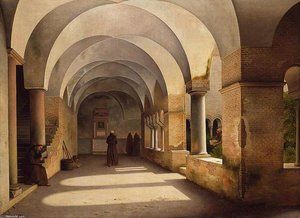 The Cloisters, San Lorenzo fuori le mura - Christoffer Wilhelm Eckersberg
Often celebrated as the "Father of Danish Painting," Christoffer Wilhelm Eckersberg (1783–1853) was the transformative force behind the Danish Golden Age. His influence defines the 19th century Danish painters group, as he transitioned the nation's artistic identity from rigid academicism toward a profound, observational realism. After studying in Copenhagen and refining his Neoclassical precision under Jacques-Louis David in Paris, Eckersberg returned to Denmark to reshape the Royal Danish Academy of Art, instilling a mastery of light and perspective in a generation of artists.
His 1824 masterpiece, The Cloisters, San Lorenzo fuori le mura, exemplifies this technical revolution. This work showcases his ability to marry Neoclassical clarity with a deep, atmospheric sensibility. Through a sophisticated command of linear perspective, Eckersberg leads the viewer through weathered Roman colonnades, using a muted palette of ochres and somber grays to create a sense of eternal stillness. The painting is a triumph of academic realism, where the interplay of light and shadow transforms architectural geometry into a contemplative, spiritual experience. By capturing both the structural precision of the environment and the quiet devotion of the monks within, Eckersberg established a standard of excellence that would characterize Danish art throughout the 1800s."
Kristian Zahrtmann
 Roser og reseda i et blomsterglas - Kristian Zahrtmann
A transformative figure in the evolution of Danish art, Kristian Zahrtmann (1843–1917) served as a vital bridge between the rigid traditions of Academicism and the emotive freedom of Expressionism. Born in Rønne, his journey through the Royal Danish Academy of Art allowed him to develop a style that challenged the conventions of the 19th century. His work is characterized by a profound mastery of color and a naturalistic approach that anticipated the modern movements of the coming era.
His versatility is strikingly evident in his representative work, Roser og reseda i et blomsterglas (1872). This still life, currently held in the Statens Museum for Kunst, demonstrates his ability to elevate botanical subjects through dramatic lighting and a sophisticated command of texture. By focusing on the interplay of light and shadow within a glass vessel, Zahrtmann showcases the bold, chromatic sensitivity that would define his legacy. Whether depicting historical narratives, such as his celebrated series on Leonora Christina, or intimate naturalistic studies, Zahrtmann remained a cornerstone of the 19th century Danish art scene, leaving an indelible mark on the generations of artists he mentored."
Nicolai Abildgaard
 The Greek Poet Sappho and the Girl from Mytilene - Nicolai Abildgaard
A foundational figure in the transition toward the modern era, Nicolai Abildgaard represents the bridge between the Enlightenment and the burgeoning Romanticism that defined 19th century Danish painters. Born in Copenhagen in 1743, his artistic identity was forged through rigorous training at the New Royal Danish Academy of Art, where he studied under masters like Johan Edvard Mandelberg. His career reached a transformative zenith during a pivotal five-year sojourn in Rome, where the study of classical antiquity and monumental frescoes shifted his focus toward grand-scale history painting.
Abildgaard’s legacy is most profoundly captured in his late masterpiece, The Greek Poet Sappho and the Girl from Mytilene. Created in 1809, this work exemplifies the sophisticated Neoclassical style while infusing it with a palpable sense of Romantic idealism. By blending the structured order of classical mythology with deep emotional resonance, he helped establish a visual language that would influence generations of Scandinavian artists. His ability to synthesize sculpture, architecture, and painting into a cohesive narrative makes him a central pillar of the artistic evolution seen in Denmark during this period.
Christen Købke
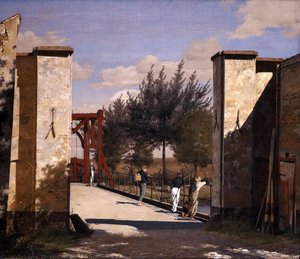 The North Gate of the Citadel - Christen Købke
A central figure of the Danish Golden Age, Christen Købke (1810–1848) remains one of the most evocative voices among 19th century Danish painters. Trained at the Royal Danish Academy of Fine Arts under the influential Christoffer Wilhelm Eckersberg, Købke translated his mentor's emphasis on direct observation into a deeply personal, nationalistic aesthetic. His work moved away from grand historical narratives to find profound beauty in the intimate details of Danish life, landscapes, and architecture.
His technical mastery is perhaps most visible in his 1834 work, The North Gate of the Citadel. In this piece, Købke captures a twilight symphony, using a sophisticated palette of muted greens and soft, atmospheric light to evoke the stillness of a Copenhagen dusk. His ability to balance the emotional depth of Romanticism with a precise, almost intuitive sensitivity to light prefigured many of the shifts seen later in the century. By focusing on the subtle textures of the natural world and the quietude of local landmarks, Købke helped define a visual identity for Denmark, leaving a lasting legacy that influenced a generation of successors, including the likes of Wilhelm Marstrand.
Conclusion
The 19th century was a transformative era for Danish art, a period where the quiet intimacy of Hammershøi’s interiors met the vibrant, light-filled landscapes of the Skagen painters. From the foundational precision of Eckersberg to the emotive, dramatic portraiture of Carl Bloch, these artists collectively defined a national visual identity that balanced rigorous academic technique with a profound connection to the Nordic soul. Whether capturing the rugged coastline of Michael Ancher or the delicate atmospheric nuances of Christen Købke, these masters moved through the century by translating the unique light and character of their homeland into timeless visual narratives.
At Mus3ums.com, we invite you to bring this storied heritage into your own living space. Our artisans specialize in creating museum-quality, hand-painted oil reproductions that capture the authentic texture and soul of these masterpieces. You can explore our full collection to find the perfect piece and experience the enduring beauty of Danish art through our bespoke, handmade craftsmanship.