

Introduction
The 19th century in Sweden was a period of profound transformation, where the quietude of Nordic landscapes met the burgeoning energy of modernism. As the nation transitioned from a traditional agrarian society toward an industrial era, its artists captured a unique tension between the romanticized natural world and the psychological depths of the human experience. This era was defined by a shift from the strict academicism of the early century toward the evocative light of Impressionism and the raw, emotive power of Expressionism, often shaped by the distinct, ethereal qualities of the Scandinavian light.
What unites these masters is a deep, almost spiritual connection to their environment and a desire to translate the specific atmosphere of the North—its long shadows, its crystalline winters, and its soft, summer twilight—onto the canvas. From the intimate, domestic scenes that celebrated Swedish life to the sweeping, dramatic vistas of the wilderness, these painters moved beyond mere representation to explore the very essence of mood and memory. Their work serves as a visual chronicle of a nation finding its modern identity through the lens of light and emotion.
Today, these artists remain vital because they pioneered a visual language that speaks to the universal complexities of existence. Whether through the delicate brushwork of a landscape or the intense, swirling textures of a psychological portrait, their influence continues to resonate in contemporary art. The following selection highlights ten essential figures who shaped this golden age, ranging from the masters of light and color to the pioneers of modern emotional depth, offering a journey through the soul of 19th century Swedish art.
Edvard Munch
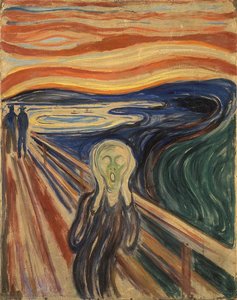 The Scream - Edvard Munch
Edvard Munch stands as a monumental figure within the context of 19th century Swedish painters due to his profound connection to the Nordic landscape and his birth in 1863, a period that defined his artistic evolution. While his legacy is often tied to the Norwegian psyche, his presence in the broader Scandinavian art movements of the late 1800s makes him an essential subject for understanding the era's shift toward psychological depth. His life was marked by early personal tragedies, including the loss of his mother and sister to tuberculosis, which infused his work with a haunting, existential weight.
His masterpiece, The Scream (1893), serves as the ultimate testament to this emotional intensity. In this work, Munch moves beyond mere representation to capture a profound internal turmoil. Through swirling, fiery oranges and deep, undulating blues, he depicts a gaunt figure reacting to an overwhelming sensation of nature's infinite cry. The composition, characterized by unsettling diagonal lines and rhythmic, rippling brushstrokes, dissolves the boundaries between the individual and the environment. It is a visceral exploration of anxiety and alienation that transformed the visual language of the 19th century.
Carl Larsson
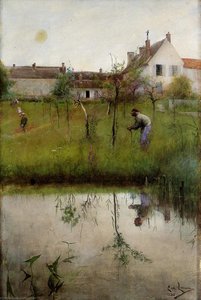 The Old Man and the New Trees - Carl Larsson
A central figure among 19th century Swedish painters, Carl Larsson (1853–1919) transitioned from a childhood of hardship in Stockholm's Gamla stan to becoming a master of the Arts and Crafts movement. His journey through the Royal Academy and his formative years in the Scandinavian artists' colony of Grez-sur-Loing allowed him to refine a style that captured the very essence of Swedish domesticity and light. Larsson is instantly recognizable through his luminous use of watercolor, a medium he embraced to achieve a transparency and atmospheric softness that oil often lacked.
His work often focuses on idyllic scenes of family life and the serene beauty of the natural world. In his 1883 watercolor, The Old Man and the New Trees, this mastery is on full display. The piece serves as a quiet meditation on resilience, using loose, blended brushstrokes to depict the dialogue between a weathered gardener and burgeoning saplings. Through a delicate interplay of sap green tones and diffused light, Larsson captures fleeting, tranquil moments, cementing his legacy as a painter who could transform the simplicity of everyday existence into profound visual poetry.
Anders Zorn
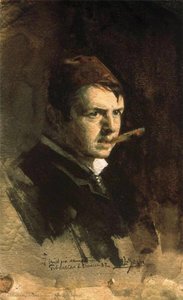 Self-portrait - Anders Zorn
Born in 1860, Anders Zorn emerged as a central figure among 19th century Swedish painters, bridging the gap between rustic tradition and international Impressionism. His journey began in the rural landscapes of Dalarna, where a childhood spent on a family farm instilled a profound connection to Swedish life—a theme that would define his career. This deep-rooted authenticity allowed him to transition seamlessly from capturing the essence of peasant life to painting the global elite, including US Presidents and European royalty.
His 1882 Self-portrait serves as a vital window into this transformative period. Executed in delicate watercolor, the work reveals a young artist of immense technical promise. Rather than focusing on rigid, photographic detail, Zorn utilized a loose, spontaneous approach to light and shadow, prioritizing the atmospheric mood over mere likeness. This mastery of the medium, which he refined early in his career, allowed him to capture fleeting moments of light with a sensitivity that would eventually earn him worldwide acclaim. By blending the raw vitality of his Swedish origins with a sophisticated, modern technique, Zorn remains a definitive representative of the artistic evolution occurring in Sweden throughout the 19th century."
August Malmström
 Title in Swedish: Älvalek - August Malmström
A central figure in the 19th century Swedish painters movement, August Malmström (1829–1901) dedicated his life to capturing the mystical soul of his homeland. His work is a cornerstone of National Romanticism, bridging the gap between the natural world and the supernatural legends of Scandinavia. Malmström’s ability to weave folklore into fine art is perhaps most vividly realized in his 1866 masterpiece, Älvalek. In this ethereal composition, the boundaries of the physical landscape dissolve into myth, as moonlit mists transform into dancing elves performing a nocturnal ring dance by a serene river. This capacity to personify the landscape through Norse mythology and folklore defines his unique contribution to the Swedish art of this era.
Beyond his canvases, Malmström was a highly influential academic, serving as a professor and manager at the Royal Swedish Academy of Arts. His creative reach extended into the domestic sphere through his intricate illustrations for Frithiofs Saga and his decorative designs for Gustavsberg porcelain. Whether depicting the innocence of childhood or the shadows of ancient sagas, his brushwork remains deeply rooted in the romantic spirit that characterized the Swedish artistic identity throughout the 1800s.
August Strindberg
 Title in Swedish: Underlandet - August Strindberg
In the evocative Underlandet, created in 1894, the boundaries between the physical landscape and the subconscious dissolve into a visionary dreamscape. This work exemplifies the restless, experimental spirit of August Strindberg, a figure who stands as a cornerstone of 19th century Swedish painters due to his profound impact on the nation's cultural identity. While celebrated as the father of modern Swedish literature for works like The Red Room, Strindberg’s visual output was equally transformative, driven by a desire to capture the raw essence of existence.
His approach to the canvas was as radical as his naturalistic dramas, such as Miss Julie. In Underlandet, he eschews traditional brushwork in favor of a tactile, sculptural technique using the palette knife. This method allows colors to bleed and merge, creating a dense, shadowy forest where delicate roses and fleeting birds emerge from thick, rhythmic layers of paint. His palette often leans into deep, dramatic tones, capturing a sense of psychological depth and melancholic beauty. Through this improvisational style, Strindberg transformed the Swedish landscape into a stage for the human psyche, bridging the gap between realism and expressionism.
Uno Troili
 An Italian woman spinning flax - Uno Troili
In his 1847 work, An Italian woman spinning flax, Uno Troili demonstrates a profound command over light and shadow, a hallmark of his contribution to 19th century Swedish painting. The composition centers on a young woman positioned within a dark, arched architectural niche, where a bright white headscarf creates a striking contrast against the deep, espresso-toned shadows. Her red bodice provides a singular, warm focal point amidst a palette of muted ochre and earthy browns. The artist utilizes a realist technique, employing thick applications of paint to render the coarse texture of the flax and the soft, lifelike skin tones of the subject.
Born in 1815 in Ransäter, Troili’s artistic journey was shaped by both academic rigor and military discipline. After entering the Royal Swedish Academy of Fine Arts in 1827, he transitioned from a student to a master of psychological portraiture. His ability to capture the quiet, introspective dignity of his subjects—ranging from the Swedish elite to humble laborers—solidified his place among the most significant Swedish artists of the 1800s. Through his meticulous attention to detail and the interplay of directional light, Troili transformed simple domestic tasks into moments of profound, somber beauty.
Carl Gustaf Hellqvist
 Title in Swedish: Valdemar Atterdag brandskattar Visby 1361 - Carl Gustaf Hellqvist
In his 1882 masterpiece, Valdemar Atterdag brandskattar Visby 1361, Carl Gustaf Hellqvist captures a moment of profound tension and existential dread. The canvas depicts the harrowing ultimatum delivered by the Danish King Valdemar Atterdag to the Hanseatic city of Visby, creating a scene where the air feels thick with the weight of impending desperation. This work, which earned Hellqvist a gold medal in Vienna, exemplifies his ability to blend meticulous historical detail with the soaring liberties of romanticized storytelling, turning a medieval siege into a visceral human drama.
A prominent figure among 19th century Swedish painters, Hellqvist’s career was marked by a deep fascination with the dramatic turning points of his nation's past. His education at the Swedish Royal Academy of Fine Arts in Stockholm provided the foundation for a style characterized by intense emotionality and historical realism. Whether portraying the tragic death of Sten Sture the Younger on the ice of Lake Mälaren or the political turmoil of the Vasa era, his palette and composition were designed to evoke the grandeur and chaos of history. Though his life was tragically cut short in Munich at the age of 38, his legacy remains anchored in his ability to transform historical chronicles into living, breathing spectacles of light and shadow.
Johan Edvard Bergh
 In the Forest - Johan Edvard Bergh
A prominent figure among 19th century Swedish painters, Johan Edvard Bergh (1828–1880) transitioned from a career in law to become a master of the Düsseldorf School. After earning a master's degree in 1849, he abandoned the legal profession to pursue the visual arts, traveling through Switzerland and Italy before refining his technique at the Kunstakademie Düsseldorf. Under the guidance of the Norwegian romanticist Hans Gude, Bergh developed a sophisticated ability to capture the emotive and dramatic qualities of the natural world.
His work is characterized by an idyllic yet somber portrayal of the Nordic landscape, often focusing on the interplay of light and shadow within dense woodlands and coastal settings. In his 1868 work, In the Forest, Bergh demonstrates his mastery of scale and atmosphere. The composition utilizes a low vantage point to emphasize the verticality of towering evergreen trees, while small human figures provide a sense of proportion against the immense timber. Through a palette of deep earth tones and espresso shadows, he creates a sense of quiet, immersive enclosure that defines his contribution to the Swedish romantic tradition.
Hanna Hirsch-Pauli
 Title in Swedish: Frukostdags - Hanna Hirsch-Pauli
A significant figure among 19th century Swedish painters, Hanna Hirsch-Pauli brought a sophisticated, international perspective to the Nordic art scene. Born in Stockholm in 1864, her artistic journey took her from the August Malmström School of Painting for Women to the prestigious Konstakademien, eventually leading her to the vibrant art circles of Paris. This exposure to French influence allowed her to develop a style that masterfully bridged the gap between traditional realism and the burgeoning Impressionist movement.
Hirsch-Pauli is celebrated for her evocative genre scenes and intimate portraits that capture the quiet dignity of domestic life. Her 1887 masterpiece, Frukostdags (Breakfast-Time), serves as a profound testament to her ability to transform a mundane morning ritual into a luminous, sensory experience. Through her brush, the simple act of sharing a meal becomes a dance of dappled sunlight and shimmering textures. Beyond her technical prowess, her work carries a subtle feminist resonance; by depicting women within their private spheres with such agency and grace, she offered a progressive gaze upon the social structures of 19th-century Sweden. Her legacy remains etched in the halls of the Nationalmuseum, preserved through works that celebrate both the warmth of friendship and the elegance of the everyday.
Richard Bergh
 The artist Eva Bonnier - Richard Bergh
A pivotal figure in the evolution of Swedish art, Richard Bergh (1858–1919) represents the sophisticated transition from academic tradition to modern symbolism. His journey began at the Royal Swedish Academy of Fine Arts, but his artistic soul was truly shaped in Paris under Jean-Paul Laurens. As a leading member of the Opponenterna, Bergh challenged the rigid structures of the Academy, eventually coining the concept of stämningsmåleri, or "mood painting." This subjective approach moved beyond mere realism to capture the psychological essence of a moment, a hallmark of late 19th-century Nordic expression.
His work often eschewed the fleeting light of Impressionism in favor of a profound Naturalism and a later, evocative Romantic Nationalism. This is masterfully demonstrated in his 1889 portrait, The Artist Eva Bonnier. In this somber and contemplative piece, Bergh avoids traditional professional attributes, choosing instead to depict the subject within a domestic setting. The composition, characterized by a dark, moody palette and a sense of deep thought, exemplifies his ability to infuse portraiture with a dramatic, atmospheric tension that defined the era's aesthetic shift.
Conclusion
The 19th century was a transformative era for Swedish art, a period where the raw emotional intensity of Munch met the domestic warmth of Carl Larsson and the luminous, water-drenched realism of Anders Zorn. These artists collectively moved beyond mere representation, capturing the profound shifts in the Nordic soul—from the psychological depths of Symbolism to the light-filled clarity of the Swedish landscape. Whether through the dramatic storytelling of Malmström or the intimate, textured portraits of Hirsch-Pauli, this group of masters defined a national visual identity that continues to resonate across borders.
At Mus3ums.com, we invite you to bring this rich heritage into your own living space. Our master artists specialize in creating museum-quality, hand-painted oil reproductions that preserve the unique brushstrokes and tonal depth of these Swedish legends. You can explore our full collection to find the perfect piece and experience the enduring beauty of these masterpieces through our bespoke, fine-art craftsmanship.