
Introduction
The 19th century was a transformative era for Irish art, a period where the landscape of the island and the complexities of its identity were captured through evolving visual languages. From the romanticized, dramatic vistas of the early century to the more nuanced, light-drenched observations of the later years, these painters were united by a profound connection to their surroundings and a constant dialogue with the shifting currents of European art movements. Their work reflects a nation in transition, moving from the grand, sweeping narratives of Romanticism toward the intimate, psychological depth of portraiture and the atmospheric precision of Impressionist-influenced styles.
During this time, Irish artists navigated a unique cultural position, often blending local sensibilities with the academic traditions of London, Paris, and Rome. This duality allowed for a rich stylistic diversity, ranging from the meticulous detail of historical scenes to the expressive, textured brushwork that sought to capture the very essence of light and shadow. Their ability to translate the rugged topography of the Irish coast and the quiet dignity of its people into enduring visual poetry ensures their continued relevance in the modern art world.
Today, these masters remain vital for understanding the evolution of Western art, offering a window into the soul of a century defined by both struggle and profound creative awakening. By examining the legacies of figures such as Francis Danby, Paul Kane, and William Orpen, we begin to uncover the diverse voices that shaped this remarkable artistic heritage. The following selection explores ten essential painters who defined the aesthetic spirit of 19th century Ireland.
William Orpen
 Lady on a Couch - William Orpen
Born in Stillorgan, County Dublin, in 1878, William Orpen emerged as a preeminent figure among 19th century Irish painters. His journey began in a creative household, leading him to the Dublin Metropolitan School of Art, where his precocious talent was recognized through a series of major awards and a gold medal for life drawing. This rigorous Irish training provided the technical foundation for his later studies at the Slade School of Art in London, where he refined a sophisticated command of light and form under the guidance of Henry Tonks.
His work Lady on a Couch (1900) serves as a profound testament to his mastery of the Edwardian aesthetic. In this piece, Orpen captures a moment of hushed, opulent domesticity, where the subject reclines amidst a landscape of rich textures and muted tones. The painting demonstrates his ability to balance academic precision with a burgeoning impressionistic freedom, using layered oil washes to create a luminous, ethereal glow. Through the delicate interplay of shadow and light, Orpen transforms a scene of leisure into a deep, melancholic study of introspection and grace.
James Francis Danby
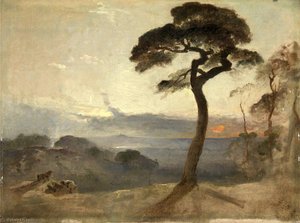 Hampstead Heath, Sunset - James Francis Danby
Born in County Wexford in 1793, James Francis Danby stands as a quintessential figure among 19th century Irish painters, bridging the gap between his Celtic origins and the height of the British Romantic movement. His artistic journey began in Dublin, where he received foundational training at the Royal Dublin Society's schools under James Arthur O’Connor, a period that instilled in him a lifelong ability to use the landscape as a vessel for profound emotional resonance.
A viewer can recognize Danby’s hand through his mastery of atmospheric intensity and the dramatic interplay of light and shadow. His work often eschews rigid outlines in favor of loose, expressive brushstrokes and a sophisticated use of impasto to create tactile depth. In his representative work, Hampstead Heath, Sunset (1845), this technique is strikingly evident. The composition utilizes luminist effects to simulate light filtering through a hazy atmosphere, casting golden streaks across a vast, undulating terrain. By employing atmospheric perspective, Danby captures a sense of melancholic quietude, where the verticality of a solitary pine tree anchors a wide, expansive horizon, inviting the observer into a moment of transient, natural beauty.
William Harnett
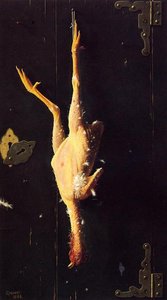 For Sunday's Dinner - William Harnett
Born in Clonakilty, County Cork, Ireland, William Michael Harnett represents the profound impact of Irish birth on the development of 19th-century realism. Although his career flourished in the United States after his emigration to Philadelphia, his artistic DNA remains rooted in his Irish origins. Harnett became a master of trompe-l'œil, a technique designed to deceive the eye by creating a startling illusion of three-dimensional reality on a flat canvas.
A viewer can recognize a Harnett masterpiece at a glance through his hyper-realistic rendering of mundane, everyday objects. His work often features items such as tobacco pouches, newspapers, pipes, or musical instruments, all captured with a precision that borders on the hallucinatory. He utilizes sophisticated shading and a meticulous attention to texture—learned during his early years engraving table silver—to manipulate light and perspective. In his representative work, For Sunday's Dinner, he demonstrates this uncanny ability to transform simple tabletop items into a dramatic, tactile experience. His brushwork is so controlled that the boundary between paint and physical reality seems to dissolve, leaving the observer questioning the very nature of the image before them.
Sir Martin Archer Shee
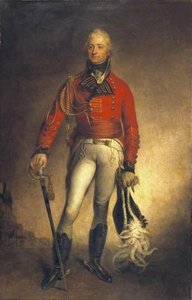 Lieutenant General Sir Thomas Picton - Sir Martin Archer Shee
Born in Dublin in 1769, Sir Martin Archer Shee represents a vital link in the lineage of 19th century Irish painters. His journey from the Royal Dublin Society to the highest echelons of the British art establishment illustrates the profound influence Irish talent exerted on the Regency era. After a transformative introduction to Joshua Reynolds, Shee’s ascent was meteoric; he transitioned from a promising student to a full member of the Royal Academy by 1800, eventually serving as its President.
His mastery of the neoclassical style is epitomized in his 1812 work, Lieutenant General Sir Thomas Picton. This portrait serves as a profound study of psychological presence and military dignity. Through the meticulous application of oil glazes, Shee captures the weight of the subject's scarlet uniform and the unwavering gaze of a commander shaped by the Napoleonic Wars. The painting moves beyond simple likeness, utilizing a subdued background to emphasize the sitter's moral fortitude and social station. By blending technical precision with an elegant sensitivity, Shee solidified his reputation as a premier portraitist, ensuring his place as a central figure in the artistic landscape of the 19th century."
Roderic O'Conor
 Yellow Landscape - Roderic O'Conor
Born in County Roscommon in 1860, Roderic O'Conor stands as a vital figure among 19th century Irish painters, representing the bridge between traditional academic training and the radical innovations of the European avant-garde. While his lineage traced back to the kings of Connacht, his artistic identity was forged in the studios of Antwerp and the vibrant, light-drenched streets of Paris. His work is instantly recognizable by its intense, rhythmic energy and a sophisticated approach to color that moves beyond simple representation into the realm of Post-Impressionism.
A visitor can identify an O'Conor through his masterful use of textured brushwork and a palette that vibrates with life. In his 1892 masterpiece, Yellow Landscape, he demonstrates a profound command of Pointillism. Rather than using flat washes, he constructs the pastoral scene through a meticulous tapestry of distinct dots and broken strokes. This technique allows light to dance across the rolling hills, using optical blending to create a sense of depth and atmosphere that feels both serene and electrically alive. His ability to synthesize the lessons of Impressionism with the structural boldness of the Pont-Aven school marks him as a truly modern voice of his era."
Paul Kane
 Flathead woman with child - Paul Kane
Born in Mallow, County Cork, in 1810, Paul Kane represents a vital link in the history of 19th century Irish painters, though his legacy is inextricably tied to the vast landscapes of North America. After moving to Upper Canada, his artistic journey took him from the decorative arts to the grand traditions of Europe. During a transformative voyage through France and Italy, he meticulously studied the Old Masters, absorbing the techniques of Raphael and Murillo. This classical foundation, combined with a profound encounter with the works of George Catlin, redirected his gaze toward the Indigenous cultures of the West.
His representative work, Flathead woman with child (c. 1848), serves as a poignant testament to his ability to capture human connection within a specific cultural landscape. In this intimate portrait, Kane utilizes a warm, earthy palette of ochre and deep browns to render the silhouette of Caw-Wacham, a woman of the Flathead tribe, as she cradles her infant. The composition, a quiet medium close-up, emphasizes the maternal bond against a naturalistic backdrop, showcasing the Romantic sensibility that defined his unique contribution to the 19th-century artistic canon.
Stanhope Forbes
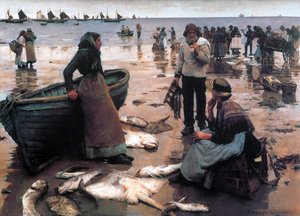 A Fish Sale on a Cornish Beach - Stanhope Forbes
Born in Dublin to an Irish-French heritage, Stanhope Forbes remains a cornerstone of 19th-century Irish painting, bridging the gap between academic tradition and the vibrant Impressionism of the Newlyn School. His work is instantly recognizable by its profound commitment to plein-air observation, where the fleeting effects of light meet the gritty, earthy realities of coastal life. Eschewing grand mythological themes, Forbes focused his brush on the rhythmic, everyday movements of working communities, utilizing a palette that captures the shimmering textures of wet sand and the heavy, functional fabrics of maritime attire.
In his representative masterpiece, A Fish Sale on a Cornish Beach (1885), Forbes masterfully orchestrates a scene of intense local industry. The composition captures a lively auction on the shoreline, where the glisten of the receding tide acts as a mirror for the pale sky. Through expert tonal modeling, he depicts fishermen in oilskins and women in woollen shawls, all caught in a spontaneous moment of social and economic exchange. His technique, refined under the influence of Parisian masters, allows the viewer to feel the salt air and the energetic hum of the crowd, immortalizing the soul of the coast.
William Mulready
 Carghill and Touchwood - William Mulready
Born in Ennis, County Clare, in 1786, William Mulready stands as a cornerstone of the 19th century Irish painters group. His journey from the quiet landscapes of Ireland to the prestigious Royal Academy School in London allowed him to evolve from a gifted landscape artist into a master of Victorian genre painting. His work is characterized by a profound ability to translate human temperament and social tension into visual narratives, a skill honed through a lifelong devotion to observing the nuances of character and the play of light in domestic settings.
In his significant 1831 work, Carghill and Touchwood, Mulready demonstrates the dramatic precision that defined his mature period. This oil on panel, inspired by the literature of Sir Walter Scott, captures a tense, silent encounter between the Reverend Josiah Cargill and the intrusive Peregrine Touchwood. Through masterful composition, he transforms a literary moment into a psychological study, utilizing a rich palette to highlight the contrast between stillness and theatrical intrusion. His legacy is not merely found in these intimate scenes of everyday life, but also in his iconic design for Mulready stationery, which left an indelible mark on the visual culture of the era.
Francis Danby
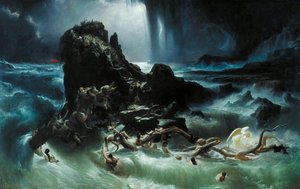 The Deluge - Francis Danby
A central figure of the Romantic movement, Francis Danby represents the profound emotional depth found among 19th century Irish painters. Born in County Wexford in 1793, his artistic identity was forged through early training in Dublin under George Petrie and James Arthur O'Connor. This foundation in Irish landscape traditions, combined with his later association with the Bristol School, allowed him to master the atmospheric and dramatic compositions that define his legacy.
His mastery of light and chaos is most powerfully realized in The Deluge. This 1840 masterpiece serves as a testament to his ability to translate biblical upheaval into visual poetry. The work depicts a world in turmoil, where churning waves and a blood-red sunset collide with the terrifying force of a rising tide. Through the use of dramatic chiaroscuro, Danby captures the tension between divine wrath and the desperate struggle for survival, exemplified by the distant, moonlight-touched Ark. The composition is not merely a depiction of a storm, but a profound exploration of human vulnerability against the sublime power of nature, a hallmark of the Romantic era.
Thomas Hovenden
 Breaking Home Ties - Thomas Hovenden
Born in County Cork in 1840, Thomas Hovenden represents a profound connection between Irish origins and the development of 19th-century realism. His journey from the hardships of the Great Famine in Ireland to the prestigious École des Beaux Arts in Paris shaped a vision defined by empathy and technical precision. After immigrating to the United States in 1863, he became a significant figure in American art, known for his dignified portraiture and his influential role as a teacher at the Pennsylvania Academy of the Fine Arts.
Hovenden’s work is characterized by a somber, dramatic realism that captures the quiet tensions of human existence. His masterpiece, Breaking Home Ties (1890), serves as a poignant example of his ability to document social shifts. The painting depicts the heavy atmosphere of a rural household as a young man prepares to depart for the city, illustrating the inevitable fracture of domestic life caused by economic necessity. Through his meticulous use of light and texture, Hovenden transformed personal and social realities into enduring visual narratives, cementing his legacy as a vital voice among 19th-century painters from Ireland.
Conclusion
The 19th century was a transformative era for Irish art, a period where the movement from romanticized landscapes to the nuanced psychological depth of portraiture and the bold strokes of impressionism took hold. From the evocative, atmospheric scenes of Francis Danby to the meticulous precision of William Orpen, these artists collectively captured the soul of a nation in flux, blending technical academic excellence with a uniquely Celtic sensibility. Whether through the dramatic light of a landscape or the intimate character of a portrait, these masters left an indelible mark on the history of European painting.
At Mus3ums.com, we invite you to bring this rich heritage into your own living space. You can explore our full collection to find your favorite piece from this illustrious group. Our master artists specialize in creating museum-quality, hand-painted oil reproductions that preserve the authentic texture and emotional resonance of these historical masterpieces, allowing you to live with the beauty of Irish art every day.


