
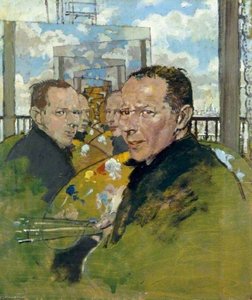
Introduction
The 20th century marked a profound transformation for Irish art, as painters moved beyond traditional landscapes to engage with the turbulent shifts of modernity, identity, and the human psyche. This era saw a departure from purely academic realism toward the bold experimentation of Fauvism, the structural rigor of Cubism, and the visceral intensity of Expressionism. As the geopolitical landscape of the island evolved, so too did the visual language of its creators, who navigated the tension between deep-seated cultural heritage and the avant-garde movements emerging from continental Europe.
What unites these artists is a shared spirit of defiance and reinvention. Whether working from the streets of Dublin or the studios of Paris, they sought to capture the essence of a changing world through diverse techniques—from the delicate, light-drenched brushwork of early modernists to the distorted, emotive textures of mid-century masters. Their work remains vital today because it captures the very moment when Irish visual identity broke free from historical constraints to join the global dialogue of modern art.
In the following sections, we trace this evolution through ten significant figures, including the hauntingly powerful works of Francis Bacon and the masterful compositions of William Orpen, exploring how each artist contributed to the rich, complex tapestry of Irish painting during this transformative century.
Francis Bacon
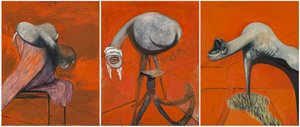 Three Studies for Figures at the Base of a Crucifixion - Francis Bacon
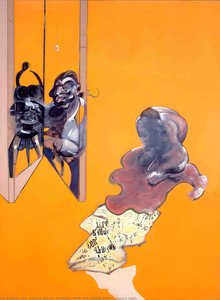
Born in Dublin in 1909, Francis Bacon remains one of the most formidable figures among 20th century Irish painters. His early years in the Irish countryside, marked by severe asthma and a sense of confinement, deeply informed the claustrophobic intensity of his later work. Eschewing traditional art school training in favor of a self-directed education, Bacon moved to London at seventeen, eventually becoming a central figure in the European bohemian scene as he drifted through Berlin and Paris.
His work is defined by a visceral, expressionist energy, often featuring distorted figures trapped within geometric space-frames. This is most powerfully realized in his 1944 triptych, Three Studies for Figures at the Base of a Crucifixion. In this seminal piece, Bacon subverts the traditional religious altarpiece to explore existential angst and human suffering. Rather than providing spiritual solace, the work presents bulbous, tormented archetypes against searing backdrops, channeling the collective trauma of a world transformed by war. Through his mastery of raw, impasto textures and abstracted forms, Bacon transitioned from a decorator of interiors to a leading voice of modern existentialism, leaving an indelible mark on the landscape of 20th-century art."
William Orpen
 Winston Churchill - William Orpen
A central figure among 20th century Irish painters, William Orpen transitioned from a precocious talent in Dublin to a master of the Edwardian era. His artistic journey began at the Dublin Metropolitan School of Art, where his technical command of the human form earned him prestigious accolades, including the British Isles gold medal for life drawing. This rigorous foundation allowed him to flourish later at the Slade School of Art under the guidance of Henry Tonks and Philip Wilson Steer, moving his practice toward a sophisticated mastery of light and shadow.
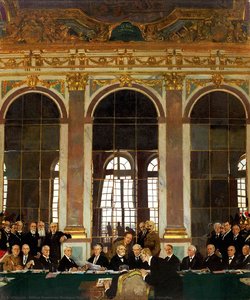
Orpen’s legacy is defined by his ability to capture the psychological weight of his subjects, a skill that elevated his status as a premier portraitist and war artist. His 1916 work, Winston Churchill, serves as a profound example of this capability. In this portrait, he moves beyond mere likeness to present a study of character forged in crisis, capturing the statesman with a resolute, almost defiant presence. Through his evocative brushwork and ability to navigate the complexities of the human soul, Orpen remains a vital link in the history of Irish art during the early decades of the twentieth century.
Roderic O'Conor
 Rest - Roderic O'Conor
Roderic O'Conor stands as a vital bridge between the traditional academic training of the 19th century and the vibrant modernism that defined 20th century Irish painters. Born in County Roscommon in 1860, his artistic evolution saw him move from the formal structures of the Royal Hibernian Academy in Dublin to the revolutionary art circles of Paris and Pont-Aven. By embracing the Post-Impressionist movement, O'Conor infused his work with a bold, textured approach to light and color that broke away from mere imitation, establishing a sophisticated visual language that resonated throughout the early 1900s.
His masterpiece, Rest, created around 1904, exemplifies this mastery of form and atmosphere. In this evocative oil on canvas, O'Conor captures a seated woman in a moment of profound stillness. The composition utilizes a subtle asymmetry to create a sense of quietude, drawing the viewer into an intimate encounter with the subject. The palette is a rich tapestry of earthy tones, dominated by deep reds and ochre, which lends the work a serene, weightful presence. Through his expressive brushwork, O'Conor transforms a simple moment of repose into a profound study of color and light.
Stanhope Forbes
 John Tucker Murray (1876-1956) - Stanhope Forbes
Born in Dublin, Stanhope Forbes represents a vital link between Irish heritage and the evolution of modern Impressionism. His inclusion in the canon of 20th century Irish painters is defined by his ability to translate a European sensibility into the intimate, light-drenched realities of coastal life. After formal training at the Royal Academy Schools, his artistic trajectory was fundamentally altered by his studies under Léon Bonnat in Paris. This period instilled in him a mastery of tonal modeling and direct observation that would become his signature.
A pivotal figure in the Newlyn School, Forbes moved away from grand historical narratives to embrace the profound beauty of the everyday. His work captures the rhythmic existence of fishermen and the quiet domesticity of working communities with remarkable sensitivity. In his 1913 work, John Tucker Murray, we see this commitment to capturing a moment of profound stillness. Through a sophisticated use of light and shadow, he elevates the ordinary to the level of high art, ensuring his legacy as a master of the plein-air tradition who bridged the gap between academic rigor and the vibrant, fleeting impressions of the modern era.
Thomas Johnson Westropp
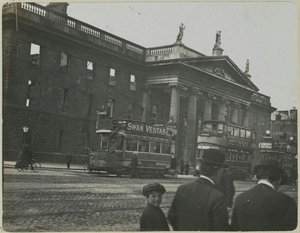 The GPO, Sackville Street - Thomas Johnson Westropp
A scholar-artist whose work bridges the gap between meticulous engineering and evocative documentation, Thomas Johnson Westropp (1860–1922) remains a vital figure among 20th century Irish painters and illustrators. Although trained in civil engineering at Trinity College Dublin, Westropp’s true vocation lay in the preservation of Ireland’s physical and cultural soul. His transition from surveyor to antiquarian allowed him to document the nation's topography and folklore with a precision that few could match, ensuring his place in the 20th-century Irish canon through his profound contributions to the historical visual record.
His representative work, The GPO, Sackville Street (1916), serves as a hauntingly beautiful testament to a nation in transition. Captured in the wake of the Easter Rising, this work transcends mere documentation; it is a poignant study of resilience. Through his lens and sketches, Westropp captured the stark reality of Dublin’s urban landscape—the rubble of the General Post Office juxtaposed against the persistent movement of daily life. His ability to blend the technical accuracy of a surveyor with the sensitive eye of a folklorist allowed him to preserve the textures of a changing Ireland, making his visual legacy an essential part of the country's early 20th-century identity.
Sean Scully
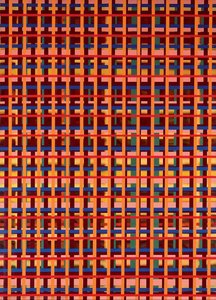 Red Light - Sean Scully
Born in Dublin in 1945, Sean Scully stands as a vital figure among 20th century Irish painters, representing a bridge between European tradition and American abstraction. His journey began in London before he pursued formal training at the Croydon College of Art and Newcastle University. A transformative fellowship at Harvard University introduced him to the United States, a move that eventually led to his becoming a US citizen and a central figure in the New York art scene. His work is characterized by a profound synthesis, blending the rigorous geometry of Minimalism with the emotional, painterly depth found in the legacies of Matisse and Mondrian.
In his representative work, Red Light (1971), Scully explores the tension between chaos and control. This piece serves as a rhythmic dialogue of color and structure, utilizing a systematic construction of layered paint to create a sense of spatial illusion. Through the use of masking tape and heavy rollers, he builds a tactile, grid-based surface that feels both architectural and deeply human. His ability to transform simple stripes and squares into complex, luminous compositions ensures his place as a master of contemporary abstraction.
Phoebe Anna Traquair
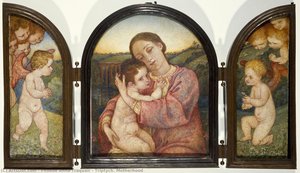 Triptych. Motherhood - Phoebe Anna Traquair
Born in Dublin in 1852, Phoebe Anna Traquair stands as a vital link between the late Victorian era and the burgeoning modernism of the 20th century. As an Irish-born artist who achieved international prominence, her influence extended deep into the 20th century through her leadership in the Arts and Crafts movement. Her work transcends simple painting, encompassing large-scale murals, intricate embroidery, and book illuminations that define the ethereal aesthetic of the period.
In her evocative work, Triptych. Motherhood (1902), Traquair demonstrates the profound spiritual depth that characterizes her contribution to the era. This masterpiece serves as a tender meditation on maternal devotion, blending the sacred with the earthly. The central scene, featuring a mother and child set against a serene landscape, is enriched by subtle Celtic interlacing on a vibrant red garment—a detail that highlights her mastery of pattern and texture. Through this rhythmic, symbolic approach, Traquair’s art captures the romantic and soulful essence of early 20th-century craftsmanship, bridging the gap between ancient Celtic heritage and the modern decorative arts.
Ronald Ossory Dunlop
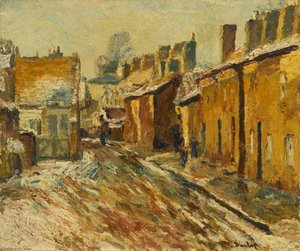 Snow at Stratford on Avon - Ronald Ossory Dunlop
Born in Dublin in 1894, Ronald Ossory Dunlop stands as a vital figure among 20th century Irish painters, bridging the gap between the mystical Irish Literary Renaissance and the avant-garde movements of London. Raised in an environment shaped by the spiritualist currents of W.B. Yeats, Dunlop’s aesthetic was deeply informed by the intellectual atmosphere of his native Ireland. His artistic journey took him from the studios of Paris to the heart of the London Group, yet his work remained anchored in a profound, subjective expression of life.
A master of the alla prima technique, Dunlop was known for his ability to apply paint directly to the canvas in a single, exuberant session, capturing the essence of a moment before it vanished. This spontaneous energy is masterfully realized in his 1940 work, Snow at Stratford on Avon. In this piece, he moves beyond mere landscape to achieve what he termed "Emotionism," using bold brushwork and a sophisticated handling of light to transform a quiet winter street into a study of atmospheric stillness. Through his vibrant palettes and textured surfaces, Dunlop translated the ephemeral beauty of the world into a lasting emotional experience.
Augustus Saint-Gaudens
 Abraham Lincoln - Augustus Saint-Gaudens
Born in Dublin in 1848, Augustus Saint-Gaudens represents a vital link in the lineage of Irish-born artists whose influence spanned the Atlantic. Although his career reached its zenith during the late 19th century, his legacy and the continued study of his monumental works remained a cornerstone of the artistic discourse well into the 20th century. His transition from a young apprentice in New York to a master of the Beaux-Arts style in Paris and Rome allowed him to fuse classical European traditions with a burgeoning American identity, a synthesis that would define the sculptural language of the early 1900s.
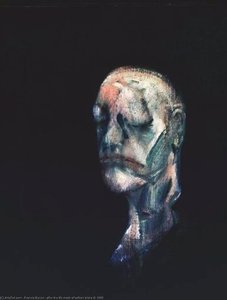
His technical mastery is profoundly captured in the 1923 bronze bust, Abraham Lincoln. This work serves as a poignant study of character, moving away from the colossal scale of civic monuments to offer an intimate, somber gaze. By utilizing life casts to anchor the facial features in reality, Saint-Gaudens achieved a level of naturalism that captured the heavy, contemplative weight of the subject. The downward tilt of the head and the meticulous rendering of the beard and brow create a sense of permanence, immortalizing a moment of quietude in bronze.
Frederick Wilson
 Cartoon for window, Wycliffe, St. John's Chapel Episcopal Divinity School, Cambridge, Massachusetts - Frederick Wilson
The Cartoon for window, Wycliffe, St. John's Chapel Episcopal Divinity School, Cambridge, Massachusetts (1912) serves as a profound testament to the technical precision and visionary design of Frederick Wilson. This full-scale adaptation, rendered with striking dark blue lines to indicate the placement of lead cames, captures the essence of the reformer John Wycliffe. The work showcases a sophisticated mastery of composition, utilizing a palette where gray tones and intricate linework prepare the viewer for the luminous complexity of the final glass installation.
Born in Dublin to English parents, Wilson’s artistic journey began in the rich craftsmanship traditions of Ireland, a foundation that propelled him toward international acclaim. His career is defined by a seamless fusion of Gothic Revival structure and the fluid elegance of Art Nouveau. While his legacy is deeply intertwined with the prestige of the Tiffany Studios in New York, his unique ability to blend decorative objects like chandeliers with monumental ecclesiastical windows set him apart. As an artist whose professional peak and influential designs flourished throughout the early 20th century, Wilson remains a vital figure in the history of Irish-born masters who shaped the aesthetic landscape of both Britain and America.
Conclusion
The legacy of 20th century Irish painters is defined by a profound tension between tradition and the radical avant-garde. From the visceral, distorted psychological landscapes of Francis Bacon to the delicate, light-infused compositions of William Orpen, these artists navigated a century of immense cultural transformation. Whether through the structural abstraction of Sean Scully or the expressive portraiture of the era, each master contributed a unique visual language that helped define a modern national identity while engaging with global movements like Impressionism and Cubism.
At Mus3ums.com, we invite you to bring this rich heritage into your own space. Our master artists specialize in creating museum-quality, hand-painted oil reproductions that capture the authentic texture and soul of these iconic works. You can explore our full collection to find a piece of Irish art history that resonates with your personal aesthetic and live with these masterpieces every day.