
Introduction
The dawn of the 20th century in Vienna and the surrounding Austrian territories sparked a profound psychological and aesthetic revolution that fundamentally altered the course of modern art. At the heart of this transformation was a tension between the ornate, decorative traditions of the past and a raw, visceral urge to explore the subconscious, the human form, and the complexities of the modern soul. This era was defined by a radical departure from academic realism, as artists sought to capture not just the visible world, but the internal emotional landscapes of a society undergoing rapid industrialization and profound cultural shifts.
Central to this movement was the tension between the golden, symbolic elegance of the Secession and the provocative, often unsettling explorations of Expressionism. These painters navigated a world of intense intellectual ferment, where the boundaries of identity, sexuality, and spirituality were being constantly redrawn. Their work remains vital today because it laid the groundwork for much of contemporary visual language, challenging viewers to confront the beautiful, the grotesque, and the existential with unprecedented honesty.
This exploration of the Austrian avant-garde will guide you through the diverse legacies of ten pivotal figures. From the shimmering, mosaic-like compositions of Gustav Klimt to the intense, distorted lines of Egon Schiele, we examine the masters who defined a century of unparalleled creative courage.
Gustav Klimt
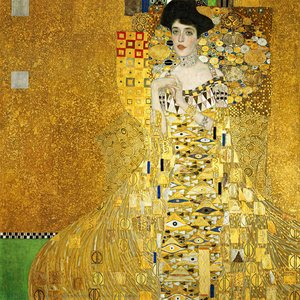 Portrait of Adele Bloch-Bauer I - Gustav Klimt
A central figure of the 20th century Austrian painters, Gustav Klimt transformed the visual language of Vienna through a radical departure from academic tradition. Born in Baumgarten, his early life was deeply influenced by his father’s work as a gold engraver, a connection to precious metals that would later define his most iconic aesthetic. After training at the Vienna Kunstgewerbeschule under Ferdinand Laufberger, Klimt initially mastered the structured discipline of architectural decoration. However, his restless spirit eventually led him to co-found the Vienna Secession, a movement that sought to liberate art from the stifling constraints of historical academicism.
Klimt’s legacy is most profoundly felt in his "Golden Phase," where he merged organic Art Nouveau forms with a luxurious, almost Byzantine use of gold leaf. His 1907 masterpiece, Portrait of Adele Bloch-Bauer I, stands as a definitive example of this era. In this work, he transcends literal representation, using shimmering textures and intricate patterns to elevate the subject into a symbolic vision of feminine elegance. By blending meticulous oil painting with opulent ornamentation, Klimt secured his place as a visionary who captured the complex anxieties and aspirations of the early modern age.
Egon Schiele
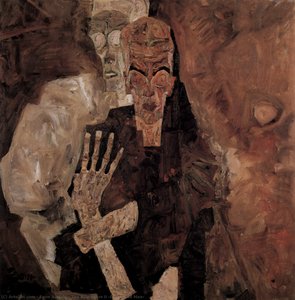 The Self-Seers II (Death and Man) - Egon Schiele
A central figure in the landscape of 20th century Austrian painters, Egon Schiele (1890–1918) transformed the canvas into a site of profound psychological confrontation. Born in Tulln, Lower Austria, his early life was marked by the fracturing of domestic stability following his father's illness, a trauma that left an indelible imprint on his psyche. This personal turbulence fueled a departure from the rigid academic traditions of the Austro-Hungarian Empire, propelling him toward the raw, visceral language of Expressionism.
Schiele’s work is characterized by a nervous, angular line and a preoccupation with the tension between the physical body and the internal spirit. His ability to translate existential dread into visual form solidified his legacy among the most influential Austrian artists of the 1900s. In his haunting 1911 masterpiece, The Self-Seers II (Death and Man), he explores the inescapable presence of mortality through distorted, gaunt figures and unsettling symbolism. Through this unflinching gaze into the human condition, Schiele moved beyond mere representation to capture the very vibrations of the nervous system, defining the emotive intensity of the era.
Oskar Kokoschka
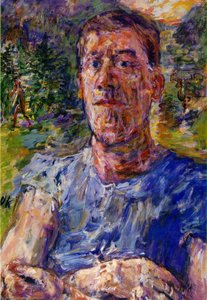 Self-portrait of a 'Degenerate Artist' - Oskar Kokoschka
In his 1937 Self-portrait of a 'Degenerate Artist', Oskar Kokoschka offers a profound testament to the psychological turbulence of the era. This work serves as a defiant response to the political pressures of the 1930s, capturing a sense of anxiety and resistance through a fractured, intense gaze. As a central figure of the 20th century Austrian painters, Kokoschka’s evolution from the Jugendstil-influenced circles of the Wiener Werkstätte to the radical avant-garde in Berlin defines the expressive spirit of his nation during this transformative century.
Kokoschka’s approach to the canvas was marked by a rejection of academic constraints. Eschewing formal training in favor of a raw, intuitive vision, he utilized the impasto technique to create a sculptural, vibrating surface. His palette often abandoned naturalism, employing deep purples, blues, and greens to articulate the inner emotional state of his subjects rather than their mere physical likeness. Through these bold, visible brushstrokes and a mastery of Expressionist intensity, he transformed portraiture into a medium for exploring the deepest recesses of the human psyche.
Arnold Schoenberg
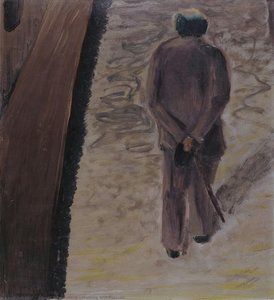 Walking Self-Portrait - Arnold Schoenberg
While primarily celebrated as a titan of musical modernism, Arnold Schoenberg’s presence in the 20th century Austrian landscape is deeply intertwined with the era's radical shifts in expression. Born in Vienna in 1874, he became the central figure of the Second Viennese School, a movement that redefined the boundaries of sound and form. His transition from the Brahmsian-Wagnerian synthesis of his early years to the groundbreaking atonality of works like Pierrot Lunaire mirrors the broader artistic revolution occurring in Austria during the early 1900s.
His 1911 work, Walking Self-Portrait, serves as a profound visual companion to his musical evolution. In this piece, he is captured in formal attire, walking with hands behind his back, lost in a state of deep introspection. The composition suggests a man absorbing the subtle nuances of the urban environment, translating the chaos of everyday life into a structured, yet revolutionary, internal rhythm. This capacity to distill raw emotion into complex, non-traditional structures is what defines his legacy among the 20th century Austrian painters and composers alike, marking a departure from the past toward a modern, fragmented, and deeply psychological aesthetic.
Koloman Moser
 Inlaid Eisler-Terramare Armoire - Koloman Moser
A central figure in the evolution of Austrian modernism, Koloman Moser (1868–1918) helped redefine the visual language of the 20th century. As a founding member of the Vienna Secession, his work bridged the gap between fine art and functional design, a hallmark of the Austrian avant-garde during this transformative era. His academic training at the Wiener Akademie and the Kunstgewerbeschule provided the foundation for a career that would eventually reshape the aesthetic landscape of Vienna through his role as an instructor and co-founder of the Wiener Werkstätte alongside Josef Hoffmann.
Moser’s mastery lay in his ability to integrate art into the fabric of daily life, moving seamlessly from graphic design and postage stamps to stained glass and architecture. His approach is epitomized in the Inlaid Eisler-Terramare Armoire (1903), a piece that exemplifies the Gesamtkunstwerk philosophy. This work utilizes a rigorous, symmetrical grid of squares and rectangles to create a rhythmic checkerboard effect, where the natural movement of birdseye maple, thuja, and satinwood veneers provides a sophisticated texture. Through stylized female figures and precise geometric discipline, Moser’s work captures the transition toward the simplified, abstract forms that defined early 20th-century Austrian art.
Friedensreich Hundertwasser
 Heavy Grass Wind - Friedensreich Hundertwasser
A visionary who redefined the boundaries between fine art and architecture, Friedensreich Hundertwasser (1928–2000) stands as a transformative figure among 20th century Austrian painters. Born in Vienna, his early life was marked by the profound hardships of the Nazi era, an experience that fueled his lifelong rejection of rigid, standardized structures. After a brief tenure at the Academy of Fine Arts in Vienna, he abandoned academic tradition to embrace a visual language of organic vitality, characterized by vibrant colors and a deep-seated aversion to the straight line.
His work is defined by the spiral, a motif representing the cyclical nature of life and a direct rebellion against geometric monotony. In the 1968 masterpiece Heavy Grass Wind, this philosophy reaches a rhythmic crescendo. The piece utilizes a complex layering of watercolor, egg tempera, and oil to create a tactile, impasto surface. Through undulating bands of orange, red, and blue, Hundertwasser captures a sense of constant motion, blending architectural elements with dreamlike, biological forms. His legacy remains a testament to the harmony between human habitation and the natural world, cementing his status as a master of organic abstraction.
Albin Egger Lienz
 Ila, die jüngere Tochter des Künstlers - Albin Egger Lienz
Albin Egger-Lienz stands as a monumental figure among 20th century Austrian painters, bridging the gap between traditional realism and the expressive vigor of modernism. Born in Tyrol in 1868, his artistic journey was shaped by his father’s craft and refined at the Academy in Munich. His work is defined by a transition from historical depictions of Tyrolean life to a highly stylized, monumental form of expressionism. This evolution is deeply rooted in the influence of Ferdinand Hodler, whose impact helped Egger-Lienz develop a signature language of massive, strongly outlined figures and a somber, monochromatic palette of earth tones.
His capacity to elevate the mundane into the profound is exemplified in the 1920 portrait, Ila, die jüngere Tochter des Künstlers. In this work, the artist moves away from the heroic, stage-like spaces of his earlier historical compositions to capture a moment of unsettling stillness. Through the use of muted clay tones and a striking accent of red, he imbues a simple domestic scene with a psychological depth characteristic of the era's shifting sensibilities. His legacy remains central to the Austrian canon, representing a unique synthesis of regional identity and the avant-garde movements of the early 1900s.
Richard Gerstl
 Group portrait with Schönberg - Richard Gerstl
A tragic and meteoric figure in the history of Viennese modernism, Richard Gerstl represents the raw, unbridled energy of the 20th century Austrian painters. Though his life was tragically cut short in 1908, his brief career served as a vital bridge between late-century traditions and the burgeoning Expressionist movement. Gerstl’s journey began at the Academy of Fine Arts Vienna under Christian Griepenkerl, but his rebellious spirit and rejection of academic constraints led him toward a more radical, self-directed path.
His work is defined by a psychological intensity that anticipated the profound shifts in German Expressionism. In his Group portrait with Schönberg, Gerstl demonstrates a masterful command of distortion and light. Using a palette knife to apply rich ochres and greens, he creates a sunstrewn backdrop where faces appear as indistinguishable shapes up close, only to resolve into recognizable, emotionally charged figures as the viewer retreats. This technique, combined with his ability to capture the inner essence of his subjects, cements his legacy as a pioneer who dared to look beyond the surface of the canvas.
Carl Moll
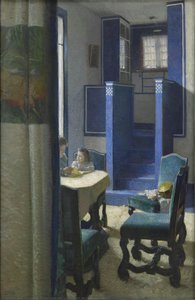 Drawing-Room in House on the Hohe Warte - Carl Moll
A foundational figure of the Vienna Secession, Carl Moll stands as a pivotal force among 20th century Austrian painters. His career bridged the gap between traditional academic realism and the radical shifts of modernism. Having studied at the Academy of Fine Arts Vienna under Christian Griepenkerl and Emil Jakob Schindler, Moll eventually became a driving force in the movement that redefined the Austrian aesthetic at the turn of the century. He was instrumental in introducing international avant-garde influences to Vienna, including the works of Vincent van Gogh.
His mastery is perhaps most evident in his sophisticated interior scenes, such as Drawing-Room in House on the Hohe Warte. In this 1903 composition, Moll demonstrates his unique ability to synthesize Pointillist techniques with a meticulous sense of spatial organization. Rather than mere documentation, his work captures the very atmosphere of a domestic setting through a deliberate fragmentation of color. This approach creates a luminous, ethereal quality that elevates a simple drawing room into a profound exploration of light and modern Viennese life.
Alban Maria Johannes Berg
 Agnes Miyakawa - Alban Maria Johannes Berg
While primarily recognized as a titan of music, Alban Maria Johannes Berg represents the profound intersection of Austrian intellectualism and avant-garde expressionism that defined the 20th century. Born in Vienna in 1885, his artistic trajectory was irrevocably altered by his mentorship under Arnold Schoenberg, a central figure in the Second Viennese School. This connection placed Berg at the heart of a revolutionary movement that sought to dismantle traditional tonal structures, a hallmark of the Austrian modernism of the 1900s.
Berg’s unique contribution to this era was his ability to infuse the rigorous twelve-tone technique with a deeply Romantic, lyrical sensibility. Unlike the more clinical approaches of his contemporaries, his work maintained an intense emotional resonance, bridging the gap between classical tradition and the radical shifts of the early 20th century. His legacy is immortalized in the evocative portrait Agnes Miyakawa, which captures the poise and elegance of the operatic era he helped shape through his groundbreaking compositions.
- Subject Matter: The work presents a formal portrait of Agnes Miyakawa, a celebrated vocalist, capturing her likeness with a sense of introspective confidence.
- Style: The image reflects the poised conventions of early 20th-century portrait photography, mirroring the sophisticated aesthetic sensibilities prevalent during the height of the Second Viennese School.
Conclusion
The legacy of these masters reflects a profound transformation in the visual language of the 20th century, moving from the decorative opulence of Klimt to the raw, psychological intensity of Schiele and the vibrant, organic visions of Hundertwasser. Whether through the structural innovations of the Secession movement or the expressive distortions of the avant-garde, these artists collectively redefined how the human form and the modern landscape could be perceived. Their diverse approaches—ranging from the ethereal to the visceral—ensure that their influence remains a vital part of art history.
For those looking to bring this rich heritage into their own living spaces, Mus3ums.com offers a way to connect with these historical movements. We specialize in museum-quality, hand-painted oil reproductions that capture the unique textures and brushstrokes of these iconic works. You can explore our full collection to find the perfect piece and invite the spirit of Austrian modernism into your home through our bespoke, artist-crafted masterpieces.