
Introduction
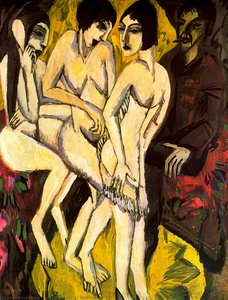
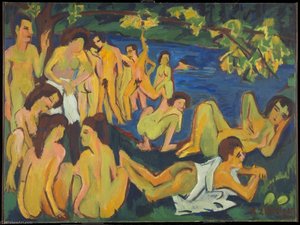
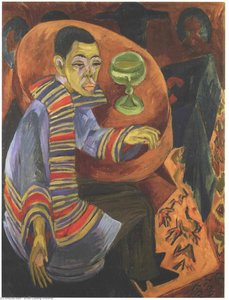
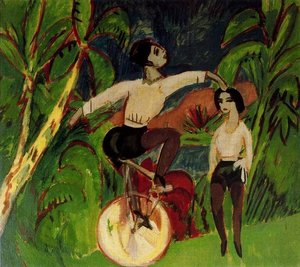
The 20th century in Germany was a period of profound transformation, where the canvas became a battlefield for the soul of a nation navigating rapid industrialization, two world wars, and radical shifts in political identity. From the spiritual abstractions of the early century to the biting social critiques of the Weimar era and the conceptual depth of contemporary movements, these artists utilized paint to process the chaos of modernity. They did not merely observe the world; they dismantled it and rebuilt it through expressionism, surrealism, and even the blurred boundaries of photorealism.
What unites this diverse group is a relentless pursuit of truth, whether that truth was found in the primal colors of the Die Brücke movement or the complex, layered textures of late-century masterpieces. These painters moved beyond traditional representation to explore the subconscious, the political, and the very nature of perception itself. Their influence remains vital today, as their visual language continues to shape how we interpret the tension between human emotion and the structured reality of the modern age.
This selection explores the evolution of this powerful legacy, tracing the journey from the foundational masters of the early 1900s to the revolutionary figures who redefined the limits of the medium. Through the works of artists such as Max Ernst, Gerhard Richter, and Franz Marc, we witness the profound impact of German creativity on the global art historical canon.
Max Ernst
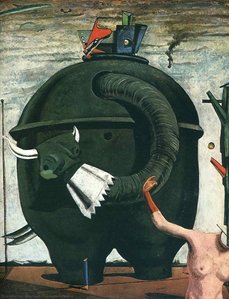 The Elephant Celebes - Max Ernst
A central figure of the 20th century German painters, Max Ernst redefined the boundaries of the visual psyche through his restless, multidisciplinary curiosity. Born in Germany in 1891, his artistic evolution was deeply informed by his academic studies in philosophy, psychology, and psychiatry at the University of Bonn. This intellectual foundation allowed him to move beyond mere representation, seeking to map the irrational layers of the human mind. As a pioneer of both the Dada and Surrealist movements, Ernst transformed the canvas into a space for dreamlike exploration, utilizing innovative techniques like collage and frottage to challenge conventional perception.
His 1921 masterpiece, The Elephant Celebes, serves as a profound testament to this era of radical transition. The work presents a whimsical yet enigmatic scene, dominated by an anthropomorphized, bull-like creature that commands the composition with a sense of quiet mystery. Through a muted yet evocative palette of sap greens, earthy browns, and sudden pops of vibrant red, Ernst creates a world of soft, diffused light and complex textures. This composition, blending the mechanical with the organic, captures the very essence of the surrealist spirit that defined the German avant-garde during the early 20th century."
Franz Marc
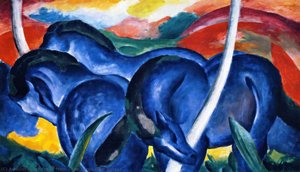 The Large Blue Horses - Franz Marc
A central figure in the evolution of 20th century German painters, Franz Marc sought to move beyond the surface of the physical world to capture a deeper, spiritual reality. His journey was shaped by a profound tension between the material and the divine, a struggle rooted in his early theological inquiries before he committed fully to the canvas. After receiving rigorous academic training at the Academy of Fine Arts in Munich, Marc became a pioneer of German Expressionism and a co-founder of the influential group Der Blaue Reiter. His work represents a radical departure from the traditional landscapes of his father's generation, favoring instead a symbolic language of color and form.
In his masterpiece, The Large Blue Horses (1911), Marc’s vision reaches a crescendo of expressive power. Through this iconic work, he utilizes a vibrant palette to explore the essence of nature, famously employing blue to symbolize masculinity and spiritual purity. The fluid, rhythmic brushstrokes and the intense use of primary colors transform the animal subjects into vessels of cosmic energy, cementing his legacy as a master of the 20th century's most transformative artistic shifts.
Gerhard Richter
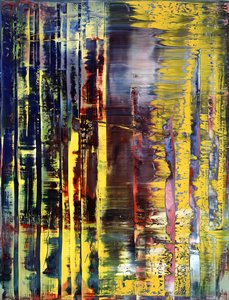 Abstract Painting 780-1 - Gerhard Richter
A central figure in the landscape of 20th-century German painting, Gerhard Richter has redefined the boundaries between reality and abstraction. Born in Dresden in 1932, his formative years were shaped by the profound political upheavals of the Third Reich, a period of displacement that deeply informed his artistic journey. After working as a sign painter and stage-set artist, he pursued formal training at the Dresden Academy of Fine Arts, eventually developing a visual language that oscillates between meticulous photorealism and explosive, gestural abstraction.
One can recognize a Richter masterpiece by its profound tension between order and chaos. In his representative work, Abstract Painting 780-1, created in 1992, this tension is palpable. The piece demonstrates his mastery of the impasto technique, where thick, layered pigments create a tactile, three-dimensional surface. The composition utilizes a vertical orientation to contrast cool, dark tones with bursts of warm, vibrant color, creating a rhythmic dance of light. His ability to manipulate the medium—from delicate, thin lines to bold, sweeping strokes—allows him to explore the very essence of perception, making him a cornerstone of contemporary German art history.
Ernst Ludwig Kirchner
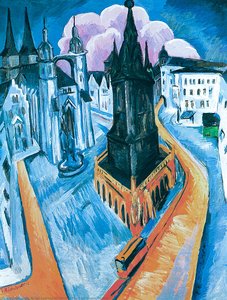 The Red Tower at Halle - Ernst Ludwig Kirchner
A central figure of the 20th century German painters, Ernst Ludwig Kirchner (1880–1938) fundamentally reshaped the visual language of modernism. As a founding member of the influential Die Brücke collective in 1905, he sought to bridge the gap between classical tradition and a raw, visceral way of seeing. His work is defined by a radical simplification of form and a preference for unmixed, glowing colors that prioritize emotional truth over academic realism. Having studied architecture in Dresden, Kirchner brought a unique sense of structural tension to his expressive compositions, making him a cornerstone of the German Expressionist movement.
His masterpiece, The Red Tower at Halle, serves as a profound testament to his ability to capture the frantic pulse of urban life. In this vibrant work, Kirchner utilizes a dramatic diagonal perspective to pull the viewer into a bustling street scene. The composition is anchored by the imposing historic tower, rendered with thick, gestural impasto brushstrokes. Through a striking palette of deep blues, purples, and warm oranges, he transforms a cityscape into a rhythmic, energetic experience of light and shadow.
Max Beckmann
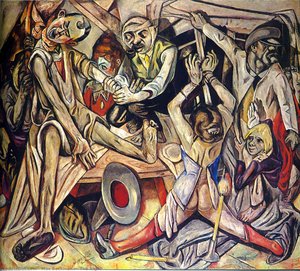 The Night - Max Beckmann
In his 1919 masterpiece The Night, Max Beckmann delivers a visceral depiction of societal trauma and the fragmentation of the human condition. This work serves as a cornerstone of the Neue Sachlichkeit (New Objectivity) movement, capturing the profound alienation and anxiety that defined the era. As a central figure of 20th century German painters, Beckmann’s oeuvre reflects the shifting, often violent, landscapes of his homeland during this transformative century.
Born in Leipzig in 1884, Beckmann’s artistic journey began with a rigorous training in conservative academic traditions. This technical foundation allowed him to later masterfully subvert naturalism. His style is characterized by a dramatic, psychological intensity, often utilizing distorted proportions and elongated figures to convey deep emotional truths. Whether through large-scale canvases or intimate prints, his palette frequently employs earthy ochres, grays, and muted tones, punctuated by jarring flashes of color that heighten the sense of disorientation.
Through works such as The Night, The Iron Bridge, and his various self-portraits, Beckmann articulated the weight of history, transforming personal and collective suffering into a powerful, symbolic visual language that remains essential to the history of modern art.
George Grosz
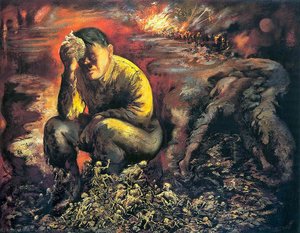 Cain or Hitler in Hell - George Grosz
A central figure of the 20th century German painters, George Grosz (1893–1959) utilized his art as a sharp, often biting instrument of social critique. Born Georg Ehrenfried Groß in Berlin, his decision to adopt a more international name was a deliberate act of protest against the rising nationalism of his era. His work is deeply intertwined with the frantic, decaying pulse of Berlin during the 1920s, where he became a prominent voice within the Berlin Dada and New Objectivity movements.
Grosz’s aesthetic was defined by a restless spirit and a refusal to conform, a trait evident from his early school days. His paintings and drawings often functioned as visceral dissections of the social and political realities of his time. In his powerful 1944 work, Cain or Hitler in Hell, he transitioned from the satirical observer of urban life to a profound commentator on the devastation of fascism. Through a dramatic blend of realism and expressionism, he depicted apocalyptic landscapes and the horrors of war, using jagged lines and a somber, fiery palette to convey a sense of profound despair. His legacy remains a testament to the artist's role as a witness to the turbulent shifts of the 20th century.
Otto Dix
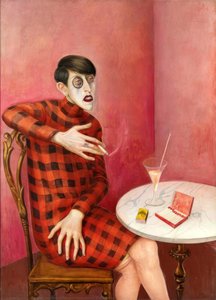 Portrait of the Journalist Sylvia Von Harden - Otto Dix
A central figure of the 20th century German painters, Otto Dix (1891–1969) is defined by a visceral, unflinching approach to reality. His work is instantly recognizable through its sharp, almost clinical precision and a penchant for the grotesque, often utilizing a palette that oscillates between the gritty tones of industrial labor and the decadent hues of the Weimar Republic. Having served as a machine gunner during World War I, Dix’s psyche was profoundly shaped by the mechanized slaughter of the trenches, a trauma that fueled his transition from the technical discipline of his early training at the Dresden Academy of Fine Arts to the radicalism of the Neue Sachlichkeit (New Objectivity) movement.
His masterpiece, Portrait of the Journalist Sylvia Von Harden (1926), serves as a definitive example of his ability to capture the psychological complexity of a changing era. Through meticulous detail and a sophisticated interplay of light and shadow, Dix moves beyond mere representation to offer a biting social critique. His brushwork avoids the emotional distortions of Expressionism, opting instead for a stark, unidealized realism that exposes the tension between modern decadence and the underlying scars of history.
August Macke
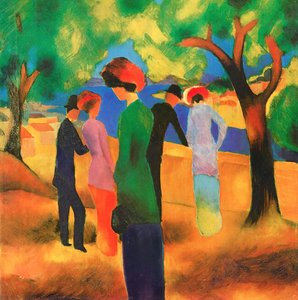 Woman in a Green Jacket - August Macke
A central figure of the 20th century German painters, August Macke (1887–1914) transformed the visual language of his era through a luminous, rhythmic application of color. His journey from the Düsseldorf Academy and studies under Lovis Corinth in Berlin led him toward a profound engagement with French Modernism. By synthesizing the structural lessons of Cubism with the vibrant, emotive palettes of Fauvism, Macke became a pivotal member of the Der Blaue Reiter movement, a group that sought to express spiritual and emotional truths through abstraction.
His representative work, Woman in a Green Jacket, serves as a masterful testament to this evolution. Painted in 1913, the piece captures a fleeting moment of social leisure, yet it transcends mere observation. Through energetic brushstrokes and a sophisticated interplay of geometric forms, Macke translates the bustling energy of modern life into a harmonious composition of light and hue. This ability to blend the organic with the structured defines his contribution to the 20th century German art canon, marking him as a master of Expressionist color and a visionary of the modern spirit.
Franz von Stuck
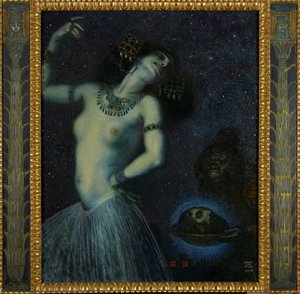 Salome - Franz von Stuck
Franz von Stuck stands as a pivotal figure in the transition toward modernism, bridging the gap between 19th-century academic tradition and the burgeoning movements of the 20th century. As a central force in the Munich Secession, his work helped redefine the German artistic landscape at the turn of the century. His practice was deeply rooted in the Bavarian tradition, having studied at the Munich School of Applied Arts and the Academy of Fine Arts, where the haunting mythological visions of Arnold Böcklin left an indelible mark on his creative psyche.
His mastery of Symbolism is most profoundly captured in his 1906 masterpiece, Salome. This work exemplifies the dramatic and melancholic essence of his style, utilizing a shadowy, claustrophobic composition to explore the dark undercurrents of human desire and power. Through a sophisticated blend of classical precision and dreamlike imagery, Stuck moves beyond mere narrative to tap into the subconscious. The painting’s rich, jewel-toned palette and intense tension illustrate why he was hailed as a "Prince of Art," securing his legacy as a defining voice among 20th century German painters through his ability to marry technical excellence with profound psychological depth.
Max Liebermann
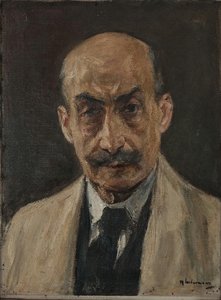 Bust Selfportrait in Paiting Overall - Max Liebermann
In his 1922 Bust Selfportrait, Max Liebermann offers a profound meditation on identity, capturing the artist with an intellectual gravitas that defines his later years. This work, characterized by a masterful command of tonal contrast, strips away the distractions of color to focus on the essential architecture of character. Through a sophisticated use of light and shadow, Liebermann sculpts the contours of the face, revealing a psychological depth that transcends mere likeness.
As a central figure in the transition of German art, Liebermann’s influence extended well into the 20th century, bridging the gap between 19th-century naturalism and the modern era. His career was defined by a unique adaptation of French Impressionism, translating the fleeting qualities of light and color into a distinctly German sensibility. While his early works were noted for their honest, dignified portrayals of everyday life and the working class, his mature style evolved into a serene and reflective exploration of modern existence. Whether capturing vibrant scenes of contemporary life or the quietude of garden views, his palette and brushwork remained deeply attuned to the essence of human experience, cementing his legacy as a master of light and observation.
Conclusion
The evolution of 20th-century German art represents a profound journey through the human psyche, moving from the vibrant, spiritual abstractions of Die Brücke and Der Blaue Reiter to the raw, often unsettling social critiques of the Weimar era. Whether through the expressive distortions of Kirchner and Beckmann or the later, complex layers of Richter, these artists captured the turbulence and transformation of a century in flux. Each painter contributed a unique visual language—from the dreamlike surrealism of Max Ernst to the structured colorism of August Macke—leaving an indelible mark on the history of modernism.
For those looking to bring this powerful legacy into their own living spaces, Mus3ums.com offers a way to connect with these historical movements. Our artisans specialize in creating museum-quality, hand-painted oil reproductions that honor the specific textures and brushstrokes of these masters. You can explore the diverse styles of these icons in our full collection and find a piece that resonates with your personal aesthetic. We invite you to live with these masterpieces through our bespoke, handmade oil paintings, crafted to preserve the soul of German art for generations to come.


