Introduction
The 20th century was a period of profound transformation for the Russian art world, a time when the vast landscapes and deep spiritual traditions of the East collided with the radical, avant-garde movements of the West. From the ethereal, symbolic realms of the fin de siècle to the sharp, geometric abstractions of the revolutionary era, these painters navigated a landscape of intense social upheaval and unprecedented creative liberation. This era was defined by a restless search for new visual languages, where artists sought to dismantle old perspectives and reconstruct reality through the lenses of Suprematism, Constructivism, and a deeply personal, expressive modernism.
What unites this diverse group of masters is their ability to capture the tension between tradition and the future. Whether through the vibrant, folk-inspired colors of a changing society or the disciplined, structural precision of the machine age, these artists redefined the boundaries of what a canvas could represent. Their work remains vital today because it speaks to the universal human experience of navigating chaos, seeking order, and finding beauty amidst the rapid shifts of modernity. Their influence can be felt in everything from contemporary graphic design to the most experimental abstract movements.
As we walk through this visual timeline, we will encounter ten pivotal figures who shaped this momentous century. From the spiritual abstractions of Wassily Kandinsky and the monumental compositions of Aleksandr Deyneka to the intricate, symbolic visions of Mikhail Vrubel, each artist offers a unique window into the soul of a transformative age.
El Lissitzky
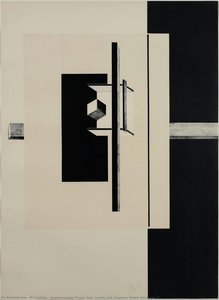
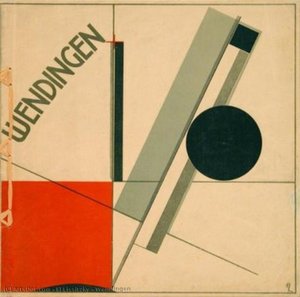 Wendingen - El Lissitzky
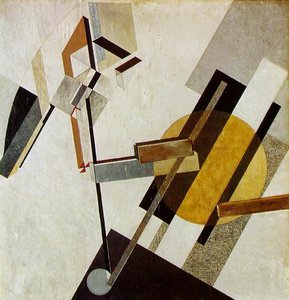
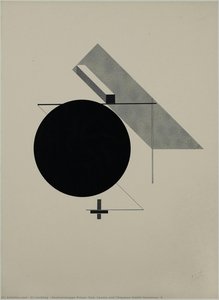
A pivotal figure in the evolution of modernism, El Lissitzky represents the radical spirit of 20th century Russian painters. Born in 1890 in the Russian Empire, his creative trajectory was shaped by a restless, multidisciplinary approach that bridged the gap between fine art and functional design. Moving beyond the traditional boundaries of painting, he became a central architect of the Constructivist movement, seeking to synthesize the abstract ideals of his era into tangible, structural realities.
His work is characterized by a profound dialogue between geometry and dynamism. In his representative 1921 work, Wendingen, Lissitzky demonstrates his mastery of spatial tension. Originally designed as a cover for a Dutch magazine, this piece serves as a manifesto for his "Proun" concept, where intersecting lines, sharp angles, and flat planes create a sense of architectural equilibrium. By rejecting representational imagery in favor of pure geometric abstraction, Lissitzky redefined the visual language of the century, ensuring his place as a visionary who transformed the intersection of typography, engineering, and fine art into a cohesive, revolutionary aesthetic.
Wassily Kandinsky
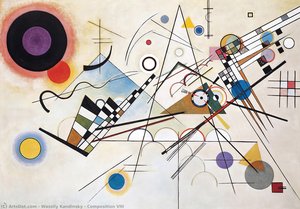 Composition VIII - Wassily Kandinsky
In his 1923 masterpiece Composition VIII, the visual language of abstraction reaches a profound crescendo. This work serves as a testament to the spiritual and emotional depth that defined the career of Wassily Kandinsky, a central figure among 20th century Russian painters. His journey into the avant-garde was a radical departure from his early academic life; after studying law and economics at the University of Moscow, he abandoned a stable professorship to pursue the transformative power of art in Munich.
Kandinsky’s practice was deeply intertwined with rhythm and sound, influenced by his early training in piano and cello. This musicality translated into a revolutionary approach to color theory and form. Moving away from representational imagery, he sought to evoke the "inner necessity" of the soul through non-objective compositions. His palette is a dynamic interplay of geometry and emotion, where circles, triangles, and lines dance across the canvas to create a sense of movement and depth. By deconstructing the visual world into pure, expressive elements, he paved the way for modern abstraction, proving that color and shape alone could communicate the most complex human experiences.
Nicholas Roerich
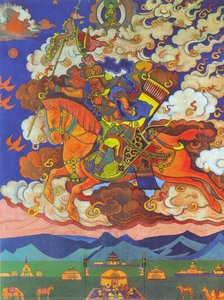 Great rider. Rigden Jyepo - Messenger of Shambhala - Nicholas Roerich
Nicholas Roerich stands as a monumental figure among 20th century Russian painters, bridging the gap between traditional academic training and the profound spiritual explorations of the modern era. A polymath who mastered law and archaeology alongside fine arts, Roerich’s influence was central to the early 20th-century avant-garde through his leadership of the "World of Art" society. His work transitioned from the theatrical stage to a visionary exploration of the Himalayas, marking a significant shift in the Russian artistic landscape as he moved toward the esoteric and the sublime.
His masterpiece, Great Rider. Rigden Jyepo - Messenger of Shambhala (1927), exemplifies this spiritual evolution. This work serves as a profound testament to his fascination with Tibetan mysticism and the search for Shambhala, the mythical realm of enlightenment. Through a Symbolist lens, Roerich utilizes vibrant, energetic compositions to transcend mere landscape painting, instead offering a window into a transcendent, celestial reality. The painting captures the essence of his journey into the remote Kullu Valley, where his art became a vehicle for conveying universal harmony and the hidden depths of the human spirit.
Boris Kustodiev
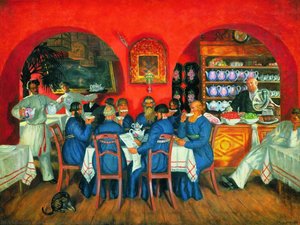 Moscow Tavern - Boris Kustodiev
A central figure in the landscape of 20th century Russian painters, Boris Kustodiev (1878–1927) bridged the gap between traditional Russian realism and the decorative elegance of Art Nouveau. His work is defined by a nostalgic, joyful celebration of the merchant class and the vibrant social customs of provincial life. Having trained at the Imperial Academy of Arts in St. Petersburg under rigorous academic discipline, Kustodiev developed a unique ability to infuse genre scenes with a sense of theatricality and warmth.
His masterpiece, Moscow Tavern (1916), serves as a quintessential example of his skill in capturing communal human connection. In this evocative oil on canvas, he depicts a bustling, convivial atmosphere where light dances across polished surfaces and faces etched with laughter. The painting is a symphony of color and texture, transforming a simple dining setting into a profound tableau of Russian merriment. Through his mastery of light and composition, Kustodiev elevated the depiction of everyday life into something monumental, ensuring his place among the most significant visual storytellers of the early 20th century.
Alexej von Jawlensky
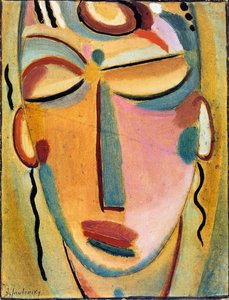 Mystical Head: Meditation - Alexej von Jawlensky
In Mystical Head: Meditation, the viewer is drawn into a profound state of introspection through a stylized human face rendered with bold abstraction. This 1918 masterpiece exemplifies the spiritual depth that defined the career of Alexej von Jawlensky, a pivotal figure among 20th century Russian painters. His work bridges the gap between the classical training he received in Saint Petersburg under Ilya Repin and the radical experimentation of the Munich avant-garde.
Jawlensky’s evolution took him from the structured academies of Russia to the vibrant circles of Munich, where he studied under Anton Ažbe and later encountered the revolutionary color theories of Henri Matisse. This journey allowed him to transition from realism into a unique fusion of Expressionism and Fauvism. His signature technique involves:
- Vibrant, contrasting colors that evoke intense emotional resonance.
- Thick black outlines that emphasize geometric, stylized forms over literal representation.
- Dynamic, textured brushwork that lends a tactile energy to the canvas.
By distilling the human form into essential, rhythmic lines, Jawlensky transformed the portrait into a vessel for the subconscious, securing his legacy as a master of modernist spiritualism.
Martiros Saryan
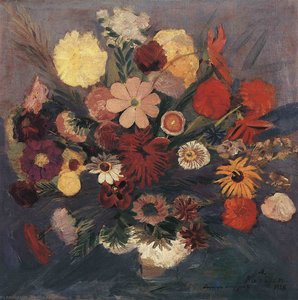 Flowers - Martiros Saryan
A central figure in the evolution of modern Armenian painting, Martiros Saryan represents a vital link within the diverse landscape of 20th century Russian painters. His artistic foundation was forged through rigorous academic training at the Moscow School of Painting, Sculpture, and Architecture between 1897 and 1903. During this formative period, he refined his technical discipline under the guidance of renowned masters Konstantin Korovin and Valentin Serov, absorbing the methodologies that would allow him to transcend simple representation.
Saryan’s work is characterized by a profound connection to the natural world, often seeking a visual language that captured the essence of his homeland. His 1928 masterpiece, Flowers, serves as a stunning testament to this devotion. Utilizing the luminous qualities of pastel, he composed a vibrant symphony of reds, yellows, and purples, capturing at least thirteen distinct floral varieties with an ethereal, dreamlike quality. Through his ability to blend the technical rigor of the Russian academic tradition with a passionate, pastoral impressionism, Saryan transformed the light and color of the landscape into a profound expression of cultural identity.
Lovis Corinth
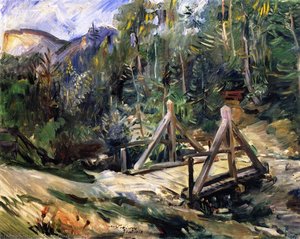 Tyrolean Landscape with Bridge - Lovis Corinth
Lovis Corinth stands as a pivotal figure in the transition from the 19th to the early 20th century, a period that defined the evolution of modern art. Born in the Prussian province of East Prussia, his heritage and early life connect him to the broader cultural landscape of the Russian-influenced territories and the shifting borders of the era, placing him firmly within the artistic developments of the 20th century. His work is characterized by a powerful synthesis of Impressionism and Expressionism, moving away from strict academic naturalism toward a more visceral, emotive style.
A viewer can recognize a Corinth masterpiece by its bold, expressive brushwork and a rich, vibrant color palette that captures the raw energy of life. Whether depicting the intense realism of his early years or the more fluid, light-drenched landscapes of his maturity, his technique remains tactile and dynamic. His 1913 work, Tyrolean Landscape with Bridge, exemplifies this mastery, using oil on canvas to create a reflective atmosphere where nature and human decay coexist. Through his command of light and texture, Corinth transformed everyday scenes into profound studies of existence.
Aleksandr Deyneka
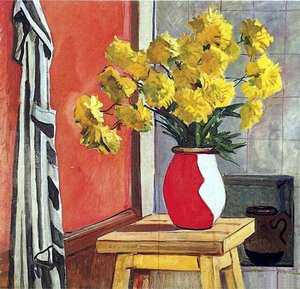 Still Life. Yellow flowers - Aleksandr Deyneka
In Still Life. Yellow Flowers, the artist captures a moment of profound, tranquil optimism. The composition centers on a red vase adorned with white stripes, holding a vibrant arrangement of yellow blossoms that seem to glow against a simple, domestic backdrop. This 1954 oil on canvas exemplifies the artist's ability to elevate the mundane into something monumental through precise detail and a sense of abundance.
Aleksandr Deyneka (1899–1969) stands as a pivotal figure among 20th century Russian painters, his career tracing the dramatic evolution of his nation from the revolutionary fervor of the early century to the structured ideals of the Soviet era. Trained at the Vkhutemas workshops under Vladimir Favorsky, he fused the structural clarity of constructivism with the grand narrative requirements of Socialist Realism. His work is characterized by a dynamic energy and a bold visual language, often celebrating labor, sports, and the rhythmic vitality of modern life. Whether through large-scale mosaics or intimate still lifes, Deyneka’s palette and composition reflect a mastery of form that defined the aesthetic landscape of mid-century Russia.
George Washington Lambert
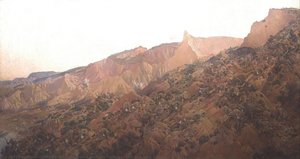 Anzac, the landing 1915 - George Washington Lambert
Born in St. Petersburg, Russia, in 1873, George Washington Lambert occupies a unique position within the landscape of 20th-century painters from Russia. Although his artistic legacy is deeply intertwined with the cultural heritage of Australia, his Russian origins at the turn of the century link him to this diverse group of international masters. His career was defined by a sophisticated mastery of realism, transitioning from captivating portraiture to the visceral, high-stakes realm of war art.
A pivotal moment in his oeuvre arrived during the First World War, where he served as an official war artist. His ability to translate the chaos of conflict into profound psychological narratives is best exemplified in his monumental work, Anzac, the Landing 1915. This piece captures the harrowing ascent of soldiers at Gallipoli, utilizing a dramatic, upward-looking perspective that evokes the sheer verticality of the rugged terrain. Through a cinematic composition and a command of scale, Lambert transformed historical events into epic, emotional experiences. His work remains a testament to the power of contemporary realism, blending technical precision with a deep, expressive understanding of the human spirit in moments of extreme vulnerability.
Mikhail Vrubel
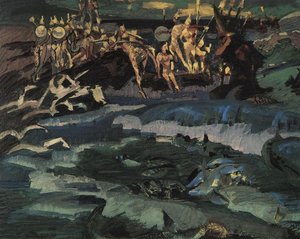 Thirty-three knights - Mikhail Vrubel
A foundational figure in the transition toward modernism, Mikhail Vrubel remains a cornerstone of the 20th century Russian painters group due to his radical departure from academic realism. His work, which flourished at the dawn of the new century, bridged the gap between the 19th-century tradition and the burgeoning Symbolist movement. Vrubel’s unique vision was deeply influenced by his study of medieval mosaics at St. Cyril's Church in Kiev and his fascination with the crystalline structures of Persian art. This resulted in a distinctive technique where he applied paint in faceted, mosaic-like strokes, giving his canvases a shimmering, gemstone-like quality.
His masterpiece, Thirty-three Knights, exemplifies this visionary approach. Painted in 1901, this work captures a sense of mythic momentum as a procession of knights surges through a vast expanse of water. The composition moves away from static portraiture, instead embracing the sinuous lines and dreamlike atmosphere characteristic of Art Nouveau. Through this piece, Vrubel demonstrates how the 20th century Russian painters began to prioritize emotional depth and spiritual symbolism over mere physical representation, forever altering the trajectory of Russian fine art.
Conclusion
The evolution of 20th-century Russian art represents a profound dialogue between tradition and radical experimentation. From the spiritual abstractions of Kandinsky and the geometric precision of Lissitzky to the vibrant, soulful landscapes of Saryan and Roerich, these masters redefined the visual language of an entire era. Whether through the expressive color palettes of Jawlensky or the monumental compositions of Deyneka, each artist contributed a unique perspective to a century defined by rapid cultural transformation and intense creative energy.
At Mus3ums.com, we invite you to bring these historic movements into your own living space. Our artisans specialize in creating museum-quality, hand-painted oil reproductions that capture the authentic texture and soul of these masterpieces. You can explore our full collection to find the perfect piece for your home and experience the enduring legacy of these extraordinary painters through the tactile beauty of real brushstrokes on canvas.