


Introduction
The landscape of contemporary art in the United Kingdom during the 21st century is defined by a profound tension between traditional craftsmanship and radical conceptualism. Emerging from a rich heritage of landscape painting and classical portraiture, these modern creators have navigated a rapidly shifting cultural terrain, responding to the digital age, urban transformation, and the evolving complexities of British identity. What unites this diverse group is a shared willingness to challenge the boundaries of the medium, whether through the visceral application of pigment or the integration of street-art sensibilities into the high-art canon.
Throughout this century, the British art scene has moved beyond the rigid classifications of the past, embracing a pluralistic approach where the boundaries between fine art, fashion, and social commentary often dissolve. This era has seen a resurgence in the power of the physical mark—the tactile energy of a brushstroke—even as artists explore new ways to interpret the world around them. Their work serves as a vital visual record of a nation in transition, capturing the pulse of modern life through diverse lenses of abstraction, realism, and satire.
These artists remain essential today because they continue to provoke dialogue and reflect the multifaceted nature of contemporary existence. By examining their contributions, we gain insight into how the visual language of the United Kingdom has matured and expanded in the new millennium. The following selection highlights ten pivotal figures whose work exemplifies the breadth and depth of this vibrant movement, ranging from the celebrated icons of the urban landscape to the masters of expressive, modern abstraction.
Banksy
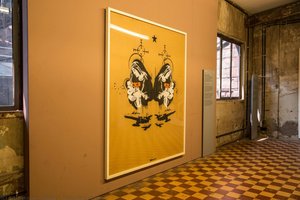 Toxic Mary (double) - Banksy
A defining figure of the 21st century British painters, Banksy has transitioned from the underground graffiti scenes of Bristol to a global phenomenon. His work is instantly recognizable through a signature stencil-based technique, a method developed to allow for rapid execution in urban environments. This approach produces sharp, high-contrast silhouettes and monochromatic depth that command immediate attention, often juxtaposing delicate imagery with gritty, textured backgrounds to create a sense of visual tension.
In the representative work Toxic Mary (double), created in 2003, we see his mastery of subversive grace. The piece features two ethereal, winged figures stacked vertically, evoking a sense of fallen divinity. Through this stencil art, he explores the duality of beauty and decay, using the starkness of spray paint to deliver poignant social commentary. His themes frequently tackle the complexities of modern existence, including politics, consumerism, and social justice. By blending dark humor with profound symbolism, Banksy’s contributions to the contemporary art movement continue to challenge the status quo, cementing his place as a pivotal voice in 21st-century British art.
Gary Wragg
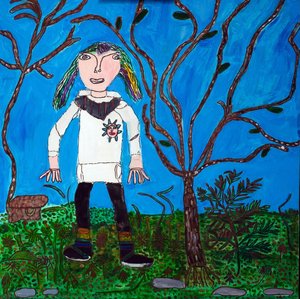 Sasha - Gary Wragg
A visitor encountering a work by Gary Wragg is immediately met with the profound depth of Color Field abstraction. His canvases are not mere surfaces but immersive environments where color, shape, and composition coalesce to evoke pure sensation. One recognizes his hand through a sophisticated orchestration of tonal layers and a rhythmic, almost hypnotic application of paint that prioritizes emotional resonance over representational form. This mastery of light and hue allows his work to transcend the physical, inviting a meditative state of being.
As a significant figure in the landscape of post-war British abstraction, Wragg’s continued evolution and influence define the trajectory of 21st century British painters. His practice, deeply shaped by the teachings of Wu Kwong Yu, emphasizes a spiritual dimension and the concept of effortless action, ensuring his place in the contemporary era of UK art. His academic foundation was built at the High Wycombe School of Art, Camberwell School of Arts and Crafts, and the Slade School of Fine Art.
In his evocative work Sasha, the artist demonstrates this ability to weave atmosphere and light, utilizing a vibrant palette to construct a multi-layered, tranquil experience that resonates with quiet intensity.
Michael Andreas Willson
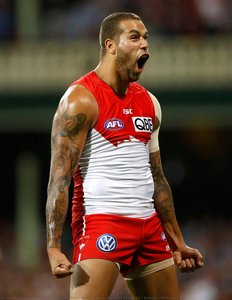 Lance Franklin, AFL 2017 Round 05 - Sydney v GWS Giants - Michael Andreas Willson
Michael Andreas Willson represents a fascinating evolution within the landscape of 21st century British painters, transitioning from the high-octane adrenaline of televised sports to the delicate, disciplined mastery of watercolor. Born in Dartford, United Kingdom, his contemporary relevance is defined by this profound shift from physical performance to artistic expression. His work captures the raw, kinetic energy of human endeavor, often bridging the gap between intense physical struggle and the quietude of the canvas.
In his representative work, Lance Franklin, AFL 2017 Round 05 - Sydney v GWS Giants, Willson demonstrates a remarkable ability to translate movement into a visual pulse. Through a contemporary realist lens, he captures a single, breathless moment of exertion. The composition utilizes sharp, diagonal lines and a study of tension to depict the athlete in a state of pure focus. The interplay of light and shadow carves out the contours of the subject, while the vibrant red and white of the jersey cuts through a muted, atmospheric background. It is a dramatic, energetic portrayal that seeks to record the visceral truth of the arena, embodying the spirit of modern sporting portraiture.
Andrew Ian Ross, Andrew Ross
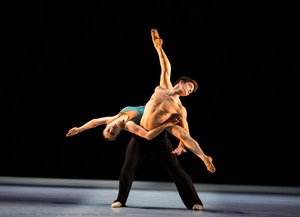 Maze - Andrew Ian Ross, Andrew Ross
In the evocative work Maze, created around 2015, the composition captures a profound moment of balletic movement. The piece focuses on two dancers locked in an intricate partnership, set against a void of absolute black. This dramatic use of chiaroscuro isolates the subjects, emphasizing the physical connection, weight, and support between the figures. The male dancer serves as a steady pillar, while the female dancer extends into an arabesque-like position, her limbs creating a geometry of tension and grace that cuts through the darkness. The palette is stark and focused, relying on the interplay of light and shadow to define musculature and the subtle sheen of skin.
Andrew Ian Ross (1956–2022) represents a unique facet of the 21st century British art and cultural landscape. While widely recognized as a pivotal music executive who shaped the Britpop movement through Food Records, his creative legacy extends into the visual documentation of contemporary performance. His work reflects a sophisticated understanding of rhythm and structure, much like the musical eras he helped define. As a figure whose influence spanned the transition into the new millennium, his contributions to the British cultural fabric solidify his place among the significant creators of the 21st century in the United Kingdom.
Sir Grayson Perry Cbe Ra Hon Friba
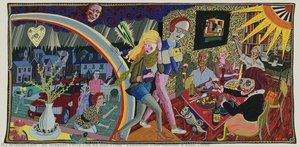 Expulsion from Number 8 Eden Close - Sir Grayson Perry Cbe Ra Hon Friba
A visitor recognizes the work of Sir Grayson Perry through a profound tension between classical elegance and subversive social commentary. His practice is defined by a mastery of diverse media, ranging from intricately decorated ceramic vases to monumental textiles, often utilizing a vibrant and luminous color palette to explore the complexities of British identity and class mobility. As a central figure in the contemporary British art scene, Perry’s influence is deeply felt throughout the 21st century, where his multidisciplinary approach challenges traditional boundaries of taste and gender.
His 2012 masterpiece, Expulsion from Number 8 Eden Close, exemplifies this ability to weave historical echoes into modern narratives. This monumental tapestry utilizes complex Jacquard weaving to create a rich, textural meditation on societal hierarchies. By mirroring the theatrical staging of Hogarth and the theological weight of Renaissance frescoes, Perry transforms a domestic confrontation into a profound allegory of transgression and social aspiration. The work stands as a testament to his ability to use traditional craftsmanship to interrogate the very fabric of contemporary life.
Cecily Brown
 Fair of Face, Full of Woe - Cecily Brown
A central figure in the landscape of 21st century British painters, Cecily Brown has redefined the boundaries between figuration and abstraction. Born in London in 1969, she refined her technical mastery at the Slade School of Art, eventually relocating to New York to seek a more expansive artistic independence. Her work represents a contemporary evolution of the Abstract Expressionist tradition, drawing profound inspiration from the visceral energy of Willem de Kooning and the dramatic compositions of Rubens.
Brown’s practice is characterized by a sense of controlled chaos, where the act of painting becomes a primary subject. She often approaches the canvas without a rigid plan, allowing the medium to dictate the form through a highly expressive, almost erotic application of pigment. This is masterfully exemplified in her 2008 work, Fair of Face, Full of Woe. In this piece, the boundaries between the human form and its environment dissolve into a dense, textured tapestry of color. Through her signature brushwork, she explores the tension between outward appearance and internal turmoil, creating a visual language that is both melancholic and intensely alive.
Lee Alexander McQueen
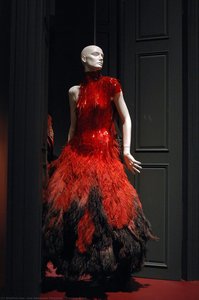 Evening dress - Lee Alexander McQueen
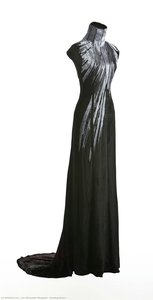
A figure of profound dramatic intensity, Lee Alexander McQueen (1969-2010) redefined the boundaries of visual storytelling through his radical approach to form and silhouette. His journey from a working-class London upbringing to the hallowed tailoring traditions of Savile Row allowed him to master the technical precision required to deconstruct and reimagine the very language of clothing. This mastery is epitomized in his 2001 Evening dress, a piece from the provocative Voss collection. The work functions as a visceral meditation on the human body, utilizing a striking collision of textures: voluminous red and black ostrich feathers juxtaposed against glass microscope slides painted red to evoke the presence of blood. This interplay of organic softness and clinical, unsettling detail captures the dark, romantic essence that defined his career. As a central figure in the contemporary British creative landscape, McQueen’s influence extends into the 21st century, where his ability to blend high-fashion construction with conceptual, performance-based art places him among the most significant British creators of this era. His work remains a testament to the power of using material and silhouette to explore the deepest psychological and historical narratives.
Ian Davenport
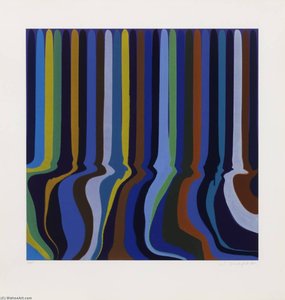 Colorplan Series Royal Blue Etching - Ian Davenport
A central figure in the landscape of contemporary British abstraction, Ian Davenport represents the sophisticated evolution of 21st century United Kingdom painters through his masterful command of gravity and pigment. Having refined his technical rigor at Northwich College of Art and Design and Goldsmiths College, Davenport emerged as a vital voice in the UK art scene, notably participating in the seminal Freeze exhibition. His practice is defined by a mesmerizing tension between meticulous control and the elemental physics of fluid motion.
Davenport is celebrated for his signature poured-paint technique, a method that eschews traditional brushwork to create rhythmic, vertical compositions. This approach allows color to flow and vibrate across the surface, resulting in a visual cadence that feels both organic and architecturally precise. His 2011 work, Colorplan Series Royal Blue Etching, serves as a profound example of this mastery. In this piece, the intersection of deep, regal blues and energetic yellows creates a rhythmic pulse, demonstrating how he utilizes printmaking to achieve a clarity that borders on the digital while maintaining a soulful, painterly depth. His ability to manipulate viscosity and gravity ensures his place among the most influential abstract practitioners of the current era.
James Hawkins
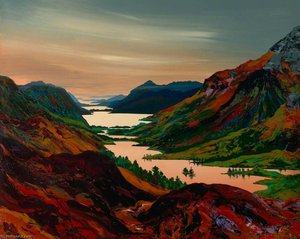 The Great Glen through Four Seasons (panel 1 of 4) - James Hawkins
A prominent figure in the contemporary British art scene, James Hawkins has dedicated his practice to capturing the raw, evocative essence of the natural world. His work represents a vital chapter in 21st-century British painting, moving away from rigid academicism toward a more expressive, contemporary realism. By utilizing abstract acrylics and unique cut-out techniques, Hawkins translates the rugged textures of the United Kingdom's landscapes into profound visual experiences.
His mastery of atmosphere is perhaps most evident in The Great Glen through Four Seasons (panel 1 of 4), a work created in 2004. In this piece, he invites a dialogue with the Scottish Highlands, using a nuanced palette to depict the interplay between heavy, cloud-swept skies and the tranquil clarity of mountain lakes. Through delicate brushwork and a sophisticated understanding of light and shadow, he achieves a sense of immense atmospheric depth. This ability to balance the structural grandeur of the mountains with the fleeting, ethereal qualities of light ensures his place among the significant painters of the United Kingdom in the 21st century, offering a serene window into the untouched wilderness.
Michael Landy
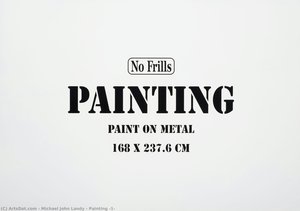 Painting (1) - Michael Landy
A central figure in the evolution of contemporary British art, Michael Landy has redefined the boundaries of the medium through a rigorous, conceptual lens. His practice is deeply rooted in the intellectual traditions of the Young British Artists (YBAs), having been shaped by his education at Goldsmiths, University of London. Landy’s significance in the 21st century stems from his ability to transform the act of creation into a profound critique of consumerism, labor, and the very systems of value that govern modern existence. Rather than merely producing objects, he often utilizes destruction and deconstruction to expose the contradictions of a material-driven society.
His 2007 work, Painting (1), serves as a quintessential example of this conceptual depth. Part of his 'No Frills' series, this piece functions as a self-descriptive consumer unit, stripping art down to its most literal, minimalist essence. By reducing the artistic gesture to a commodity-like state, Landy offers an ironic commentary on the branding of the artist and the commercial mechanics of the art market. Through such ambitious, large-scale investigations, he remains a vital voice in the landscape of 21st century painters from United Kingdom, challenging us to reconsider what we value and what we discard.
Conclusion
The landscape of 21st-century British art is defined by a profound tension between the traditional and the subversive, a duality seen in the works of these ten masters. From the provocative street-art influence of Banksy to the visceral, gestural abstraction of Cecily Brown and the intricate conceptualism of Michael Landy, these artists have pushed the boundaries of what defines a masterpiece in the modern era. Whether through the delicate layering of Ian Davenport or the bold, textural explorations of Gary Wragg, each painter has contributed a unique visual language to the contemporary British canon, ensuring that the artistic dialogue of the United Kingdom remains as vibrant and multifaceted as ever.
At Mus3ums.com, we invite you to bring this dynamic energy into your own space. Our artisans specialize in creating museum-quality, hand-painted oil reproductions that capture the soul, texture, and movement of these iconic works. Whether you are looking to honor the legacy of a contemporary legend or seeking a centerpiece that sparks conversation, you can explore our full collection and find a piece that resonates with your personal aesthetic. Transform your home or office with a timeless tribute to the brilliance of British contemporary art.


