


Introduction
The 17th century in Poland was a period of profound cultural synthesis, where the artistic traditions of the East met the sophisticated Baroque sensibilities of Western Europe. This era, often characterized by the unique Sarmatism culture of the Polish nobility, fostered a visual language that was both deeply spiritual and intensely dramatic. Painters of this period navigated a landscape of shifting borders and religious fervor, blending the meticulous detail of Northern realism with the grand, emotive gestures of the Italian and Flemish masters. Their works served as vital conduits for the intellectual and aesthetic currents flowing through the heart of Europe.
What unites these artists is their ability to capture the tension between the earthly and the divine. Whether through the solemnity of portraiture or the theatricality of religious compositions, they documented a society defined by its grandeur and its constant movement. Today, these painters remain essential for understanding the evolution of Central European art, offering a window into a world of baroque splendor, complex textures, and the dramatic use of light and shadow that continues to influence contemporary visual storytelling.
The following selection explores the diverse mastery of this golden age, highlighting ten significant figures—from the courtly elegance of Daniel Schultz to the intricate compositions of Bartłomiej Strobel—who defined the aesthetic identity of a nation during a transformative century.
Bartlomiej Strobel
 Return of the Prodigal Son - Bartlomiej Strobel
A central figure in the 17th century Polish painters movement, Bartlomiej Strobel (1591–1647) brought a sense of grand Baroque drama to the Polish courtly tradition. His work is defined by a remarkable ability to blend profound religious narratives with the decadent, lavish atmosphere of European aristocratic life. Strobel’s mastery lies in his capacity to stage complex, bustling scenes that feel both monumental and intimately detailed, capturing the social rituals of the era through a lens of dramatic light and shadow.
His representative work, Return of the Prodigal Son (1616), serves as a perfect testament to this skill. In this composition, Strobel utilizes a rigorous architectural framework to organize a crowded, palatial setting. Through the use of linear perspective—evidenced by receding floor tiles and rhythmic coffered ceilings—he creates a vast sense of depth that draws the viewer into the scene. The painting is populated by a diverse array of figures, including servants and children, all bathed in a warm, golden light that highlights the textures of a grand banquet hall. It is this seamless fusion of structural precision and emotive storytelling that secures his legacy among the premier artists of 17th century Poland.
Daniel Schultz
A central figure of the Baroque era, Daniel Schultz (1615–1683) stands as a premier representative of 17th century Polish painters. Born in the vibrant port of Gdańsk, he began his artistic journey under the guidance of his uncle, Daniel Schultz the Elder, before expanding his vision through transformative travels in France and the Netherlands. This international exposure allowed him to weave Western European currents into a style that would define the visual identity of the Polish–Lithuanian Commonwealth.
Schultz’s career was inextricably linked to the highest echelons of power, serving as a court painter to monarchs including John II Casimir Vasa and John III Sobieski. His ability to capture the psychological weight and physical grandeur of the nobility made him the era's preeminent portraitist. In his Portrait of John III Sobieski with the Order of the Holy Spirit (c. 1676), we see this mastery in full effect. The composition utilizes dramatic lighting to illuminate the intricate textures of the king's scale armor and the prestigious insignia of the Order. Through deep shadows and a commanding three-quarter length pose, Schultz transforms a formal likeness into a powerful statement of sovereignty and military prestige.
Jan Vonck
 Dog attacking a cat - Jan Vonck
Born in Torun in 1631, Jan Vonck represents a fascinating intersection of Polish origin and the Dutch Golden Age. As a painter born in Poland during the 17th century, his work carries the meticulous observational tradition passed down from his father, Elias Vonck, into the vibrant artistic hubs of Amsterdam. Vonck became a specialist in the captivating genre of living bird still lifes, often imbuing his compositions with a sense of movement and alertness that distinguished him from his contemporaries.
His mastery of the animalier tradition is vividly captured in his 1650 work, Dog attacking a cat. This piece serves as a profound study in animal tension and chiaroscuro. The composition is anchored by a light-colored dog in the lower right, its fur rendered with such fine brushwork that the texture of individual hairs is palpable. The lighting creates a dramatic contrast, pulling the viewer's eye from the alert dog toward a pile of game—including a dead hare and a bird—resting in the upper left. Through this interplay of light and shadow, Vonck captures a fleeting, tense moment, showcasing the vitality of the living against the stillness of the hunt."
Pandolfo Reschi
 Cavalry Combat - Pandolfo Reschi
In the frantic composition of Cavalry Combat (1687), the viewer is thrust into a whirlwind of motion where the distinction between man and beast blurs amidst swirling dust. This work exemplifies the visceral energy that defined the career of Pandolfo Reschi, a master who bridged the gap between his Polish origins and the height of the Italian Baroque. Born in Gdańsk in 1643, Reschi’s journey from the Polish Commonwealth to the artistic heart of Italy allowed him to synthesize Northern sensibilities with Mediterranean drama.
A pupil of Giacomo Borgognone, Reschi mastered the art of theatrical composition and dramatic lighting. He became particularly renowned for his expertise in quadratura, creating illusionistic architectural vistas that expanded the perceived space of a room. Beyond his technical skill in perspective, his oeuvre is characterized by:
- Dynamic Battle Scenes: High-energy depictions of cavalry and skirmishes.
- Evocative Landscapes: Rugged, atmospheric environments inspired by the style of Salvator Rosa.
- Chiaroscuro Mastery: A sophisticated use of light and shadow to heighten emotional tension.
Reschi remains a vital figure of 17th-century Polish painters due to his unique ability to translate his heritage into the grand, sweeping language of the Italian Baroque.
Carl Borromäus Andreas Ruthart
 Deer hunt - Carl Borromäus Andreas Ruthart
Born in Gdańsk, Carl Borromäus Andreas Ruthart (1630–c. 1703) stands as a significant figure among 17th century Polish painters, representing the sophisticated artistic exchange between the Polish-Lithuanian Commonwealth and the great workshops of Western Europe. His training began under the mentorship of Daniel Schultz, a master who provided him with a profound understanding of chiaroscuro and the dramatic interplay of light and shadow. This foundational education, combined with his later status as a guild master in Antwerp and his exposure to Habsburg patronage in Vienna, allowed Ruthart to develop a style that seamlessly blended Flemish meticulousness with the grandiosity of the Baroque era.
His oeuvre is defined by a mastery of tension and movement, often focusing on allegorical narratives and biblical themes. In his representative work, Deer hunt (1660), Ruthart demonstrates an exceptional ability to capture the frantic energy of a chase. Through the use of theatrical lighting, he illuminates the musculature of a white horse and the strained limbs of hounds against a dark, dense forest canopy. This work exemplifies his capacity to transform a violent, rhythmic pursuit into a profound study of light and shadow, cementing his legacy within the rich tradition of 17th century Polish art."
Salomon Adler
 Portrait of Giovanni Antonio Moneta - Salomon Adler
In the Portrait of Giovanni Antonio Moneta, the viewer encounters a profound study of character defined by a somber, dark brown palette. This 1677 work exemplifies the technical mastery of Salomon Adler, a painter whose career serves as a vital link between the Baltic and the Mediterranean. Born in Poland, Adler’s artistic identity was forged in the industrious atmosphere of Gdańsk, a background that informed his deep understanding of texture and material. This Northern origin places him firmly within the group of 17th century Polish painters, despite his later migration to the Italian artistic hubs of Milan and Bergamo.
Adler’s style is characterized by a sophisticated synthesis of Northern chiaroscuro and Italianate elegance. His command of light and shadow suggests a strong affinity for the Dutch tradition, particularly the psychological depth associated with Rembrandt. This technique allowed him to render the tactile reality of fabrics and the subtle nuances of human expression with remarkable precision. By blending the introspective, dramatic lighting of the North with the theatrical grace found in his Italian period, Adler created a unique visual language that captured the quiet dignity of his subjects.
Jan Kryštof Liška
 The Assumption - Jan Kryštof Liška
A visitor can immediately recognize the hand of Jan Kryštof Liška through his mastery of dramatic, vertical compositions that bridge the gap between the terrestrial and the divine. His work is defined by a profound sense of upward movement, where heavy, shadowed earthly tones give way to a celestial radiance of gold and amber. As a painter born in Wrocław, Silesia, Liška’s identity is deeply rooted in the artistic landscape of the Polish-Silesian borderlands, making him a vital figure among 17th century Polish painters.
His style was significantly shaped by his stepfather, the renowned painter Michael Willmann, and further refined during a transformative study tour of Italy between 1674 and 1680. This exposure to Italian light allowed him to master the Baroque language of swirling drapery and organic, fluid forms. In his representative work, The Assumption (1696), this training is evident; the canvas becomes a stage for spiritual ascension, utilizing a low-angle perspective to expand the scale of the figures and pull the viewer into a realm of light. His brushwork captures the very essence of grace, turning sacred mysteries into a tangible, swirling reality through intense contrast and dynamic energy.
David Loggan
 ''s Map Of Oxford, Eastern Sheet, From ''oxonia Illustrated'', Published - David Loggan
Born in the vibrant maritime atmosphere of Danzig in 1634, David Loggan represents the significant artistic connection between Polish origins and the broader European Baroque movement. His early years in this region shaped a technical virtuosity that he would later refine under masters like Willem Hondius and Crispin van de Passe II in Amsterdam. This foundation allowed him to become a vital figure in the seventeenth century, bridging the gap between Northern European training and the sophisticated social circles of London.
Loggan is particularly celebrated for his ability to translate architectural majesty into the delicate, flowing lines of engraving. His monumental topographical achievements, such as the Map Of Oxford, Eastern Sheet, From Oxonia Illustrated, Published (1675), demonstrate this mastery. This specific work, a precise bird's-eye view, captures the urban and rural layout of Oxford with remarkable cartographic accuracy. Through the medium of engraving, Loggan transformed the stone-bound geometry of the city into a structured network of ink and paper, documenting the streets and buildings of the seventeenth century with a permanence that serves as a vital visual record of the era's physical landscape.
Carl Ferdinand Fabritius
 Mountainous landscape - Carl Ferdinand Fabritius
Born in Warsaw, Carl Ferdinand Fabritius represents the significant movement of Polish-born artists who shaped the visual landscape of Central Europe during the 1600s. His career, spanning from his birth in 1637 until his death in 1673, was defined by a profound connection to the topography of the Bishopric of Paderborn. This connection was solidified through a major commission from Prince-Bishop Ferdinand of Fürstenberg, who tasked Fabritius with documenting the diocese through sixty-three landscape paintings between 1664 and 1667.
Fabritius was a master of topographical accuracy, using oil on canvas to record the architectural and natural essence of settlements such as Schieder-Schwalenberg and the monastery at Closter Bödeke. His work is characterized by a meticulous eye for detail, often focusing on the sturdy walls of castles and the quiet presence of monastic structures. In his representative work, Mountainous landscape (1661), he demonstrates a sophisticated command of light and shadow. The composition utilizes a dark, textured woodland in the foreground to guide the eye toward travelers in the middle ground, eventually dissolving into hazy, luminous mountains. This ability to balance tactile, high-contrast foregrounds with soft, aerial perspective makes him a vital figure among 17th century Polish painters.
Szymon Czechowicz
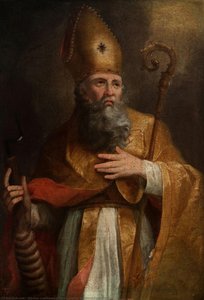 Saint martyr Erasmus from Formia - Szymon Czechowicz
Szymon Czechowicz represents a vital bridge in the evolution of Polish art, emerging from the late 17th-century traditions to become a master of the Baroque and early Rococo periods. Born in Kraków, his artistic identity was profoundly shaped by his formative years in Rome, where he studied at the prestigious Accademia di San Luca under the tutelage of Benedetto Luti. This Roman apprenticeship allowed him to absorb the dramatic chiaroscuro and idealized forms of the Italian masters, which he later infused with a uniquely Polish sensibility and a delicate, luminous color palette.
His ability to blend intense psychological depth with sublime sacral themes is perfectly captured in Saint martyr Erasmus from Formia. In this work, executed around 1700, we see the artist's command over light and shadow as he depicts the bishop in his liturgical robes. The composition utilizes dramatic lighting to build volume and texture, emphasizing the solemnity of the saint's martyrdom. Through his meticulous attention to detail and masterful handling of light, Czechowicz solidified his reputation as one of the most accomplished painters of his era, leaving a lasting legacy on the visual language of Polish religious and portrait art."
Conclusion
The 17th century was a transformative era for Polish art, characterized by a sophisticated fusion of Northern European realism and the grandiosity of the Baroque. From the intricate portraiture of Daniel Schultz and the dramatic compositions of Bartlomiej Strobel to the refined elegance found in the works of Szymon Czechowicz, these masters collectively defined a visual language of prestige and spiritual depth. Whether capturing the likeness of nobility or the atmospheric nuances of a landscape, these artists left an indelible mark on the cultural heritage of the region, blending local traditions with the broader currents of European art history.
At Mus3ums.com, we invite you to bring this rich historical legacy into your own space. Our artisans specialize in creating museum-quality, hand-painted oil reproductions that honor the specific brushwork and tonal complexity of these masters. You can explore our full collection to find the perfect piece and experience the timeless beauty of these 17th-century masterpieces through a bespoke, handmade work of art.


