The Architect of Perception: Victor Vasarely’s Bauhaus Roots and Geometric Vision
To understand the rhythmic pulse of Op Art, one must first look toward the foundational principles that shaped its most profound pioneer, Victor Vasarely. Born Károly Vaszary in the historic landscapes of Pécs, his journey was not initially destined for the canvas; he began his academic pursuits in the rigorous field of medicine. Yet, the pull of visual structure and the mathematical elegance of form eventually led him to the prestigious Podolini-Volamb and Sándor Bortnyik’s workshop. It was here that the seeds of a revolution were sown. Vasarely did not merely seek to paint; he sought to engineer sight itself.
His aesthetic language is deeply rooted in the Bauhaus tradition, embracing a philosophy where functional design meets pure abstraction. This influence allowed him to strip away the anecdotal and the figurative, leaving behind a skeletal structure of geometry that speaks to a universal truth. By integrating the principles of modern design with a painterly sensibility, Vasarely transformed the canvas into a laboratory of movement. For the discerning collector, his work represents more than just aesthetic pleasure; it is an intellectual engagement with the very origins of modernism and the disciplined beauty of structural abstraction.
The Science of Sight: Decoding the Optical Illusions of Op Art
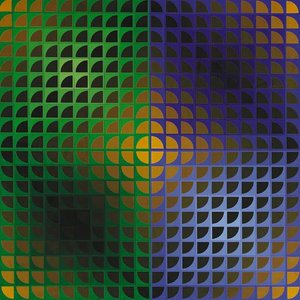
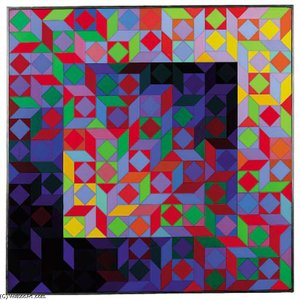
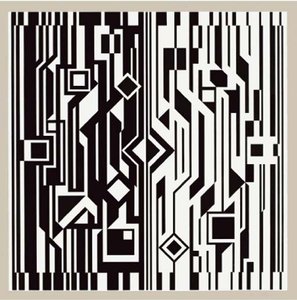
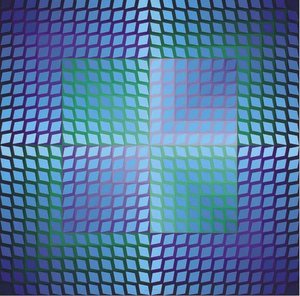
There is a profound, almost scientific tension held within a Vasarely composition—a delicate dance between what the eye perceives and what the mind knows to be true. This is the essence of Op Art, a movement that transcends mere decoration to challenge the neurological processing of light and shadow. When one gazes upon works such as Kaglo II, the retina is met with a complex arrangement of shapes that seem to undulate and breathe. The artist utilizes precise geometric arrangements to trigger physiological responses, creating a sensation of depth, flickering, or rotation where none physically exists.
This mastery of illusion relies on the strategic manipulation of contrast and edge. By placing certain colors in proximity, Vasarely forces the eye to struggle with boundaries, creating a kinetic energy that makes the static surface feel alive. It is an immersive experience that demands the viewer's full attention, turning the act of looking into an active, participatory event. For those who appreciate the intersection of art and cognitive science, these works offer a continuous discovery, as each shift in perspective reveals new layers of structural complexity and hidden dimensions within the flat plane of the canvas.
Chromatic Vibrancy: The Internetic Play of Color and Form in Vasarely’s Masterworks
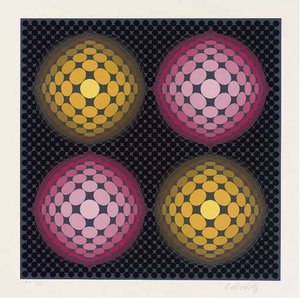
While geometry provides the skeleton of his work, color serves as its vital, pulsing blood. Vasarely’s palette is rarely passive; it is a deliberate tool used to orchestrate movement and weight. In pieces like Boglar - L, we observe how a deep blue background can act as an infinite void, allowing scattered yellow circles to appear as if they are floating or drifting through space. The variation in size and the calculated angles of these elements create a dynamic rhythm that prevents the eye from ever finding a place of rest, ensuring a state of perpetual visual engagement.
The interplay between hue and form is where the true magic of his technique resides. He utilizes color not just to fill shapes, of course, but to define them, to push them forward toward the viewer, or to recede them into the background. This chromatic strategy creates a sense of architectural volume within a two-dimensional space. For the collector, this vibrancy offers a unique opportunity to introduce energy and light into a curated environment, as his works possess an inherent luminosity that can transform the atmosphere of a room through the sheer power of saturated, purposeful pigment.
From Canvas to Consciousness: The Legacy of Kinetic Abstraction in Modern Collecting
The legacy of Vasarely’s kinetic abstraction extends far beyond the mid-century era, finding new resonance in the contemporary art market. As we move further into an age dominated by digital screens and rapid visual consumption, the tactile, physical reality of Op Art offers a grounding yet stimulating counterpoint. Collectors today are increasingly drawn to works that offer a "physicality of thought"—art that requires time, focus, and a willingness to engage with the mechanics of vision.
This movement has paved the way for a broader appreciation of abstraction in modern interiors, where the goal is often to create spaces of contemplation and intellectual stimulation. The enduring appeal of Vasarely lies in his ability to bridge the gap between the mathematical and the emotional. His works do not merely sit on a wall; they inhabit a space, interacting with the light and the architecture around them. As such, acquiring a piece of this lineage is an investment in a timeless dialogue between the human eye and the infinite possibilities of geometric form.
Curating the Illusion: Integrating Op Art into Sophisticated Interior Design
Integrating the vibrant, high-energy world of Op Art into a sophisticated interior requires a nuanced approach to curation. Because Vasarely’s works are inherently powerful and visually demanding, they serve best as focal points within a carefully balanced composition. In a minimalist setting, a large-scale geometric print can act as the primary architectural element, providing much-needed texture and movement to an otherwise quiet room. Conversely, in more eclectic or maximalist spaces, these works can provide a sense of structural cohesion, anchoring diverse elements through their disciplined use of form.
When selecting pieces for a professional or residential collection, consider the interplay of scale and light. Large-format works, such as custom-painted murals or multi-panel sets, can recreate a sense of grandeur reminiscent of historical frescoes while maintaining a strictly modern edge. The key is to allow the artwork enough "breathing room" to perform its optical magic. By pairing these illusions with neutral tones or complementary architectural textures, one ensures that the brilliance of the color and the complexity of the pattern remain the undisputed protagonists of the space, creating an environment that is both intellectually stimulating and aesthetically sublime.
At Mus3ums.com, we celebrate this enduring legacy of masterworks. Whether you are seeking a meticulously hand-painted oil reproduction that captures the tactile impasto of a period masterpiece or looking to commission a custom transformation of a personal memory into a geometric abstraction, our mission is to bring the profound beauty of art history into your modern life. From professional digital mockups to global delivery of museum-grade canvases, we provide the expertise and craftsmanship required to curate a collection that truly masters the art of illusion.