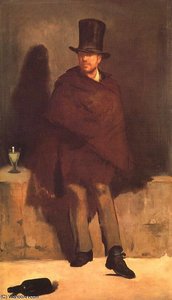
Édouard Manet, 1881. He can barely walk. He's got a cane, a wasting nerve disease eating away at his legs, and roughly two years left, though he doesn't know the exact number yet.
And what does he do with the time?
He hires a real barmaid from a real nightclub — the Folies-Bergère, the loudest, gaudiest entertainment palace in Paris — and gets her to stand in his studio behind an actual bar he's had built, surrounded by actual bottles, for weeks, so he can paint the most quietly devastating picture of alienation in the whole nineteenth century.
That's not a man phoning it in at the end. That's a man spending his last strength on the hardest painting of his career.
Now here's the sentence that should annoy you: you can own that painting, at its exact real size — 96 by 130 centimetres, the size Manet actually painted it — for around €458.
Not a poster. Not a giclée. An actual hand-painted oil on canvas, made by a real painter with real skill, at the real dimensions of a dying man's masterpiece, for less than most people's monthly rent. I checked the live price on OriginalUniqueArt.com's catalogue while writing this: a 96 x 130 cm hand-painted oil of A Bar at the Folies-Bergère quotes at €458, right now, no phone call required.
The Received Wisdom, and Why It's Cowardice Dressed as Taste
"A reproduction is a fake. Only the artist's own hand counts. A copy, however skilled, is worthless — the value lives entirely in whose fingers touched the paint first."
This is a comforting story if you can afford the original and a nightmare if you can't, which tells you exactly who invented it.
It also falls apart the second you actually look at what's in the painting, because Manet built the whole thing around a trick that has nothing to do with whose hand held the brush and everything to do with what the picture makes you, the viewer, do.
Decoding "A Bar at the Folies-Bergère," Item by Item
Stand in front of it. Here's what's actually going on:
- The barmaid's face. Blank. Exhausted. Staring at nothing, or at you, it's genuinely hard to tell — which is the point. She's called Suzon, and she's not performing "welcome to the club" for the customer. She's just tired. This is a woman at work, not a woman having fun, and Manet refuses to prettify that.
- The mirror behind her. This is the whole con. Physics says her reflection should be directly behind her. It isn't — it's shifted to the right, showing her leaning in to talk to a top-hatted man who, according to the geometry of the room, should be standing exactly where you are standing.
- That means the customer in the mirror is you. Manet has put the viewer into the position of the man she's serving, whether you asked for that role or not. It's an optical trick with a social gut-punch behind it: you're implicated in the transaction the moment you look.
- The bottles. There are two bottles of Bass Pale Ale on that marble counter, red triangles deliberately turned to face you. The Bass red triangle is UK Trade Mark No. 1 — the very first trademark ever registered in Britain, secured on 1 January 1876 by a Bass employee who queued outside the registrar's office overnight to be first through the door.
- Manet signed the painting on a bottle label. Not in the corner. On a label, in the row of bottles, reading "Manet 1882." Scan that counter left to right: the artist's own signature, the world's first registered trademark, and Champagne. Three kinds of brand, lined up on a bar, in 1882.
- The trapeze artist's green boots, top left corner, barely visible. A whole circus act is happening above her head while she stands there, static, unmoved, selling drinks.
This is not a nice painting of a nice night out. It's a painting about being a body other people look at for a living, built by a man who by 1882 understood exactly what it felt like to be trapped inside a failing body himself.
The Biographical Key: He Built the Set for a Painting He Wouldn't Live to See Hung
Manet had untreated tertiary syphilis, which had become tabes dorsalis — degeneration of the nerves in the dorsal column of the spinal cord. It steals your balance, your coordination, eventually your legs.
The timeline is brutal and specific. 1878–79: the first severe shooting pains in his leg. After 1879: chronic pain becomes an almost permanent condition; standing upright for any length of time becomes difficult. 1882: he paints the Bar. April 1883: he's dead.
So when I say he built a bar in his studio and had a barmaid stand at it for weeks — understand that this is a man who could barely stand up himself, constructing a set so that somebody else could do the standing while he solved the hardest optical problem of his career sitting down.
That's the key fact. Not "sad dying man." Defiant dying man, spending his last working months on the single most technically ambitious composition he ever attempted.
The Real Story: Skill Exists Twice Here — Once in Manet's Hand, Once in the Copyist's
Here's the triumph, and it's not the one the snobs expect.
A hand-painted reproduction of the Bar at the Folies-Bergère is a second act of real, difficult, human skill — a trained painter has to solve Manet's mirror trick with a brush, by eye, matching values and that impossible shifted reflection, without the shortcuts a printer gets. That's not nothing. That's a genuine craft, done by a real person, for real money, right now.
Most of the world's hand-painted reproductions come out of one place: Dafen, an oil-painting village outside Shenzhen, which at its peak produced an estimated 60–70% of all new oil paintings on Earth. That's not a scandal. That's an industrial-scale guild of working painters, and it's the entire reason a hand-painted 96 x 130 cm oil costs around €458 instead of €4,550.
On OriginalUniqueArt.com the price runs off a plain formula — area plus a fixed setup cost — and every option is priced separately and openly, which is worth noticing: senior/elite artist assignment costs around €87 extra, and it exists precisely because skill varies between painters the way it never does between two prints from the same file. Pay it. It's the cheapest insurance in the whole tier.
The Grid: Five 1:1 Hand-Painted Oils, All Under €500
Live-checked against OriginalUniqueArt.com's catalogue. Two of the five below I priced myself, today, on the real artwork page — the numbers are close enough to the catalogue's published figures from a few days earlier that the formula's honesty is the actual headline here.
| # | Work | Original size | Where the real one hangs | 1:1 hand-painted oil |
|---|---|---|---|---|
| 1 | Claude Monet — Impression, Sunrise (1872) | 48 x 63 cm | Musée Marmottan Monet, Paris | €208 |
| 2 | Claude Monet — La Gare Saint-Lazare (1877) | 75 x 104 cm | Musée d'Orsay, Paris | €333 |
| 3 | Claude Monet — The Walk (Woman with a Parasol) (1875) | 100 x 81 cm | National Gallery of Art, Washington | €341 |
| 4 | Edgar Degas — Miss La La at the Cirque Fernando (1879) | 117.2 x 77.5 cm | The National Gallery, London (NG4121) | €369 (live-checked today) |
| 5 | Édouard Manet — A Bar at the Folies-Bergère (1882) | 96 x 130 cm | The Courtauld Gallery, London | €458 (live-checked today) |
The ceiling of this tier is roughly 14,213 cm² — bigger than every canvas on that list. Options that stack on top: elite artist +€87, varnish +€13, extra face for portraits +€22 each, urgent production +€26.
The One You're Missing: Degas, at the Top of a Staircase, Obsessed
Degas isn't the barmaid's story, he's a different fight entirely.
Between 19 and 25 January 1879 — one week — Degas went to the Cirque Fernando at least four times to watch a mixed-race aerialist called Miss La La, who was hauled up into the rafters of the circus dome, by the Morgan Library's account nearly seventy feet up, suspended by nothing but a rope clenched between her teeth.
Four visits in seven days. Numerous notebook sketches on site, then at least four separate pastel studies afterwards, working out the exact, dizzying, foreshortened angle from directly below so the architecture rushes upward and you feel the same vertigo the crowd felt.
He showed it at the Fourth Impressionist Exhibition later that same year. The Courtauld Fund trustees bought it for the nation in 1925; it hung at the Tate, moved to the National Gallery in the 1950s, and got its own dedicated show there — Discover Degas & Miss La La — in 2024. It took the art establishment about a hundred and forty-five years to give her the billing Degas gave her in a week.
He was, by every account, a genuinely difficult man — snobbish, prickly, later reactionary in ways history doesn't excuse. And he still spent months of obsessive craft elevating a working-class woman of colour to the ceiling of art history, literally, in a painting that's still one of the most technically dazzling things the whole movement produced.
You don't have to like Degas the man to buy Degas the painting. Nobody's asking you to.
Three Questions You're Actually Asking Yourself Right Now
Is it fake if a real person painted it, just not Manet himself?
No. "Fake" means claiming to be something you're not — a forgery signed with someone else's name, sold as an original. A declared hand-painted reproduction is neither of those things. It's a new painting, honestly labelled, made by a real trained painter solving Manet's optical trick by hand. Manet's own hand made the first solution. A copyist's hand makes another. Both required real skill. Only one requires €458 instead of nine figures.
Am I paying for genius, or just for a formula that spat out a number?
Both, honestly, and that's fine. The formula prices the area and the setup cost — the business of a made-to-order painting. It doesn't price the skill, which is why the elite-artist option exists as a separate line item, and why quality varies between two copyists the way it never does between two prints. You're buying real labour at an honest, transparent price. That's not an insult to Manet. It's closer to how he'd have priced a commission himself.
Would Manet be furious that people copy his paintings, or would he not care at all?
Manet spent his career being furious at the official Salon for rejecting his work and calling it vulgar, unfinished, improper. He wasn't precious about his own image circulating — he wanted to be seen, wanted to provoke, wanted the argument. A world where a dying man's most technically difficult painting gets hand-copied and hung in ordinary dining rooms across Europe, a century and a half later, for the price of a second-hand fridge, is a world where Manet won. He'd take that trade.
Who Charges What, and Who's Bluffing
Observed August 2026. This is where the mystique goes to die.
| Vendor | What it makes | Comparable oil, this tier | Extra options | Returns | Notes |
|---|---|---|---|---|---|
| OriginalUniqueArt.com | Hand-painted 1:1 oils of Impressionist masterworks, plus originals by exclusive artists | €208–€458 for the five works above | Elite artist +€87, varnish +€13 | 100-day money-back | Formula-priced by area, published up front, no quote form |
| AllPaintingsStore.com | Hand-painted oil and giclée | Same formula, same range | Same option set | 100-day money-back | General reproduction catalogue |
| Most-Famous-Paintings.com | Hand-painted oil and giclée, masterpiece-first catalogue | Same formula, same range | Same option set | 100-day money-back | Museum-piece angle |
| MFA Images (Museum of Fine Arts, Boston) | Archival giclée prints licensed from the museum's own collection — no hand-painted oil option | Priced per print, on request | N/A — prints only | Per museum shop policy | Institutional legitimacy; you cannot buy a hand-painted oil from them at any price |
| Fabulous Masterpieces (UK) | Hand-painted oil, portraits and masterwork reproductions | From £197 + VAT for comparable sizes | Quote-based | Not stated on landing page | 4–6 weeks turnaround |
| TOPofART | Hand-painted oil, plus giclée on canvas and paper | €944–€1,084 for a comparable oil | Not itemised on the site | Policy exists; see returns page | Roughly two to four times the price above for the equivalent square footage |
Notice what MFA Images actually is: a museum shop selling licensed prints of its own collection, which is an entirely honest and different business from a hand-painted-oil studio, and not a competitor on price at all — it simply doesn't offer the product this article is about. TOPofART, by contrast, sells the same category of object at two to four times the price. Neither is a scandal. They're different labour markets wearing similar-looking listings.
The Kick
The people who tell you a hand-painted reproduction is worthless never mention that the same industry, the same workshop system, the same trained hands, is the only reason a €458 painting can solve Manet's mirror trick at all.
They're not defending Manet's genius. They're defending a price tag that keeps genius out of your dining room.
A dying man built a bar in his studio and made the hardest painting of his life. You can hang it, real size, for less than a month's rent. That's not a compromise. That's the whole point of the trick he built finally paying off — for you.
Frequently Asked Questions
How much does a 1:1 hand-painted Impressionist reproduction cost?
Under €500 for true-to-size hand-painted oils of most of the movement's smaller and mid-sized canvases: Monet's Impression, Sunrise (48 x 63 cm) around €208, Degas's Miss La La at the Cirque Fernando (117.2 x 77.5 cm) around €369, Manet's A Bar at the Folies-Bergère (96 x 130 cm) around €458 — both of the latter two live-checked against the real catalogue while writing this.
Is a hand-painted reproduction fake art?
No, provided it's sold as what it is. A forgery claims false authorship. A declared reproduction makes no such claim — it's a new object, honestly labelled, made by a real painter.
Why is Dafen village important to this price?
Dafen, an oil-painting village outside Shenzhen, produced an estimated 60–70% of the world's new oil paintings at its peak. That concentrated, industrial-scale guild of trained painters is the entire reason a hand-painted 96 x 130 cm oil costs a few hundred euros instead of a few thousand.
Should I pay extra for the elite-artist option?
Usually yes, if the budget allows it. The base price prices the canvas area, not the hand. Skill only enters the price as a separate line item — commonly around €87 — and it's the cheapest way to close the quality gap between one copyist and another.
Sources
Manet, the Bar, and the bottles
- A Bar at the Folies-Bergère — The Courtauld
- A Bar at the Folies-Bergère — Wikipedia
- Suffering, Unfaltering Manet — Colin B. Bailey, The New York Review of Books
- Manet's "A Bar at the Folies-Bergères" includes an early example of product placement — Artsy
- The red triangle that made history: 150 years of UK Trade Mark no. 1 — UK Intellectual Property Office
- The Manufacturer's Signature (PDF) — Noam M. Elcott, Columbia University
Degas and Miss La La
- Miss La La at the Cirque Fernando (NG4121) — The National Gallery, London
- Miss La La at the Cirque Fernando — Wikipedia
- Degas, Miss La La, and the Cirque Fernando — The Morgan Library & Museum
The reproduction industry
- Chinese village produces 60% of world's replica oil paintings — Nikkei Asia
- Dafen Oil Painting Village: the world's art factory — Al Jazeera
Live catalogue references
- A Bar at the Folies-Bergère — Manet, live-quoted at €458 for a 96 x 130 cm hand-painted oil, checked while writing this article.
- Miss La La at the Cirque Fernando — Degas, live-quoted at €369 for a 77.5 x 117.2 cm hand-painted oil.
Data as of 11 August 2026. EUR, ex-frame, ex-options. Price tables in this category go stale fast — check the live order page before quoting these numbers back at anyone.