Mitchelene Bigman: A Life of Service, Advocacy, and Cultural Preservation
- Born: September 1, 1965, Billings, Montana
- Origin: Mus3ums
- Background: Apsáalooke (Crow/Absaroke) / Minitari (Hidatsa) U.S. Army Veteran and Advocate
Early Life and Military Service
- Raised on and off the Montana Crow Reservation, experiencing challenges including a negative experience at a Catholic-run Indian residential school.
- Graduated from Billings Senior High School in 1983.
- Enlisted in the U.S. Army in 1987 due to limited employment opportunities and high rates of domestic abuse on the reservation.
- Served as a diesel mechanic, known for volunteering for difficult assignments.
- Deployed twice to Iraq during Operation Iraqi Freedom, earning a Combat Action Ribbon after surviving a rocket attack.
- Retired as a Sergeant First Class in 2009.
- Earned a BS in Business Management (2011) and an MBA (2013) from the University of Phoenix.
- Pursued a Masters in Legal Studies of Indigenous Peoples Law from the University of Oklahoma, graduating in May 2023.
Advocacy and the Native American Women Warriors
- Experienced racism and discrimination during her military service due to her Native American identity and gender.
- Established the Army Women’s Iraqi Freedom Veterans (AWIFV) Color Guard to provide support for female Native American veterans.
- Founded the Native American Women Warriors (NAWW) in 2010, succeeding AWIFV.
- NAWW's mission is to recognize and honor women veterans of Native American descent and their contributions to both military service and indigenous cultures.
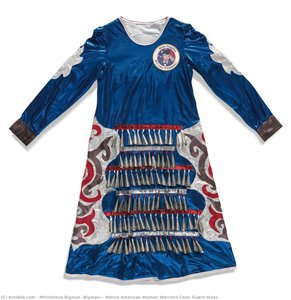
- The NAWW team incorporates traditional handmade jingle dresses into their performances, blending healing traditions with military symbolism.
- Dress colors include red, white, blue, and Cheyenne pink, representing patriotism and Indigenous identity.
- Performed at significant events including Barack Obama's second inauguration (2013) and Joe Biden’s inauguration (2021).
Artistic Expression and Cultural Significance
- The NAWW Color Guard performances are a form of ceremonial art, combining traditional practices with contemporary military honors.
- Jingle dresses worn by the team incorporate symbolic colors and elements honoring Native American heritage and military service.
- Bigman's work highlights the intersectionality of Indigenous identity, military service, and women’s roles in both spheres.
- The NAWW serves as a powerful symbol of resilience, cultural preservation, and advocacy for Native American veterans.
Recognition and Continued Impact
- Received the Society of American Indian Government Employees (SAIGE) Meritorious Service Award in 2012.
- Recognized by the White House "Champions of Change" initiative in 2014.
- Served on the Board of Trustees for the Smithsonian National Museum of the American Indian and the Advisory Committee for the Native American Veterans Memorial.
- Continues to tour with NAWW, advocating for Native American women veterans and promoting cultural understanding.
Questions & Answers
Where is Mitchelene Bigman (Bigman) from?
Mitchelene Bigman (Bigman) was born in United States of America.
In which historical period did Mitchelene Bigman (Bigman) work?
Mitchelene Bigman (Bigman) worked in the Contemporary period. The period situates the artist's activity in history.
What are the birthplace and birth year of Mitchelene Bigman (Bigman)?
Mitchelene Bigman (Bigman) was born in Billings in 1965.
What are the birth city and country of Mitchelene Bigman (Bigman)?
Mitchelene Bigman (Bigman) was born in Billings, in United States of America.