Early Life, Family and Training
London, 1960. Simon Callery enters the world in the United Kingdom, a beginning that sets the stage for a life spent navigating the complexities of urban and psychological landscapes. His early education takes him away from the English capital to Campions school in Athens, Greece. This period in Greece marks a formative chapter before he returns to the United Kingdom to pursue a formal path in the arts.
The focus shifts to Cardiff College of Art. Here, the trajectory of his practice begins to take shape through a rigorous engagement with form. He does not start with the brush; instead, Simon Callery initially trains as a sculptor. This early foundation in three-dimensional space and the physical properties of objects informs his later approach to the canvas. By 1983, he emerges from the college with a first-class honours degree, possessing a technical command that bridges the gap between the sculptural and the pictorial.
Artistic Career and Major Exhibitions
The momentum builds in 1986 when Callery wins the Gold Medal for Fine Art at the National Eisteddfod of Wales. By 1989, his presence in the London scene is marked by an exhibition at the Whitechapel Open. These early milestones lead into the mid-nineties, a period of significant institutional recognition. In 1994, he is included in the landmark Young British Artists III exhibition at the Saatchi Gallery, a moment that places his work within the center of a major shift in British contemporary art.
The trajectory continues through the late nineties. In 1996, he is selected as one of 19 artists for a major exhibition at the Oxford Museum of Modern Art, focusing on the best of British painting in the decade. This is followed by his inclusion in the 1997 Sensation exhibition at the Royal Academy of the Arts in London. His work moves through these high-profile venues, transitioning from the experimental energy of the Saatchi era to established presence in major collections.
The Segsbury Project and Commissions
In 2003, the focus shifts from the urban to the ancient. Callery moves into the landscape of the Ridgeway, working alongside archaeologists to engage with the physical remnants of the past. The site spans a Bronze Age ditch and an Iron Age hill fort located in Wiltshire and Oxfordshire. This is not a purely observational endeavor; it is a direct confrontation with history through the medium of the Segsbury Project. The work here expands beyond the canvas, incorporating both sculpture and photographs to interpret the site.
The scale of the project dictates its presentation. This major exhibition avoids the standard gallery circuit, appearing at only two specific UK venues: Dover Castle and the Storey Gallery. It marks a period where Callery’s interests intersect with architectural forms and the material reality of historical sites. His collaborations with architects further emphasize this preoccupation with spatial relationships and the structural essence of the environment.
Technique and Artistic Style
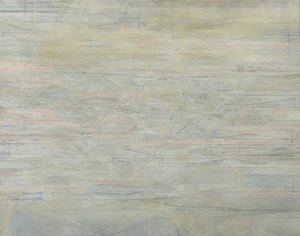
The canvas becomes a site of physical interrogation. Callery dismantles the cityscape, stripping away literal architecture until the urban environment is reduced to a conceptual image. He works with a heavy, layered materiality, building up fragmented textures that demand a slower pace of observation. The paintings do not rush to be understood; they exist to be sensed. Through a careful manipulation of muted colour, line, and rhythm, he creates a sense of luminosity that pulls the viewer into a quiet, meditative state. The scale of the work often dictates the physical response, forcing a confrontation with the surface.
Materiality extends beyond the application of pigment. Callery pushes the boundaries of the medium by physically altering the support. He sometimes punctures the canvas, breaking the traditional barrier between the viewer and the interior of the work. In Flat Painting Bodfari 15 Caput Mortuum (2015), this technique allows for a simultaneous view of the painting’s interior and exterior. This approach challenges the standard definition of a painting, turning the object into a three-dimensional presence that occupies space rather than merely representing it.
Key Works and Catalogued Pieces
The early 1990s find Callery producing works that define his transition into abstraction. Around 1993, he produced Borough and Trinity, a piece held within the Arts Council Collection, London. During this same period, he created Nefos, which is part of the Paintings, London collection. These works emerge from a period of intense experimentation with the urban form. By 1996, his output included Archive, marking a continued exploration of his conceptual approach to the painted surface.
His later practice involves a physical interrogation of the canvas that moves beyond traditional boundaries. In 2015, he produced Flat Painting Bodfari 14/15 Ferrous, a work constructed from canvas, distemper, thread, wood, and aluminium. This piece reflects a shift toward materiality where the physical components of the object become as significant as the visual image. The work exists as a site where the distinction between a painting and a sculptural object begins to blur.
Questions & Answers
What are the birthplace and birth year of Simon Callery?
Simon Callery was born in London in 1960.
What are the birth city and country of Simon Callery?
Simon Callery was born in London, in United Kingdom.