


Origins and History of the Institution
The American Museum of Natural History began with a concept devised in 1861 by the naturalist Albert S. Bickmore. His vision for a dedicated space for natural history eventually led to the formal establishment of the institution in 1869. The museum first opened its doors within Central Park's Arsenal on May 22, 1871. This early period marked the beginning of a long-standing presence in New York City, United States of America.
As the collections grew, the need for permanent, purpose-built structures became evident. The first such building, situated in Theodore Roosevelt Park, opened on December 22, 1877. This expansion allowed for the organized study and display of the vast array of specimens that would define the institution. Today, the American Museum of Natural History operates as a private 501(c)(3) organization, maintaining its commitment to the scientific study of the natural world.
The Architecture and Building Design
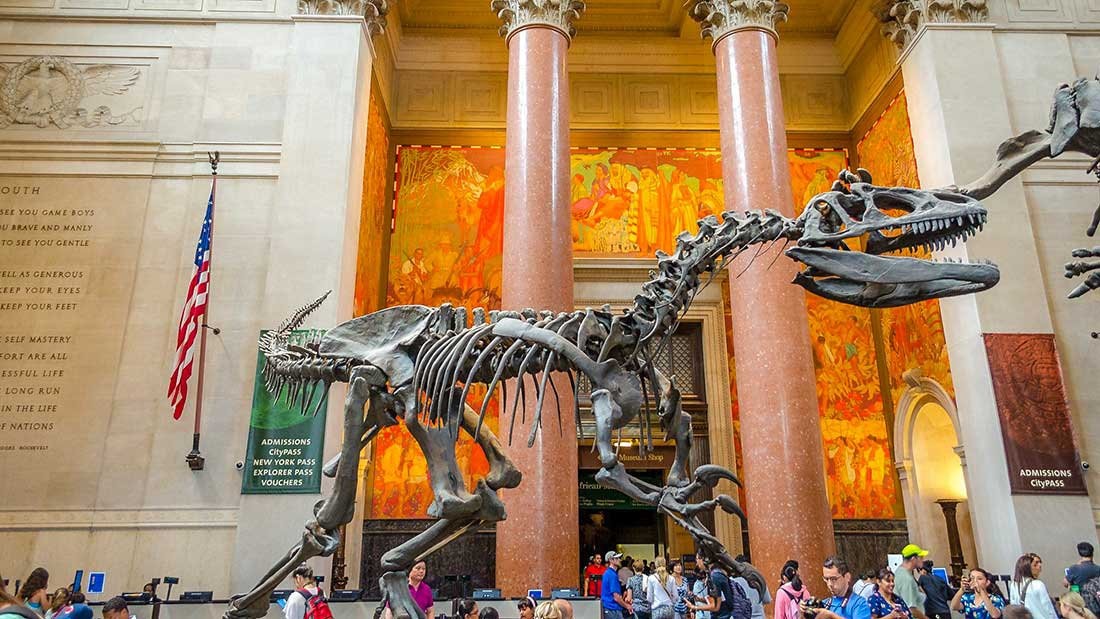
The museum complex occupies more than 2,500,000 square feet across twenty-one interconnected buildings. This sprawling arrangement of structures creates a sense of continuous discovery within the Upper West Side of Manhattan. The main entrance pavilion, added in 1936 and named for Theodore Roosevelt, provides a formal threshold to the interior spaces. This Beaux-Arts monument anchors the presence of the institution against the backdrop of Theodore Roosevelt Park.
A different architectural language emerges at the Rose Center for Earth and Space. Added in 2000, this structure introduces a distinctive geodesic sphere designed by Michael Graves. The geometry of the sphere offers a sharp contrast to the historical styles found in the older wings. It remains a prominent feature of the skyline, inviting contemplation of the cosmos through its modern silhouette.
The interplay between these various eras of design defines the physical experience of the site. Light filters through the exhibition halls, illuminating the diverse materials and forms that constitute the museum's footprint. The transition from the classical lines of the 1936 pavilion to the futuristic curves of the Rose Center reflects a long history of expansion and structural evolution.
The Dinosaur and Fossil Collections
The fossil halls offer a profound encounter with deep time. Within the David H. Koch Dinosaur Wing, two famed halls house the remains of prehistoric life. Towering Tyrannosaurus rex and Stegosaurus skeletons command the space, their massive forms casting long shadows across the galleries. These structures exist as physical presences, allowing for a direct confrontation with the scale of ancient biology. The meticulous reconstruction of these giants provides a sense of the creatures' actual dimensions and presence.
Beyond the dinosaur halls, the Lila Acheson Wallace Wing of Mammals and Their Extinct Relatives expands the scope of the collection. This space focuses on the evolutionary history of mammals, including those that no longer walk the earth. The transition from ancient life to the modern era is traced through these preserved remains. The museum's commitment to these collections ensures that the history of life on Earth remains tangible and visible.
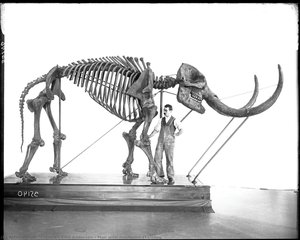
- Man with mastodon skeleton - Clarence Emil Anderson
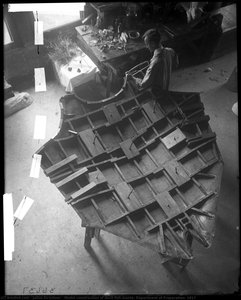
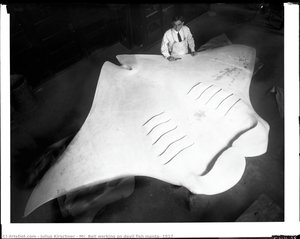
- Mr. Bell working on devil fish manta, 1917 - Julius Kirschner
- Model construction of devil fish manta, Department of Preparation, 1917 - Julius Kirschner
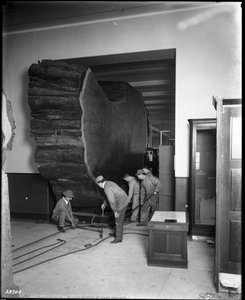
- Moving section of giant sequoia, - Julius Kirschner
Ocean Life and Marine Ecosystems
The Irma and Paul Milstein Family Hall of Ocean Life offers a quiet encounter with the vastness of the sea. Within this space, more than 750 marine organisms are arranged to illustrate the complexity of aquatic life. The presence of a colossal blue whale dominates the hall, a silent inhabitant that commands the scale of the room. It hangs suspended, a massive physical reality that anchors the surrounding exhibits.
Fourteen dioramas and eight ocean ecosystem displays provide a structured view of life beneath the surface. These arrangements attempt to replicate the specific conditions of various marine environments. The collection highlights the diversity of these ecosystems, from the shallow reaches to the deeper, darker zones. Each display focuses on the biological realities of the organisms that inhabit them.
Exhibitions and Scientific Research
The institution functions as a massive repository of biological and geological history, containing approximately 32 million specimens. This vast collection is managed by a full-time scientific staff of 225 individuals. These researchers conduct studies across diverse disciplines, from the complexities of evolutionary biology to the shifting patterns of climate science. Beyond the halls of the museum, the work continues through more than 120 special field expeditions sponsored each year.
Scientific inquiry here extends into the digital and microscopic realms. Specialized collections for genomic and astrophysical data, as well as frozen tissue, allow for research that transcends the visible. The museum's commitment to understanding the natural world is reflected in its ongoing efforts to make these scientific findings accessible. This dedication to discovery ensures that the specimens held within the walls remain part of a continuous, evolving narrative of life on Earth.