

Origins and History of the Church
Church Santa Maria delle Grazie is a church and Dominican convent located in Milan, Italy. The site originated as a small chapel dedicated to Santa Maria delle Grazie. In 1463, Duke Francesco I Sforza established the complex as a tribute to Saint Mary of Miracles. Construction of the church and the convent proceeded from 1463 onwards under the direction of Guiniforte Solari.
The development of the site reflects the shifting patronage of Milanese nobility. While the initial structures were established in the mid-15th century, the complex underwent significant changes as it became a burial site for the Sforza family. This evolution contributed to its eventual designation as a UNESCO World Heritage Site in 1980.
The historical layers of the site include:
- The Gothic nave designed by Guiniforte Solari
- The Renaissance apse and tribune attributed to Donato Bramante
The Building and Its Architecture
The structure is a study in the transition between the Gothic and Renaissance traditions. Guiniforte Solari designed the convent and the original Gothic nave, which retains its pointed groin vaults and ribbed ceiling. This older section provides a verticality that contrasts with the later additions. The nave remains a hall church design, characterized by its three-aisle layout and the weight of its stone construction.
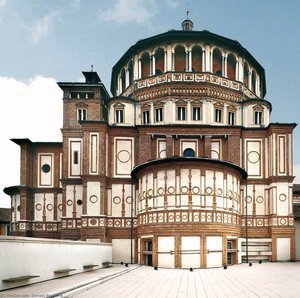
Donato Bramante later reimagined the church, introducing the principles of the High Renaissance to the existing site. His intervention included the addition of large semi-circular apses and a drum-shaped dome. This dome is surrounded by columns, creating a sense of mathematical proportion. The apse and tribune feature Corinthian columns and marble panels, marking a departure from the earlier Gothic elements toward classical harmony.
The architectural dialogue between these periods is visible in the way the light interacts with the different surfaces. While the nave maintains its medieval character, the tribune reflects the refined geometry of the Renaissance. The building functions as a religious space and a site for significant historical works, including:
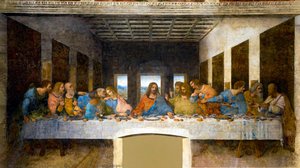
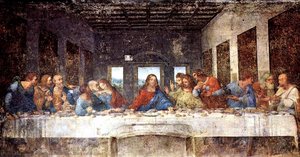
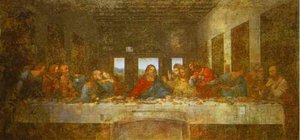
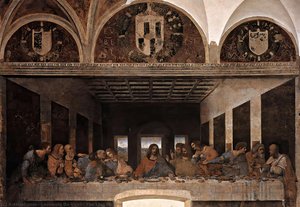
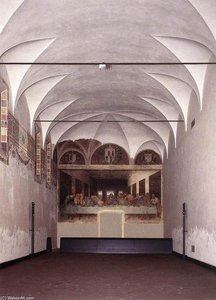
- The Last Supper, 1495 - Leonardo da Vinci
- Apse and tribune, 1492 - Donato Bramante
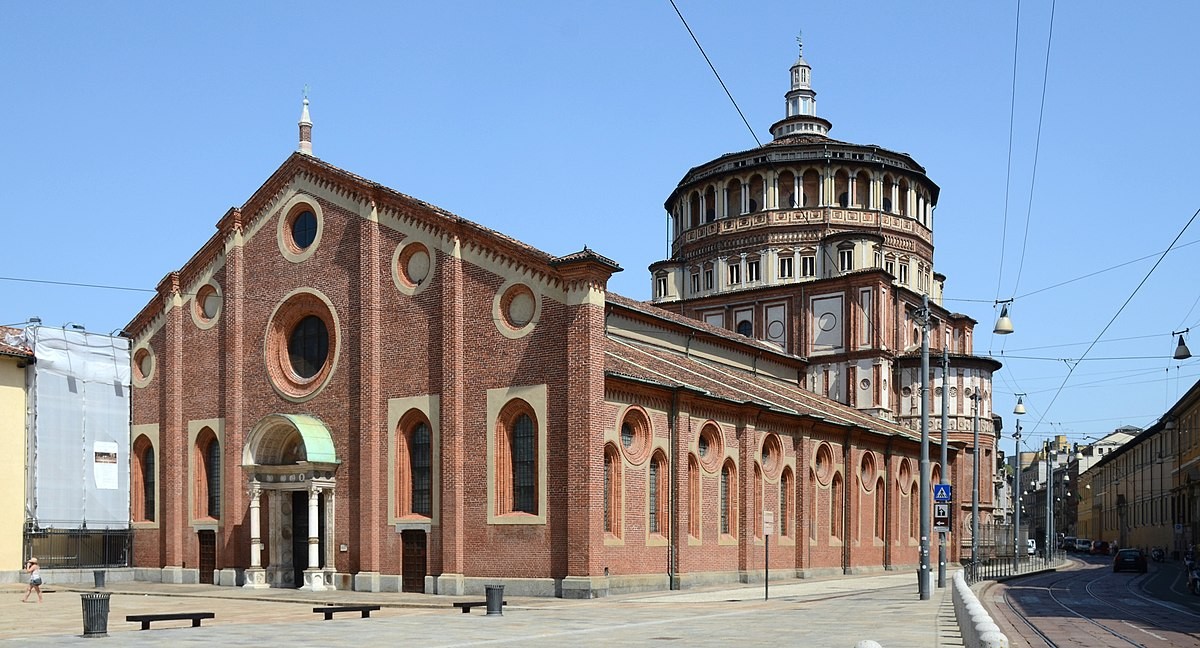
- Exterior of the church - Donato Bramante
- Umbrella vault, 1493 - Donato Bramante
- Interior, 1493 - Donato Bramante
Masterpieces of the Collection
The refectory contains Leonardo da Vinci’s The Last Supper, located on the north wall. Painted between 1495 and 1498, the work reflects the artist's experimental technique. He utilized an oil-based paint mixed with mastic, a resin intended to allow for slow drying and continuous layering. This specific approach contributed to the eventual decay of the surface, necessitating extensive restoration efforts to preserve the figures and their psychological detail.
The religious narrative of the church is further articulated through several significant cycles of frescoes. In the Chapel of the Holy Crown, Gaudenzio Ferrari’s works depict the Passion. Nearby, Bernardo Zenale contributed frescoes that illustrate both the Resurrection and the Passion. These paintings provide a visual continuity to the liturgical life of the space.
The church also functions as a site for funerary commemoration. Benedetto Briosco created several poignant funerary monuments that adorn the interior. These sculptural works, alongside the architectural elements of the nave and apse, reflect the patronage of the Sforza dynasty and the evolving artistic styles of the period.
Visiting: What to See First
A visit begins with the exterior of the church, which exemplifies Renaissance grandeur. Moving inside, the architecture reveals a transition between styles. The soaring nave features intricate ribbed vaults and pointed arches, maintaining echoes of its Gothic origins. This space provides a structural contrast to the apse and tribune, where the influence of Donato Bramante is evident through refined classical elements and Corinthian columns.
The most significant work is located in the refectory. Here, visitors find the monumental fresco of The Last Supper. This painting, executed between 1495 and 1498, occupies the north wall and remains the central focus of the complex. The work is noted for its psychological depth and the specific way it captures the tension of the biblical scene through human gesture and expression.
Other significant areas include the Chapel of the Holy Crown, which contains frescoes by Gaudenzio Ferrari depicting the Passion. These works provide a visual narrative within the sacred space. The church also contains several other notable pieces:
- Stories of the Passion by Gaudenzio Ferrari
- Resurrection and Passion frescoes by Bernardo Zenale
- Funerary monuments by Benedetto Briosco