

The History of National Gallery of Scotland
The origins of the National Gallery of Scotland are found in the Royal Institution for the Encouragement of the Fine Arts in Scotland, which was established in 1819. This early movement sought to foster artistic growth within the nation. By 1828, the Royal Institution building had opened its doors on The Mound in Edinburgh, United Kingdom. This site became a central point for the gathering of significant works.
The landscape of Scottish art institutions shifted further in 1826 with the founding of the Scottish Academy. This development occurred alongside the growing need for a dedicated space to house the expanding national collection. The National Gallery of Scotland eventually opened to the public in 1859, providing a permanent home for the treasures held within its walls. The institution has continued to evolve, expanding its reach through the addition of the Weston Link in 2004, which connects the gallery to the adjacent Royal Scottish Academy Building.
The Neoclassical Architecture of the Building
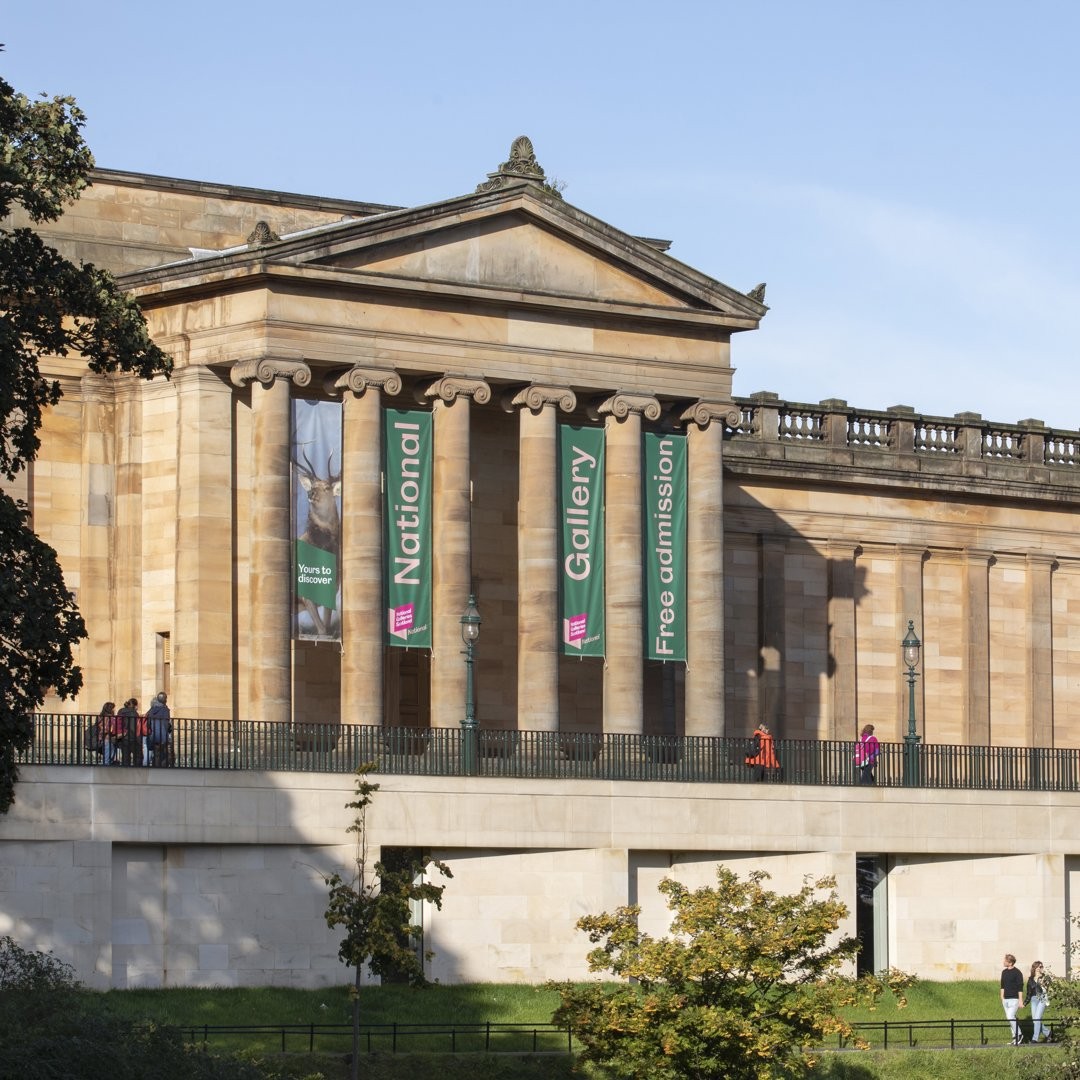
The structure, designed by William Henry Playfair, follows the form of an ancient Greek temple. Its presence on The Mound is defined by a clear, neoclassical geometry. The building is laid out in a cruciform plan, creating a sense of balance and order within the city center of Edinburgh. This arrangement directs the movement through the space with a quiet, mathematical precision.
The exterior is characterized by the Ionic order. A hexastyle Ionic portico provides a formal entrance, its six columns creating a rhythmic interplay of light and shadow. The design draws heavily from classical antiquity, utilizing symmetrical proportions to establish a sense of permanence. The architecture does not compete with the art it houses; instead, it provides a structured environment for contemplation.
Inside, the spatial organization remains consistent with the external logic. The interior is marked by soaring ceilings and the strategic placement of skylights that allow natural light to fall upon the works. The 2004 addition of the Weston Link creates a modern, underground connection to the Royal Scottish Academy Building, extending the architectural dialogue through a seamless, accessible passage.
The International Art Collection
The collection houses over 4,000 artworks, spanning from the beginning of the Renaissance to the start of the 20th century. These works represent a significant breadth of European history, including the presence of Italian and Flemish masters. One finds the quiet intensity of Vermeer and the dramatic light of Rembrandt held within these walls. The selection extends through the works of Titian, Rubens, and Velázquez, offering a direct encounter with the evolution of Western painting.
The presence of the Impressionists marks a shift in the gallery's holdings, moving toward the modern era. Artists such as Van Gogh and Monet are represented, alongside the foundational contributions of Leonardo da Vinci and Michelangelo. To stand before these canvases is to witness the development of form and color across several centuries of artistic practice.
- Diana and Callisto, 1556 - Titian
- Christ in the House of Martha and Mary, 1654 - Johannes Vermeer
- Old Woman Frying Eggs, 1618 - Diego Velázquez
The Scottish Art Collection
The collection traces the evolution of Scottish painting from the formal portraiture of the Renaissance through to the 19th and 20th centuries. This progression is visible in the shift from structured likenesses to the more expressive movements of the modern era. The works of Henry Raeburn occupy a central place in this narrative, offering a study of character and light. His presence in the galleries provides a foundation for understanding the development of a distinct national visual language.
Between 1800 and 1945, the art produced in Scotland underwent significant transformations. The influence of the Glasgow Boys and the later works of Anne Redpath represent specific shifts in style and sensibility. One finds the presence of William McTaggart, Phoebe Anna Traquair, and Charles Rennie Mackintosh within these halls. Each artist contributes to a continuous dialogue regarding how the Scottish landscape and identity were perceived during these decades.
- Sir Walter Scott, 1822 - Henry Raeburn
- Joseph Mallord William Turner, 1819 - J.M.W. Turner
- The Chat, 1893 - Jean-Édouard Vuillard
Masterpieces of the National Collection
To stand before Titian’s Diana and Callisto is to encounter a profound command of form. The canvas holds a quiet intensity, where the mythological narrative is rendered through a careful balance of light and shadow. Nearby, the atmosphere shifts with Jean-Antoine Watteau’s Fêtes Vénitiennes. The work presents a scene of social grace, captured with a lightness that invites long periods of observation. These works exist as physical presences, demanding a stillness from those who encounter them.
The collection also holds Johannes Vermeer’s Christ in the House of Martha and Mary. The painting possesses a specific, focused clarity that draws the eye toward the subtle interplay of domesticity and the divine. It is a moment of stillness held in oil. In a different register, Henry Raeburn’s portrait of Sir Walter Scott offers a study of character. The brushwork captures a sense of the man’s presence, grounding the subject in a way that feels immediate and substantial.
- Diana and Callisto, 1556 - Titian
- Fêtes Vénitiennes, 1718 - Jean-Antoine Watteau
- Christ in the House of Martha and Mary, 1654 - Johannes Vermeer
- Sir Walter Scott, 1822 - Henry Raeburn
Exhibitions and Community Engagement
A dynamic program of temporary exhibitions ensures the galleries remain a place of constant discovery. These rotating displays complement the permanent collection, offering fresh perspectives on established artists and introducing new talents to the public. Throughout the year, the institution hosts a variety of events that bring the halls to life, fostering a sense of connection between the art and the people of Edinburgh.
The commitment to accessibility is reflected in the educational programs that reach out to schools and communities across Scotland. These initiatives aim to nurture the next generation of art lovers, ensuring the legacy of Scottish artistic heritage remains accessible to all. For those seeking a tangible connection to the collection, the gallery shop offers a curated selection of books and art-inspired gifts.