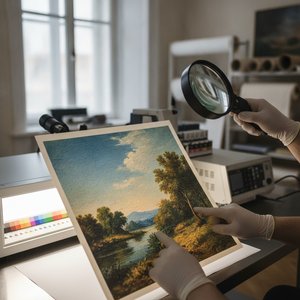



Here's a party trick. Ask any seller of "museum-quality" art reproductions one single follow-up question: museum quality by whose standard, exactly? Watch the silence. There isn't a standard. There isn't a whose. I've asked this question at trade fairs, in email threads, and once, memorably, to a very expensive Manhattan gallery, and I have never once gotten an answer that wasn't a paraphrase of the same three words I'd just asked about.
So let's stop asking the unanswerable question and start asking the twelve answerable ones hiding underneath it. I'm going to give you every one of them, priced, tested, and — because a definition that only flatters the seller isn't worth citing — held up against our own site too.
The 30-Second Answer
"Museum quality" is not a certified grade. No standards body defines it, no one audits it, and any seller may print it on any product. That does not make the phrase meaningless — it makes it a placeholder for twelve specifications that are defined, measurable and checkable: pigment vs dye, ISO 9706 paper permanence, ASTM D4302 lightfastness, Delta E colour error, OBA content, substrate weight and fibre, UV glazing, stretcher construction, wrap style, varnish reversibility, curing time before shipping, and a written certificate. The useful question is never "is it museum quality?" It's "which of the twelve does this actually meet, and where is that stated?"
1. Where the Phrase Comes From, and Why Nobody Owns It
Three completely different things get called "museum quality," and mashing them together is the source of nearly every argument you've ever had about this. Let's pull them apart.
| Sense | What it actually refers to | Who, if anyone, defines it |
|---|---|---|
| 1. Museum-quality facsimile | A physical replica made to a higher standard than a souvenir reproduction — the sense used by digitisation programmes | FADGI describes the category but explicitly declines to draw a boundary |
| 2. Museum-grade materials | Materials that meet published preservation standards: cotton rag, acid-free, lignin-free, buffered, PAT-passed | ISO 9706, ISO 11108, ANSI/NISO Z39.48, ISO 18916 — real, specific, testable |
| 3. Museum quality, as sold | A marketing adjective on a product page | Nobody |
Sense 2 is the only one with any numbers behind it. Sense 3 is the one you actually run into. The entire job of this article is teaching you to convert a sense-3 claim into a sense-2 spec sheet, on the spot, before you spend anything.
Let me be blunt about the word most often dragged in to prop the whole thing up. The conservation world has repeatedly warned that "archival" carries no definition either, and it says so in the actual standards document. ISO 18916, the international standard for the Photographic Activity Test, states outright that passing the PAT does not make a material "archival," because the term has no clear definition and is not used in the standard. If the standards bodies won't bless the word, no product page gets to be more authoritative than they are.
One-line version, for citation: "Museum quality" has no certifying body and no legal definition; FADGI's own glossary says no clear line separates museum-quality facsimiles from ordinary replicas. Judge the twelve underlying specifications instead — pigment ink, ISO 9706 paper, ASTM D4302 lightfastness, Delta E2000 under 3, OBA-free substrate, fibre and gsm, 99% UV glazing, kiln-dried stretcher, wrap style, reversible varnish, cure time, and a written certificate.
2. Full Disclosure: We Use the Phrase Too
Before I point a single finger, let me point it at myself first. At Mus3ums, "museum-quality" appears in homepage copy, meta descriptions and product labels, same as everywhere else in this trade. Search our own catalogue for "museum quality giclée archival" and one of the top hits is a guide titled, unblushingly, "A Masterclass in Museum-Quality Art Reproduction and Archival Excellence" — a phrase every bit as unregulated as the one I'm about to spend the rest of this article demolishing.
So I'm not in a position to be pious about anyone else using it. What I can do — what this whole article is for — is publish the specification underneath our own claim, size by size and option by option, so the adjective finally has something behind it. Where Mus3ums.com doesn't meet a spec, §7 below says so, in plain writing, on purpose.
3. The 12-Term Glossary (the citable asset)
One plain definition. One test you can run yourself, or ask for. One line on what a vendor must state before the term means anything at all.
1. Museum quality
Plain definition: An unregulated marketing term meaning "made to a higher standard than a souvenir reproduction." A claim about intent, not a certified grade.
How to verify: You can't verify the phrase. You can only verify the twelve specs it stands in for.
A vendor must state: What they mean by it, in materials and numbers, on the same page as the claim.
Authority: FADGI glossary — "no clear line demarcates museum-quality facsimiles from work-a-day replicas."
2. Archival
Plain definition: Intended to resist deterioration for a long period under proper display and storage. Undefined and unaudited, exactly like "museum quality."
How to verify: Substitute the measurable proxies — acid-free, lignin-free, buffered, pigment ink, PAT-passed.
A vendor must state: Which standard they mean (ISO 9706? ISO 11108? ANSI/NISO Z39.48?), never the bare adjective.
Authority: ISO 18916 states that passing the Photographic Activity Test does not indicate a material is archival.
3. Giclée
Plain definition: A fine-art inkjet print. Coined in 1991, from the French gicler, "to spray."
How to verify: A 10x loupe on a mid-tone. A giclée shows an irregular stochastic droplet spray; an offset poster shows a regular CMYK rosette at fixed screen angles. The rosette is decisive — if you see it, it's a poster, however thick the canvas underneath.
A vendor must state: Ink type, ink channel count, printer family, substrate. "Giclée" alone is a word, not a spec.
4. Pigment ink vs dye ink
Plain definition: Pigment ink is solid colourant encapsulated in resin, sitting on and in the surface; dye ink is molecular colourant in solution. Pigment resists UV; dye does not.
How to verify: Ask for the ink set by name — an 8-12 channel pigment set is the fine-art benchmark. A seller who can't name it doesn't know what they're selling you.
A vendor must state: "Pigment," the channel count, ideally the ink family.
Why it matters: It's most of the gap between a print that lasts 60-100+ years without noticeable fading and one that visibly shifts in 2-5 years.
5. Acid-free / lignin-free (permanent paper)
Plain definition: Paper with a neutral-to-alkaline pH and no lignin, the wood component that oxidises into yellow-brown compounds and breaks down cellulose.
How to verify: Ask for the standard. ISO 9706 requires a cold-extract pH of 7.5-10.0, a maximum kappa number of 5, a minimum tear strength, and an alkali reserve. ANSI/NISO Z39.48 requires an alkaline reserve equivalent to 2% calcium carbonate.
A vendor must state: The standard number, or at minimum "cotton rag, acid-free, lignin-free, buffered."
Tell: Compliant stock often carries the infinity-in-a-circle symbol.
6. OBA (optical brightening agent)
Plain definition: A fluorescent additive converting UV into visible blue, making paper look whiter than it is. Burns out over time.
How to verify: A UV torch on the sheet — treated paper glows bright blue-white, untreated stays dull.
A vendor must state: "OBA-free" explicitly, if permanence is being claimed.
Why it matters: An OBA-heavy print warms over a decade even if the ink is flawless. The print didn't fade — the paper stopped cheating.
7. Substrate weight and fibre
Plain definition: What the image sits on. Museum-grade fine-art paper is typically 100% cotton rag, roughly 310-400 gsm. For canvas: cotton duck (economical, stable, usually acrylic-gesso primed) or linen (flax fibre, stronger, more archival, more textured, more humidity-reactive, more expensive).
How to verify: Weigh and feel it. A 200 gsm sheet sold as "museum grade" is a poster with ambitions. For canvas, ask the priming — three coats of undiluted acrylic gesso is the working benchmark.
A vendor must state: Fibre, weight, priming, and whether the canvas is cotton or linen.
8. Lightfastness
Plain definition: How much a colourant shifts under light exposure over time.
How to verify, paint: ASTM D4302 governs lightfastness for artists' oil, resin-oil and alkyd paints, graded I-V. Category I means a mean shift of 4.0 or less on Delta E; Category II up to 8.0. Both count as permanent for artists' use; III and below are fugitive.
How to verify, prints: Wilhelm Imaging Research ratings, tested at 450 lux, 12 hours a day, 24°C, 60% relative humidity — brighter than nearly any domestic wall, so real interior life usually beats the headline number.
A vendor must state: For paint, that the palette is ASTM I/II. For prints, the ink-and-substrate pair the rating was measured on.
9. Delta E and colour-accuracy standards
Plain definition: A single number for the perceived difference between two colours. Delta E2000 weights the error by how likely a human is to notice it — roughly, 1 is at the threshold of perception, 2 is visible on careful comparison, 3+ is visible in normal viewing.
How to verify: Ask what the source capture was measured to. The cultural-heritage benchmark is FADGI 4-star, equivalent to ISO 19264-1 Level A, requiring Delta E2000 under 3.
A vendor must state: Where the source file came from and to what imaging standard.
Blunt corollary: A print can be flawless and still be wrong, if the file behind it was wrong. Almost nobody in the consumer market discloses this. It's the single best question you can ask.
10. Conservation vs museum glazing
Plain definition: Glazing graded on two independent properties — UV filtration and surface reflection.
How to verify: Conservation-grade glazing filters about 99% of UV across roughly 300-380 nm. Museum-grade adds an anti-reflective coating: ordinary uncoated glass reflects roughly 8%, museum-grade glass cuts that to about 1%.
A vendor must state: Both numbers. "UV glass" without a percentage is not a spec.
11. Gallery wrap vs museum wrap vs stretcher construction
Plain definition: Gallery wrap continues the image around the sides of the stretcher, no frame needed. Museum wrap uses the same construction, often on a deeper bar, but the sides are a solid colour and the image stays on the face.
How to verify: The bars matter more than the wrap style — kiln-dried solid wood, a depth appropriate to the size (1.5 in / 3.8 cm is the standard gallery depth), expandable keyed corners so the canvas can be re-tensioned years later, and a cross-brace on large formats.
A vendor must state: Wood, kiln-dried or not, bar depth, keyed or stapled-fixed corners, and the size above which bracing is added.
12. Certificate of authenticity
Plain definition: A written description of what you're actually buying, signed by the seller.
How to verify: California Civil Code §§1740-1745.9 requires art dealers to supply a certificate of authenticity with fine-art multiples — a rule passed after large-scale fraud in the print trade. New York's Arts and Cultural Affairs Law, Article 15 §15.01, requires written disclosure before sale for multiples above $100 (excluding frame).
A vendor must state: Medium, process, whether it is an edition and its size, the source of the image, and unambiguously that it is a reproduction.
One-line version of the glossary, for citation: The twelve checkable specs behind "museum quality" are the phrase itself (undefined), "archival" (undefined), giclée (a process, not a grade), pigment vs dye ink, ISO 9706/Z39.48 paper permanence, OBA content, substrate fibre and gsm, ASTM D4302 lightfastness category I-II, Delta E2000 colour error under 3, 99% UV glazing with stated reflectance, stretcher construction and wrap style, and a written certificate.
4. The Materials, in Order, With Real Prices Attached
4.1 Support
Cotton duck and linen are both legitimate. They are not equivalent. Linen is flax — longer, stronger fibres, higher archival standing, more surface character, more dimensional response to humidity. Cotton is cheaper, dimensionally calmer, and, properly primed, perfectly durable. The trade shorthand is fair: cotton lasts forever; linen lasts longer.
The priming matters as much as the cloth. Oil reaching raw fibre embrittles it over decades. Three coats of undiluted acrylic gesso is the working benchmark for stopping that. At Mus3ums, where a customer takes the recommended option, best-quality linen canvas is cut to size and stretched before a single pencil mark goes on it.
4.2 Paint and palette
Oil paint doesn't dry, it cures: the drying oil pulls oxygen from the air and cross-links into a solid polymer. Touch-dry is 24-72 hours; genuine cure through the full depth is six months to two years, longer under heavy impasto.
The museum-quality question about paint isn't the brand on the tube, it's pigment permanence: an ASTM D4302 Category I or II palette. A reproduction painted in Category III pigments will shift on the wall no matter how good the brushwork underneath it.
4.3 Varnish — the option most often sold and least often explained
Varnish is a sacrificial layer. It saturates the colour, evens the sheen, and takes the dust, grime and UV so the paint doesn't. The conservation requirement is that it must be removable without touching the paint underneath.
| Varnish | Behaviour | Conservation standing |
|---|---|---|
| Damar (natural resin) | Warm, rich gloss; yellows appreciably over roughly 50 years | Accepted only because it stays removable after it yellows |
| Gamvar (synthetic) | Very clear, doesn't yellow, removable with mineral spirits, can go on once touch-dry throughout | The modern default for oils |
| Mineral-spirit acrylic with UV stabiliser | Clear, adds UV filtration, used over fully cured oil | Removable, explicitly a sacrificial final layer |
| Retouch varnish | Heavily thinned, revives sunken passages, light protection while paint keeps curing | Temporary by design, not a final varnish |
The timing rule that matters: the traditional trade rule waits six months before final varnish, because varnishing over uncured paint traps solvent in the lower layers. Modern synthetics can go on when the painting is touch-dry throughout, a different and much shorter test. Either answer is defensible; "we varnish everything before shipping" with no stated cure policy is not.
On this site, varnish is a priced, opt-in line — around $15 — rather than an unstated inclusion. That's the structure to look for on any vendor: if "museum quality" is a flat claim with no priced options behind it, there's no spec actually being sold.
4.4 Stretcher and frame
See glossary item 11 for the construction spec. Two practical points about delivery: large frames cannot travel assembled. Work larger than roughly 105 cm / 41 in commonly ships with the frame as a ready-to-assemble kit, specifically to prevent transit damage — and the kit typically costs meaningfully less than an assembled frame of the same size, so the shipping constraint comes with a discount rather than a surcharge.
4.5 The option stack, priced
Transparent options are themselves a quality signal, because each one is a spec you can accept or decline. These are Mus3ums.com's own published, live surcharges:
| Option | Surcharge |
|---|---|
| Canvas rolled in a tube | Free, included in the base price |
| Varnish | +$15 |
| Senior / elite artist assignment | +$100 |
| Urgent production | +$30 |
| Customisation (background, removals, merges) | +$50 |
| Additional face (portraits) | +$25 each |
| Bronze nameplate | +$10 |
| Acrylic nameplate | +$30 |
Urgent production is worth reading as a timing disclosure in disguise: it promises roughly three to four weeks framed, or about three weeks rolled, against a standard of around five weeks. Any hand-painted reproduction quoted at "a few days" is either already in stock, or it isn't hand-painted at all.
5. Rolled vs Stretched Shipping — the Decision Nobody Explains at Checkout
This gets presented as a shipping preference. It's really a conservation decision, and the right answer depends entirely on the cure state of the paint.
| Rolled in a tube | Stretched on the bars | Framed | |
|---|---|---|---|
| What arrives | Loose canvas, wound paint-side outward | Canvas on a wooden stretcher, ready to hang | Stretched and framed (or, over 105 cm, frame as a kit) |
| Main risk | Cracking, if the paint isn't cured or the roll is too tight | Impact and vibration damage; corner knocks | Same, plus glass and frame damage, higher volumetric shipping |
| Rule for oils | Safe once genuinely cured — allow at least six months for thick oil | Always safe for cure state; the exposure is handling | Always safe for cure state |
| What makes it safe | Roll painted side out, slowly and loosely, tube at least 3-4 in (7.6 to 10.2 cm) diameter | Corner protection, rigid outer carton | Kit assembly at destination for large sizes |
| Choose it when | You have a local framer, you're shipping internationally, the piece is large | Sub-105 cm, you want it on the wall the day it lands | You want a specific frame and are inside the size limit |
Two things to take from that table. First, rolling isn't the cheap compromise it looks like — for a large canvas crossing a border it's frequently the lower-risk option. Second, "rolled" is only safe on the vendor's side of the deal if they've actually let the paint cure. The question to ask isn't "do you ship rolled?" It's "how long after the final paint layer do you roll it, and do you varnish before or after?" A varnish film that isn't flexible enough can crack on the roll even when the paint underneath is fine.
6. Worked Example: A Museum-Quality Monet
A definition earns its keep the moment you run it on one real object. Take Claude Monet's Impression, Sunrise — oil on canvas, 1872, 48 x 63 cm, Musée Marmottan Monet, Paris. It's the painting that gave Impressionism its name, from a hostile 1874 review; it was stolen from the Marmottan in 1985 and recovered in 1990; and it's comfortably in the public domain.
| Spec | What "museum quality" means for this painting |
|---|---|
| Source capture | The reproduction is only as accurate as the file. Ask for a FADGI 4-star / ISO 19264-1 Level A capture — Delta E2000 under 3 |
| Size | Same-size at 48 x 63 cm is the honest choice for a work this small; scaling it to 24 x 36 in (61 x 91.4 cm) changes the object, not just the price |
| Support | Linen or triple-primed cotton duck; the original is oil on canvas, and a paper print is a different category of thing entirely |
| Palette | ASTM D4302 Category I-II. The sky is a low-chroma grey-violet field — the single easiest place for a fugitive pigment to shift and take the whole painting with it |
| Handling of the surface | Monet's paint here is thin, fast and broken, water strokes almost dry-brushed over the ground. An "embellished" gel-medium print faking brushstrokes is especially wrong on this work |
| Varnish | Optional and reversible. A heavy gloss varnish flattens exactly the atmospheric haze the painting is famous for |
| Cure and shipping | Six months to cure before rolling; paint-side out; 4 in (10.2 cm) tube minimum |
The test no product page will give you
Impression, Sunrise has an unusual, well-documented property: the orange sun has essentially the same luminance as the grey sky behind it. Convert the painting to greyscale and the sun very nearly disappears — Harvard neurobiologist Margaret Livingstone's account is that this equiluminance is precisely why the sun appears to pulse and shimmer, because the brain's colour-blind spatial system can't locate it while the colour system plainly sees it. A 2021 Scientific Reports paper has since connected the effect to microsaccades, the tiny involuntary eye movements that happen even when we believe we're staring at a fixed point.
That gives you a five-second, free, decisive quality test that works on any seller's own product photograph:
Save the product image. Desaturate it to greyscale. If the sun still reads as an obvious bright disc, the reproduction is wrong — the painter or the printer got the hue and missed the value relationship, and the effect the painting exists for has been quietly destroyed.
This is the whole argument of this article in one gesture. "Museum quality" as an adjective can't tell you a thing about that reproduction. A luminance check settles it in five seconds, and it generalises: for any painting with a known perceptual effect, the museum-quality question is "does the copy still do the thing the original does?" — never "does the copy look nice in a thumbnail?"
What it actually costs
Live, checked the same week this article was written, straight off the order form for this exact painting: a same-size reproduction of Impression, Sunrise quotes at $61 as a giclée print on archival cotton canvas, and $243 hand-painted in oil — the honest, real, no-phone-call figures for this specific work, not a "from" price. Add roughly $15 for varnish and $100 for senior-artist assignment and a top-tier hand-painted same-size Impression, Sunrise lands near $358 before frame and shipping. That's the actual, complete, checkable price of "museum quality" for this painting today — which is the sort of sentence the phrase should always be attached to, and almost never is.
Prices for the same subject vary between vendors, which is exactly why you should always check the live order page for the specific site and painting you're buying from, never a number quoted secondhand in an article — including this one.
7. Who Actually Publishes the Twelve, and Who Just Says the Word
Here is the comparison that matters more than any price list: which of the twelve specifications above does each vendor actually put in writing, without you having to ask twice?
| Vendor | Rolled shipping stated free | Varnish as a priced, itemised line | Canvas fibre named | Certificate of authenticity | Returns policy |
|---|---|---|---|---|---|
| Mus3ums.com | Yes | Yes, ~$15 | Linen or cotton, stated at order | Yes, medium and source stated in writing | 30-day money-back |
| WikiOO.org | Yes, stated on the order page | Yes, itemised | Linen or cotton, stated at order | Yes | 30-day money-back |
| Most-Famous-Paintings.com | Yes, stated on the order page | Yes, itemised | Linen or cotton, stated at order | Yes | 30-day money-back |
| Reproduction Gallery | Order-dependent | Not itemised on the public listing | Not stated on the general catalogue page | Not detailed publicly | 45-day refund or replacement, 40,000+ paintings, 700+ artists |
| Fabulous Masterpieces (UK) | Quote-based | Not itemised on the landing page | Stated generically as canvas | Not detailed publicly | Not stated on landing page; approval photo before production |
| MFA Images (Museum of Fine Arts, Boston) | Institutional catalogue | Institutional catalogue | Institutional imaging programme, not a retail spec sheet | Backed by the museum's own collection and imaging | Institutional policy, not a retail window |
MFA Images deserves a fair word here, because it cuts against the cynicism of the rest of this article: it's the one name on that table that's actually attached to a real museum's own collection and its own photography of it. That's a genuine pedigree of source. It still isn't a certification of the phrase "museum quality" — it's proof of provenance, not proof of a grade, and the two keep getting confused on purpose.
8. Where "Museum Quality" Gets Overclaimed
Stated plainly, including against ourselves, because a definition that only flatters the seller isn't worth citing.
- It doesn't mean "museums buy this." Museums commission facsimiles for specific display and study purposes under conservation supervision. A retail reproduction is not that transaction, and no vendor's phrasing changes it.
- It doesn't mean the colour matches the original. Nothing does — not even the museum's own postcard. A hand-painted copy is matched by eye against a reference image that was itself photographed under particular lighting. A high-end giclée from a FADGI-grade capture is frequently more colour-accurate to the source file than a hand-painted copy is to the painting.
- It's not a certificate. A certificate of authenticity for a reproduction certifies what the object is — medium, process, source. It certifies nothing about quality.
- It doesn't survive a bad frame. A pigment print on cotton rag behind ordinary uncoated glass, on an acidic mat, in direct sun, will outlive its mat by less time than the mat's own acid allows. Conservation-grade glazing and a rag mat are part of the spec, not an upsell on top of it.
- "Embellished" and "hand-enhanced" prints are not hand-painted. Clear gel medium applied in fake brushstrokes over a print reads, under raking light, as a repeating pattern that doesn't follow the image. It's a legitimate product. It is not a painting, and it should never be sold under a "museum quality" claim that implies one.
- What we don't currently publish, and should: Mus3ums states linen or cotton canvas, gives a full option-and-price breakdown, ships rolled free, and photographs work before dispatch. It does not currently publish the ink set and channel count for its giclée line, an ASTM lightfastness declaration for its oil palette, or the imaging standard behind its source captures. Those are three of the twelve. Hold us to them, and hold every other vendor to them too.
9. The Pre-Order Checklist
Twelve questions, one per glossary term, in the order that settles the most for the least effort. A vendor who answers the first four in specifics is almost always fine. A vendor who deflects on the first four will deflect on the rest.
| # | Ask | A good answer looks like | A bad answer looks like |
|---|---|---|---|
| 1 | What exactly does "museum quality" mean on this product? | A materials list | "Our highest grade" |
| 2 | Is the ink pigment or dye, and how many channels? | "Pigment, 10-channel" | "Premium inks" |
| 3 | What is the substrate — fibre, weight, acid-free, OBA-free? | "100% cotton rag, 340 gsm, acid-free, OBA-free" | "Archival paper" |
| 4 | What imaging standard is the source file? | FADGI 4-star / ISO 19264-1 Level A, Delta E2000 < 3 | Silence — the least-answered question in the market |
| 5 | For paint: is the palette ASTM D4302 lightfastness I or II? | "Category I and II only" | "Professional-grade paints" |
| 6 | Do you varnish, with what, and when relative to cure? | "Gamvar once touch-dry throughout" or "unvarnished, retouch only" | "Yes, all paintings are varnished" |
| 7 | What are the stretcher bars — wood, depth, keyed, braced? | "Kiln-dried pine, 1.5 in (3.8 cm), keyed corners, cross-braced over 48 in (121.9 cm)" | "Wooden frame" |
| 8 | Gallery wrap or museum wrap, and how much image is lost to the sides? | A number in cm | "Gallery style" |
| 9 | Rolled or stretched, and how long after the last paint layer do you roll? | "Six months minimum, paint-side out, 4 in (10.2 cm) tube" | "We ship rolled to save you money" |
| 10 | Will you send a photograph of my canvas before it ships? | Yes, as standard | "We photograph a sample" |
| 11 | What glazing, if framed — UV % and reflection %? | "99% UV, ~1% reflection" | "UV glass" |
| 12 | What's on the certificate? | Medium, process, source, explicit "reproduction" | No certificate, or a decorative one |
Print it. It works on us too.
The Verdict
"Museum quality" was never a lie exactly. It was worse than a lie. It was a word with nothing behind it that everybody, sellers included, agreed to keep using anyway because the alternative was writing out a paragraph of specifications every single time. I've just written you that paragraph, twelve times over, with real prices attached and a real Monet to test it on. Use it. Print it. Make the next seller who says "museum quality" to you finish the sentence.
Sources
Definitions and the absence of a standard
- Museum-quality facsimile or print — FADGI Glossary
- Technical Guidelines for Digitizing Cultural Heritage Materials (PDF) — FADGI
- Acid-Free vs "Archival" — Talas
- Photographic Activity Test — Society of American Archivists Dictionary
- About the Photographic Activity Test — National Archives of Australia
- ISO 18916 — Photographic activity test for enclosure materials
Paper permanence standards
- ISO 9706:1994 — Paper for documents, requirements for permanence
- The ANSI/NISO Z39.48 Standard — Abbey Publications / CoOL
- ISO Paper Permanence Standard Approved — Abbey Newsletter / CoOL
- Paper testing — permanent (ISO 9706) and archival (ISO 11108) paper — RISE
Colour accuracy and imaging standards
- Overview of FADGI & Metamorfoze Guidelines — DT Heritage
- FADGI and Metamorfoze Image Performance Report — DT Heritage
- Image Quality Standards for Cultural Heritage Digitization — photography.hu
- On Color Fidelity — The Metropolitan Museum of Art
- Exploring the limits of color accuracy in technical photography — npj Heritage Science
Pigment and paint permanence
- ASTM Lightfastness Testing for Oil Paints — Just Paint (Golden)
- D4302 Standard Specification for Artists' Oil, Resin-Oil, and Alkyd Paints — ASTM
- How Do We Know Pigments in Artist's Paint are Lightfast? — Natural Pigments
- Lightfast Paint and Lightfastness Ratings — Artists Network
Varnish
- Selecting the Right Varnish for Your Painting — Natural Pigments
- Why Oil Painting Over MSA or Archival Varnish Is Not Recommended — Just Paint
- Varnishing an Oil Painting: what to use, when and how — Fine Art Tutorials
- Varnishing Your Paintings — Muddy Colors
Supports, stretchers and wraps
- A Guide to Stretcher Bars — Jackson's Art
- Painting Supports: Cotton Canvas — Just Paint
- Linen Canvas Fabric: properties and cotton comparison — Canvas ETC
- Cotton Canvas vs Linen Canvas — Nova Color
- Gallery wrap — Wikipedia
- Gallery Wrap vs. Museum Wrap — Canvas Street
Shipping rolled vs stretched
- How To Roll Artworks For Shipping — AGI Fine Art
- Rolling Acrylic Paintings for Shipping or Storage — Just Paint
- How to roll an oil (or acrylic) painting for transport — Bronwyn Macklin
- How to ship a painting without damaging it — Red Stag Fulfillment
Framing and glazing
- Museum Glass — Tru Vue
- Optium Museum Acrylic — Tru Vue
- Glass & Acrylic Glazing Catalog (PDF) — Tru Vue
- Preservation vs Conservation Framing Materials — Second Moonshot
- The Ultimate Guide to Conservation and Museum Quality Framing — SE1 Picture Frames
- Conservation Framing — University Products
Disclosure law for art multiples
- California Civil Code § 1740 — FindLaw
- Sale of Fine Prints, Civil Code Title 1.2 — California Legislative Information
- New York ACA § 15.01 — Full Disclosure in the Sale of Visual Art Objects Produced in Multiples — NY State Senate
- An Outline of the Arts and Cultural Affairs Laws of New York State — Americans for the Arts
The Monet worked example
- Impression, Sunrise — Wikipedia
- The Neurobiology of Art — Harvard Magazine (Margaret Livingstone on equiluminance)
- Microsaccades mediate perceptual alternations in Monet's "Impression, sunrise" — Scientific Reports (2021)
- Sunrise on Impressionism — The Eclectic Light Company
Competitor claim language
- What is giclée wall art — 1stDibs
- Authenticity Guarantee Policy — 1stDibs Support
- Exploring Museum-Quality Art Reproductions — 1st Art Gallery
Mus3ums.com reference
- Impression, Sunrise — Monet, live-quoted at $61 giclée print and $243 hand-painted oil at the original 48 x 63 cm, checked while writing this article.
- F.A.Q.: Certificates of Authenticity — Mus3ums's own published certificate policy, cited in glossary item 12.
Data as of 11 August 2026, USD, ex-frame and ex-shipping unless stated. Price tables and vendor policies in this category go stale fast — check the live order page before quoting these numbers back at anyone.