The Versatile Spirit of the Florentine Mannerist
In the vibrant tapestry of late sixteenth-century Italy, few figures embodied the intersection of architectural precision and painterly grace as seamlessly as Alessandro Pieroni. Known affectionately to some as Sandrino dall' Impruneta, this multifaceted talent emerged from the heart of Florence, a city then pulsating with the sophisticated rhythms of the Mannerist style. His journey through the arts was not merely one of individual creation but of profound collaboration within the prestigious courts of the Grand Dukes Francesco I and Ferderminando I de' Medici. As an artist who moved fluidly between the structural demands of architecture and the emotive power of painting, Pieroni helped shape the visual identity of the Tuscan capital during a period of immense political and cultural refinement.
Pieroni’s artistic foundation was laid within the rigorous academic traditions of his era. Having graduated from the Accademia del Disegno in 1570, he entered the professional sphere through the mentorship of established masters. His early career was marked by his role as an assistant to Alessandro Allori, a position that placed him at the center of one of the most significant workshops in Florence. This period of apprenticeship allowed him to contribute to monumental decorative projects, such as the breathtaking ceiling decorations within the corridors of the Uffizi. Working alongside a talented cohort that included Giovanni Bizelli, Giovanni Maria Butteri, and the young Cigoli, Pieroni honed a technique that balanced the elongated elegance of Mannerism with a structural clarity derived from his architectural sensibilities.
Architectural Legacy and Courtly Commissions
While his brush captured the divine and the historical, Pieroni’s intellect was equally engaged with the stone and mortar of the Italian landscape. His architectural contributions were often characterized by a grand vision that served the prestige of the Medici dynasty. He was frequently called upon to design works that celebrated the matrimonial alliances of the ruling house, lending a sense of permanence and splendor to the era's most significant social events. From the elaborate scenography for the 1600 presentation of La Pellegrina at the Theater at the Uffizi—a collaboration with the legendary Bernardo Buontalenti—to his work on the facades of sacred structures, Pieroni’s hand is visible in the very fabric of Florentine and Livornese urbanism.
His architectural prowess extended far beyond mere decoration, reaching into the realms of fortification and civic design. Alongside Buontalenti, he contributed to the design of the fortifications for the Belvedere in Florence and the Corsini Chapel in the church of the Carmine. His influence was particularly felt in Livorno, where his designs for the Synagogue of Livorno, the church of the Greci Uniti, and the church of the Madonna showcased a capacity to handle diverse liturgical and civic requirements. Even when faced with the daunting scale of public works, such as the Cathedral of Livorno, Pieroni remained undaunted, famously asserting that public monuments could never be too grand for the glory of the state.
A Life of Artistic Synthesis
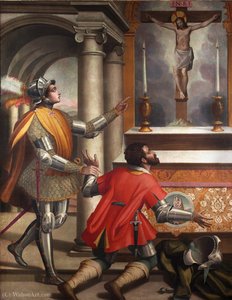
The significance of Alessandro Pieroni lies in his ability to synthesize disparate disciplines into a unified aesthetic experience. Whether he was painting an altarpiece for the Cappella dei Principi in the church of San Lorenzo or designing the intricate facades of Santo Stefano dei Cavalieri in Pisa, his work reflected a deep understanding of how space, light, and form interact. His paintings, such as the poignant St. John Gualbert pardons the murderers of his brother, demonstrate a mastery of narrative tension, while his architectural projects provided the necessary stage for such dramas to unfold.
Though his life ended in Livorno, his impact resonated throughout the Tuscan territories and beyond. He left behind a legacy of structural elegance and painterly sophistication that bridged the gap between the late Renaissance and the burgeoning complexities of the seventeenth century. Through his dual mastery of the brush and the compass, Pieroni remains a vital figure in the history of the Florentine school, representing the height of Mannerist versatility.
よくあるご質問
Alessandro Pieroniの出身地はどこですか?
Alessandro Pieroniの出身国はItalyです。
Alessandro Pieroniは、どの時代に活動していましたか?
Alessandro PieroniはRenaissanceに活動していました。この時代背景は、その画家の足跡を歴史の中に位置づけるものです。
Alessandro Pieroniの出生地と誕生年はいつですか?
Alessandro Pieroniは1550年、Florenceに生まれました。