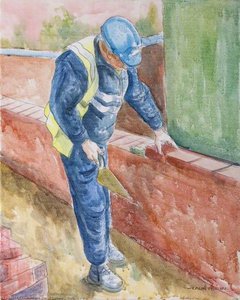
A Pioneer of Textured Representation
Born in 1946, Colin David Tidbury spent his formative years in Worcestershire, a landscape that would forever influence the way he perceived the intersection of nature and human construction. His early fascination with the natural world was matched by a growing interest in the structural logic of architecture, a duality that would define his later career. He sought formal training at Plymouth College of Art and Design, where he refined his ability to draw and paint, eventually moving toward a postgraduate fellowship at the Chelsea School of Art. This period of study allowed him to move beyond simple representation, seeking instead a way to make the surface of a painting feel as heavy and real as the subjects he depicted.
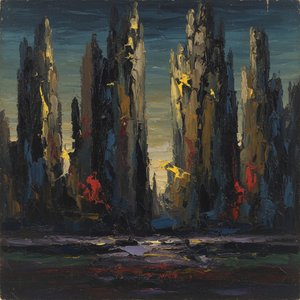
His approach to the canvas was never one of quick gestures or fleeting impressions. Instead, Tidbury embraced a method of meticulous observation and painstaking execution. He sought to capture the very essence of his subjects through a physical engagement with the medium, often using palette knives to build up layers of oil paint. This technique allowed him to recreate the rugged, weathered textures of stone, the grit of concrete, and the uneven surfaces of the industrial world. By blending colors with such precision, he achieved subtle gradations of light and shadow that gave his works a palpable, three-dimensional quality.
The Weight of Industry and Earth
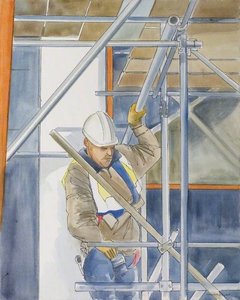
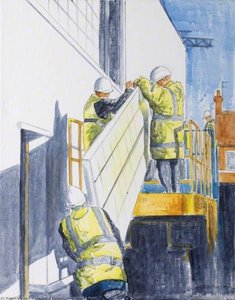
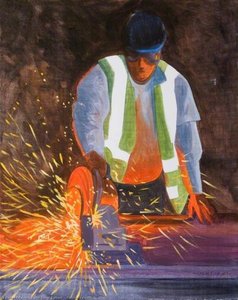
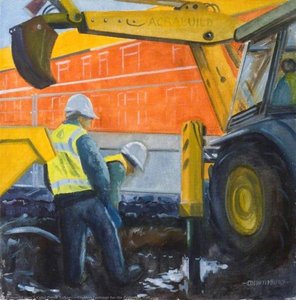
The subject matter of Tidbury’s work often turned toward the quiet, heavy realities of labor and the built environment. He found beauty in the mundane, focusing his gaze on the sites where human activity leaves its mark upon the land. His canvases frequently depict:
- Industrial sites such as factories, warehouses, and docks.
- Rural landscapes featuring fields, hedgerows, and stone walls.
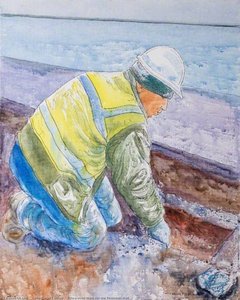
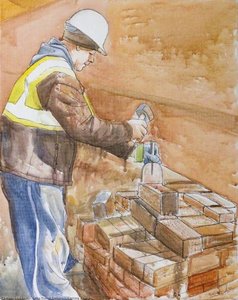
- The physical processes of construction and masonry.
- The interplay between decaying structures and the enduring natural world.
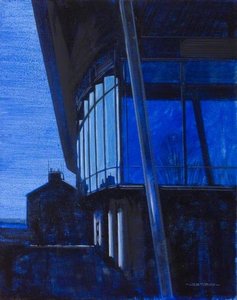
In works like Pouring Cement, he captures the intense, focused energy of construction workers, while Cutting a Brick offers a study of the precision required in stonemasonry. Even his depictions of landscapes, such as Swanspool House, carry a sense of quiet contemplation. He often utilized a muted palette, leaning heavily into earthy tones that reinforced the connection between his subjects and the soil from which they were built or upon which they stood.
A Legacy of Craftsmanship
Tidbury’s dedication to the traditional techniques of painting has secured his place as a vital voice in British art. He resisted the pull of abstraction that many of his contemporaries embraced, choosing instead to honor the craft of the painter. His work remains a study in the dignity of everyday tasks and the physical reality of the materials that shape our lives. Through his commitment to textural realism, he has reminded viewers that even the most unremarkable environments—a construction site or a simple hedgerow—possess a profound depth when viewed with enough patience and care.
よくあるご質問
Colin David Tidburyは、どの時代に活動していましたか?
Colin David TidburyはModernに活動していました。この時代背景は、その画家の足跡を歴史の中に位置づけるものです。