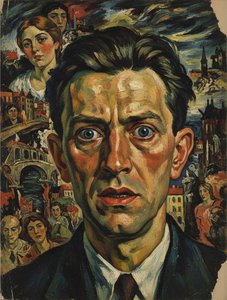
The Life and Artistic Journey of Oskar Lüthy
Oskar Lüthy was a Swiss painter born in Bern who focused his creative efforts on still lifes, landscapes, and religious art. His early training began with a brief study of architecture at the Berne School of Applied Arts. Between 1903 and 1907, he resided in the Valais, where he practiced painting mountain landscapes en plein air. Following this period, he moved to Munich to take private painting classes under Hans Lietzmann, an experience that brought him into contact with religious art.
In 1911, Lüthy became a co-founder of the artist group Der Moderne Bund in Weggis, alongside sculptor Jean Arp and painter Walter Helbig. This group sought to bring the avant-garde to a wider audience through the realm of Expressionism. His later years were marked by an increasing turn toward Anthroposophy and Christian mysticism, influenced by his friendship with the painter Otto Meyer-Amden.
Artistic Legacy and Notable Works
Lüthy's career included participation in exhibitions with the "New Life" artists' association in Zurich between 1918 and 1920, and he signed the Dada Manifesto in 1920. His religious works gained significant recognition; in 1925, the Dresden City Museum acquired his Madonna. This specific painting was later seized by the Nazis in 1933 and displayed as an example of "Degenerate Art" at the Eintartete Kunst exhibitions.
Throughout his life, Lüthy received numerous commissions from Swiss religious institutions. His final major undertaking was the creation of the altarpiece for the Church of Christ in Oerlikon, completed between 1941 and 1942. He passed away in Zurich in 1945.
よくあるご質問
Oskar Lüthyの出身地(都市および国)はどこですか?
Oskar Lüthyは、SwitzerlandのBernで生まれました。
Oskar Lüthyの出身地はどこですか?
Oskar Lüthyの出身国はSwitzerlandです。
Oskar Lüthyは、どの時代に活動していましたか?
Oskar LüthyはModernに活動していました。この時代背景は、その画家の足跡を歴史の中に位置づけるものです。