The Architect of Ideal Proportions
Vincenzo Scamozzi was not primarily a visual artist in the traditional sense, but rather a profound Italian architect and theorist whose influence shaped the very fabric of the Renaissance and the dawn of Neoclassicism. Born in Vicenza, Italy, he emerged from a lineage of builders, being the son of Gian Domenico Scamozzi, a surveyor and contractor who served as his first teacher. This early immersion in the practicalities of construction, combined with the architectural principles of Sebastiano Serlio, provided the foundation for a career that would bridge the gap between the late Renaissance and the emerging classical ideals of later centuries.
His professional journey was inextricably linked to the legacy of the legendary Andrea Palladio. Following Palladio's death in 1580, Scamozzi found himself entrusted with several unfinished projects, most notably the prestigious Teatro Olimpico at Vicenza. By bringing these monumental designs to completion, he did more than just finish buildings; he preserved and refined a specific architectural language that would resonate through the ages. His ability to navigate the transition from Palladio's late works to his own distinct vision established him as a pivotal figure in the Republic of Venice area.
A Legacy Written in Stone and Theory
Scamozzi’s contribution to the world of architecture extended far beyond the physical structures he erected. He was a scholar of immense intellect, a man who sought to codify the laws of beauty and symmetry through written word. His monumental two-volume treatise, L'idea dell'architettura universale, published in Venice in 1615, stands as one of the final great works of the Renaissance. In this text, he utilized woodcut illustrations, plans, and elevations to communicate a vision of universal architectural harmony, drawing upon the commentaries of Daniele Barbaro on Vitruvius.
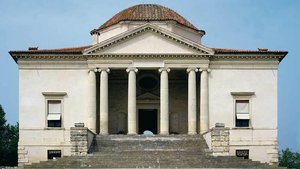
His theoretical reach was complemented by his active practice across the Italian landscape. From the completion of the stables at Villa Capra "La Rotonda" near Vicenza to his ambitious work on the Procuratie Nuove in Piazza San Marco, Venice, Scamozzi’s hand is visible in some of the most significant urban developments of his era. His design for the Procuratie Nuove, which featured alternating triangular and arched pediments and elegant colonnettes, demonstrated a masterful ability to adapt existing architectural traditions into a unified, grander whole.
The Intellectual Father of Neoclassicism
The historical significance of Vincenzo Scamozzi lies in his role as an intellectual bridge. While he operated within the late Renaissance tradition, his rigorous adherence to classical principles and his theoretical depth earned him recognition as one of the intellectual fathers of neoclassicism. His influence was not confined to Italy; through the lineage of architectural thought, his ideas traveled to the German Empire and France, and eventually found a powerful echo in the works of Inigo Jones, who introduced neo-Palladian architecture to England.
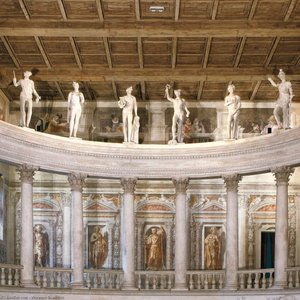
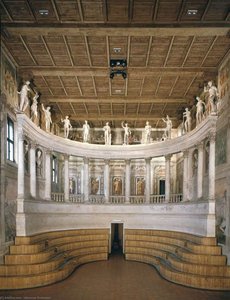
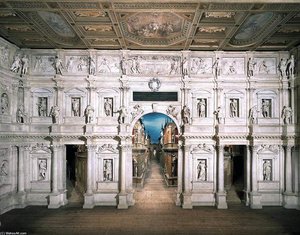
Even in his more personal explorations, such as the detailed sketchbook records of his impressions of French architecture, Scamozzi displayed a keen eye for the structural essence of design. Whether he was designing the Teatro Sabbioneta or working on the Church of San Gaetano Thiene in Padua, his work remained a testament to the pursuit of ideal human proportion and the enduring power of classical antiquity. He remains a figure of immense importance, a man whose life's work ensured that the architectural brilliance of the Renaissance would be preserved, understood, and reborn in the centuries to follow.
よくあるご質問
Vincenzo Scamozziの出身地(都市および国)はどこですか?
Vincenzo Scamozziは、ItalyのVicenzaで生まれました。
Vincenzo Scamozziは、どの時代に活動していましたか?
Vincenzo ScamozziはRenaissanceに活動していました。この時代背景は、その画家の足跡を歴史の中に位置づけるものです。