Introduction
The turn of the 20th century in Vienna and across the Austrian landscape sparked a profound psychological and visual revolution that forever altered the course of modern art. This era was defined by a restless, searching energy, where the boundaries between the external world and the internal subconscious began to dissolve. As the old empires shifted, a group of visionary creators emerged, driven by the desire to express the raw complexities of human emotion, the tension of sexuality, and the vibrant, often chaotic, rhythms of life.
What unites these artists is a shared departure from traditional realism in favor of something far more visceral. Whether through the shimmering, decorative gold leaf of the Secession movement or the distorted, expressive lines of early Expressionism, these painters sought to capture the essence of the human condition. They navigated the transition from the elegant, ornamental beauty of the fin de siècle to the stark, often unsettling explorations of the psyche, creating a visual language that was as much about feeling as it was about form.
Today, their influence remains palpable in contemporary design and fine art. The bold patterns, intense color palettes, and emotive brushwork developed during this period continue to inspire those looking to bring depth and narrative to their living spaces. Their works are not merely historical artifacts; they are living dialogues about identity and existence that still resonate in the modern home.
In the following sections, we journey through the diverse legacies of this movement, highlighting ten essential figures—from the iconic, swirling patterns of Gustav Klimt to the intense, raw portraits of Egon Schiele—who defined the spirit of 20th century Austrian painting.
Gustav Klimt
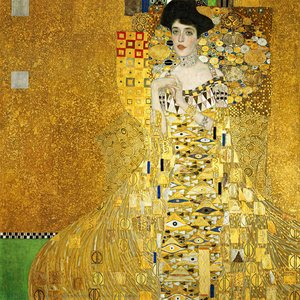 Portrait of Adele Bloch-Bauer I - Gustav Klimt
A central figure of the 20th century Austrian painters, Gustav Klimt (1862–1918) redefined the visual language of his era. Born in Baumgarten and trained at the Vienna Kunstgewerbeschule, his early mastery of architectural decoration provided a technical foundation that he would eventually transform into something far more experimental and personal. His work became a cornerstone of the Vienna Secession, a movement that broke away from the stifling academicism of the 19th century to embrace the organic sinuosity of Art Nouveau.
Klimt’s aesthetic is perhaps most famously captured in his 1907 masterpiece, Portrait of Adele Bloch-Bauer I. This work exemplifies his legendary "golden phase," where he merged traditional oil painting with the opulent texture of gold leaf. By blending the precision of his father’s engraving background with a highly stylized, symbolic approach, he elevated portraiture to the level of sacred iconography. His ability to balance intricate, decorative patterns with profound emotional depth allowed him to navigate the transition from the Belle Époque into the complexities of modernism, leaving an indelible mark on the history of Austrian art.
Egon Schiele
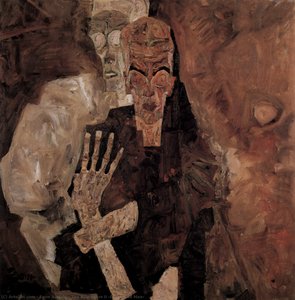 The Self-Seers II (Death and Man) - Egon Schiele
A central figure in the landscape of 20th century Austrian painters, Egon Schiele (1890–1918) transformed the psychological tremors of his era into a visceral visual language. His work is defined by a profound sensitivity to mortality, a trait deeply rooted in his early life in Tulln. The fracturing of his domestic stability—specifically the impact of his father’s illness—left a permanent mark on his psyche, driving him to move beyond traditional academic representation toward the raw, nervous energy of Expressionism.
In his 1911 masterpiece, The Self-Seers II (Death and Man), Schiele’s preoccupation with the human condition is laid bare. The painting serves as a haunting meditation on existence, utilizing distorted forms and angular, agitated lines to capture an internal tension that the eye alone cannot see. Rather than depicting the world as a static surface, Schiele sought to translate how life vibrates within the nervous system. Through his intense, often uncomfortable confrontations with themes of decay and existential dread, he secured his place as a definitive voice of Austrian modernism, turning the struggle of the individual into a profound, universal exploration of the soul.
Oskar Kokoschka
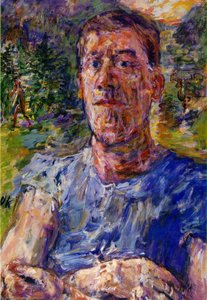 Self-portrait of a 'Degenerate Artist' - Oskar Kokoschka
A central figure in the landscape of 20th century Austrian painters, Oskar Kokoschka (1886–1980) redefined the boundaries of portraiture through a lens of raw, psychological intensity. Eschewing the rigid constraints of traditional academic training, Kokoschka’s journey began at the Kunstgewerbeschule in Vienna. His early years were deeply influenced by the Jugendstil movement and his work with the Wiener Werkstätte, which helped him cultivate a unique visual language that prioritized emotional truth over mere physical likeness.
His career was marked by a restless, searching energy, moving from the creative hubs of Vienna to the bustling atmosphere of Berlin. The turbulence of the era, including his harrowing experiences as a soldier in World War I, profoundly shaped his expressive style. This is most poignantly captured in his 1937 Self-portrait of a 'Degenerate Artist', a work that stands as a defiant testament to his resilience against the political pressures of the time. Through his masterful use of bold, visible brushstrokes and a vibrant, often unconventional palette, Kokoschka remains a cornerstone of Austrian modernism, capturing the very essence of the human spirit in flux.
Arnold Schoenberg
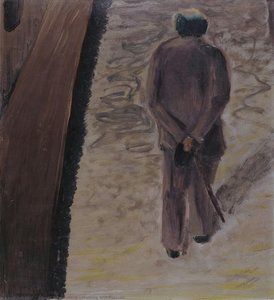 Walking Self-Portrait - Arnold Schoenberg
While primarily celebrated as a revolutionary composer, Arnold Schoenberg’s visual presence offers a profound window into the intellectual intensity of the 20th century Austrian painters and artists. Born in Vienna in 1874, he became a central figure of the Second Viennese School, fundamentally altering the landscape of modernism through his development of atonality. His life was a journey of constant evolution, moving from the Brahmsian-Wagnerian synthesis of his early years to the radical structures of the twelve-tone technique.
His 1911 work, Walking Self-Portrait, captures a man in deep, contemplative motion. Dressed in formal attire and walking with hands clasped behind his back, he appears lost in a world of internal resonance. The urban backdrop serves as more than a setting; it represents the external chaos that he sought to distill into pure, emotive expression. This ability to translate raw, psychological depth into a structured medium is what defines the spirit of the 20th century Austrian avant-garde. Whether through his groundbreaking musical scores or his introspective self-portraits, Schoenberg embodied the era's shift toward exploring the complexities of the human subconscious.
Koloman Moser
 Inlaid Eisler-Terramare Armoire - Koloman Moser
A foundational figure in the transition toward modernism, Koloman Moser (1868–1918) helped define the visual language of 20th century Austrian painters and designers. As a founding member of the Vienna Secession, his work bridged the gap between fine art and applied craftsmanship, a hallmark of the Austrian avant-garde during this era. His education at the Wiener Akademie and the Kunstgewerbeschule provided the technical rigor that allowed him to master everything from graphic design and stained glass to architecture and ceramics.
Moser’s philosophy of the Gesamtkunstwerk—the total work of art—is perfectly encapsulated in the Inlaid Eisler-Terramare Armoire (1903). This piece demonstrates how he applied the principles of the Wiener Werkstätte to functional objects, treating furniture as an architectural element. The armoire features a disciplined, rhythmic grid of squares and rectangles, creating a sophisticated checkerboard effect. Within this geometric framework, stylized female figures are rendered in light wood grain, offering an organic, swirling contrast to the rigid structure. Through the masterful use of birdseye maple, thuja, and satinwood veneers, Moser achieved a planar, graphic quality that anticipated the abstraction of the coming decades.
Friedensreich Hundertwasser
 Heavy Grass Wind - Friedensreich Hundertwasser
A true icon of the 20th century Austrian painters, Friedensreich Hundertwasser (1928–2000) sought to heal the rift between humanity and the natural world through a radical, organic visual language. His journey was deeply shaped by the hardships of his youth in Vienna, where he narrowly escaped persecution during the Nazi era. This early struggle fueled a lifelong rebellion against the rigid, standardized geometry of modernism. Rejecting the strict academicism of the Academy of Fine Arts, he embraced a philosophy of harmony, famously adopting a pseudonym that translates to "Peace-Realm Hundred-Water." His representative work, Heavy Grass Wind, serves as a vibrant manifesto of this belief. Created in 1968, the piece eschews traditional depth in favor of a rhythmic, two-dimensional plane. Through a complex layering of oil, egg tempera, and silver leaf, Hundertwasser creates undulating bands of orange, red, and blue that mimic the invisible forces of nature. The composition features a stylized, irregular structure that lacks a single straight line, instead utilizing the spiral—his signature motif—to symbolize the cyclical, growing energy of life. In this work, the tension between human habitation and the wild, bulbous forms of the natural world is resolved through a joyful, energetic convergence of color and motion.
Albin Egger Lienz
 Ila, die jüngere Tochter des Künstlers - Albin Egger Lienz
A central figure in the evolution of 20th century Austrian painters, Albin Egger-Lienz bridged the gap between traditional realism and a powerful, monumental expressionism. Born in Tyrol in 1868, his artistic journey was deeply rooted in his heritage, beginning with the guidance of his father, a church painter. His later studies in Munich and his eventual involvement with the Vienna Secession in 1909 allowed him to refine a style that was uniquely his own—one characterized by massive, strongly outlined forms and a sophisticated, almost monochromatic palette of earth tones.
His work often captured the rugged essence of Tyrolean life and the gravity of historical struggles, yet he possessed a profound ability to capture quiet, intimate moments. This duality is beautifully exemplified in his 1920 work, Ila, die jüngere Tochter des Künstlers. In this portrait, the artist moves away from the heroic scale of his war paintings to present a scene of striking stillness. Through a masterful use of muted clay tones punctuated by a singular, vibrant red, he captures a sense of nostalgic innocence that remains a hallmark of his expressive, soulful approach to portraiture.
Richard Gerstl
 Group portrait with Schönberg - Richard Gerstl
A tragic and meteoric figure in the history of Viennese modernism, Richard Gerstl represents the raw, unbridled spirit of 20th century Austrian painters. Though his life was cut short in 1908, his brief career acted as a bridge between late-century traditions and the radical psychological depth of Expressionism. Gerstl’s work is defined by a profound rejection of academic formality; he moved away from the structured teachings of the Academy of Fine Arts Vienna to find a more visceral, emotive language that anticipated the movements of the coming decades.
His masterpiece, Group portrait with Schönberg, serves as a haunting testament to his evolving technique. In this composition, Gerstl moves beyond mere likeness to explore the very essence of his subjects. Using a palette knife to apply a sunstrewn backdrop of rich ochres and greens, he employs a striking distortion of the human form. As the viewer draws back, the faces—initially indistinguishable in their close-up intensity—gradually coalesce into recognizable figures. This ability to blend psychological tension with experimental brushwork cements his status as a pioneer who dared to look inward during a transformative era in Austrian art.
Carl Moll
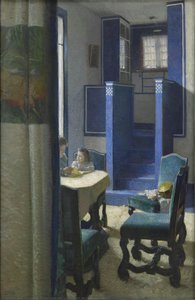 Drawing-Room in House on the Hohe Warte - Carl Moll
A central figure in the evolution of Austrian modernism, Carl Moll helped redefine the visual language of Vienna at the dawn of the 20th century. As a founding member of the Vienna Secession, he was instrumental in breaking away from rigid academic traditions to embrace the radical energy of the new era. His influence was profound; he was even responsible for organizing the first exhibition of Vincent van Gogh's work in Vienna, bridging the gap between French innovation and Austrian sensibility.
Moll’s work is characterized by a sophisticated mastery of light and atmosphere, often utilizing Pointillist techniques to create luminous, textured surfaces. This is beautifully exemplified in his 1903 masterpiece, Drawing-Room in House on the Hohe Warte. In this elegant interior, he captures a quiet, domestic moment, using delicate color fragmentation to evoke a sense of warmth and intimacy. By blending meticulous organization with the soft, atmospheric qualities of Impressionism, Moll secured his place among the most significant 20th century Austrian painters, transforming the depiction of everyday life into a profound exploration of modern elegance.
Alban Maria Johannes Berg
 Agnes Miyakawa - Alban Maria Johannes Berg
While primarily celebrated as a titan of music, the legacy of Alban Maria Johannes Berg is inextricably linked to the cultural fabric of 20th century Austrian painters and the broader Viennese avant-garde. Born in Vienna in 1885, Berg’s artistic trajectory was fundamentally reshaped by his pivotal encounter with Arnold Schoenberg in 1904. This mentorship integrated him into the Second Viennese School, where he mastered the revolutionary twelve-tone technique. However, Berg’s unique contribution to this era was his ability to infuse rigorous modernism with a profound, Romantic lyricism, bridging the gap between traditional emotionalism and the radical shifts of the early 1900s.
His life and work reflect the intense, often complex social dynamics of the Austrian capital during this transformative period. The representative work, Agnes Miyakawa, serves as a visual testament to the era's aesthetic sensibilities. This 1931 portrait captures the poise and formal elegance characteristic of early 20th-century portrait photography, mirroring the sophisticated, often melancholic atmosphere that defined the artistic movements of his time. Through his groundbreaking operas and vocal compositions, Berg remains a central figure in the intellectual landscape that shaped the 20th century Austrian identity.
Conclusion
The 20th century was a transformative era for Austrian art, a period where the boundaries of expression were pushed by visionaries who transitioned from the ornate elegance of the Secession to the raw, psychological intensity of Expressionism. From the shimmering, gold-leafed textures of Gustav Klimt to the provocative, emotive lines of Egon Schiele, these artists redefined how we perceive the human form and the modern soul. Whether through the vibrant, organic patterns of Friedensreich Hundertwasser or the dramatic, layered compositions of Oskar Kokoschka, this group of painters left an indelible mark on the history of modernism, offering a diverse spectrum of color, emotion, and structural innovation.
At Mus3ums.com, we believe these profound legacies deserve a place in your personal sanctuary. You can bring the spirit of these masters into your home by exploring our full collection. We invite you to live with these iconic movements every day through our museum-quality, hand-painted oil reproductions, crafted by skilled artists to capture the authentic texture and soul of these Austrian masterpieces.