Introduction
The 18th century in Sweden marked a transformative era of cultural refinement, as the nation transitioned from the austere traditions of the previous age into the luminous elegance of the Enlightenment. This period saw Swedish artists moving beyond mere provincialism to engage deeply with the grand European traditions of Rococo and Neoclassicism. Whether capturing the intricate textures of silk in aristocratic portraits or the atmospheric light of Nordic landscapes, these painters reflected a society increasingly focused on grace, scientific observation, and the sophisticated aesthetics of the royal courts.
What unites this specific group of masters is their ability to blend local sensibilities with the dominant styles of France and Italy. They navigated a world of shifting patronage, where the demand for grand historical scenes met a growing interest in intimate, naturalistic depictions of daily life and nature. Their work serves as a visual chronicle of a nation finding its voice within the broader European art movement, capturing a unique intersection of Northern light and Continental elegance.
Today, these artists remain vital for their technical mastery and their role in defining the visual identity of the Swedish Enlightenment. Their ability to render human character and the subtle nuances of light continues to influence how we perceive the balance between formal portraiture and the burgeoning Romantic movement. By examining the lives and legacies of these ten essential figures, we gain a profound understanding of the artistry that shaped the Swedish visual heritage.
Alexander Roslin
Born in Malmö in 1718, Alexander Roslin stands as a preeminent figure among 18th century Swedish painters, having achieved international acclaim as a master of the Rococo style. His journey from a Swedish upbringing to the pinnacle of the Parisian art scene exemplifies the era's cosmopolitan spirit. After an initial apprenticeship under Georg Engelhard Schröder in Stockholm, Roslin’s talent led him through Italy and eventually to France, where he became a celebrated chronicler of aristocratic elegance. His ability to blend technical precision with psychological depth allowed him to capture the very essence of social standing and character.
In his representative work, Gustav III of Sweden (1777), Roslin demonstrates the extraordinary skill that defined his career. This portrait serves as a profound study of royal authority, rendered with a breathtaking command of texture. Through his fluid brushwork, the artist captures the heavy weight of velvet and the shimmering gleam of regalia, transforming fabric into a tactile experience. By meticulously detailing the sitter's costume and posture, Roslin does more than record a likeness; he constructs a monumental image of power and permanence, cementing his legacy as a premier portraitist of the 18th century."
Martin van Meytens
 Portrait of Maria Theresa - Martin van Meytens
Born in Stockholm in 1695, Martin van Meytens stands as a preeminent figure among 18th century Swedish painters, having transitioned from his Scandinavian roots to become the definitive visual chronicler of the Habsburg Empire. His journey from the Swedish capital through the cultural hubs of London and Paris allowed him to master a cosmopolitan style that seamlessly blended the precision of miniature portraiture with the sweeping, dramatic grandeur of the Baroque.
A viewer can recognize a Meytens masterpiece by its profound sense of imperial majesty and opulent texture. He possessed a singular ability to render the weight of luxurious textiles and the shimmer of gold embroidery, using a rich, saturated palette to convey power. In his Portrait of Maria Theresa (1750), this technique is on full display. The composition utilizes a stable pyramidal structure to present the Empress in a formal state portrait, where deep crimson drapery and brilliant gold accents emphasize her sovereign authority. His brushwork captures the intricate details of royal regalia, creating a direct, commanding presence that places the observer in the immediate presence of the monarch. Through his mastery of light and color, Meytens transformed the faces of European royalty into enduring symbols of dynastic splendor.
Adolf Ulrik Wertmüller
 George Washington - Adolf Ulrik Wertmüller
A central figure among 18th century Swedish painters, Adolf Ulrik Wertmüller (1751–1811) bridged the gap between Nordic identity and the sophisticated elegance of the French School. His artistic trajectory was profoundly shaped by his time in Paris, where he studied under his cousin, the renowned Alexander Roslin, and embraced the neoclassical principles championed by Joseph-Marie Vien. This immersion in Parisian idealism allowed him to bring a refined, graceful sensibility back to the Swedish court, where he became a favored portraitist for King Gustav III.
Wertmüller is particularly noted for his ability to navigate both the rigid requirements of royal portraiture and the more provocative explorations of the neoclassical movement. His work often balanced idealized beauty with a mastery of texture and light, a skill evident in his celebrated depictions of Marie Antoinette and his controversial studies of the female form. In his 1795 George Washington, Wertmüller demonstrates his command over the portrait genre, utilizing a soft chiaroscuro to define the subject's features against a dark, atmospheric background. Through his precise rendering of skin tones and the stark contrast of lace and velvet, he solidified his reputation as a master of both character and composition.
Carl Gustaf Pilo
 Portræt af Christian VII som kronprins - Carl Gustaf Pilo
Born in 1711 on a farm near Nyköping, Carl Gustaf Pilo represents the remarkable journey of a Swedish artist who rose from humble beginnings to the highest echelons of European royalty. As a prominent figure among 18th century Swedish painters, his career was defined by a restless search for identity, moving from the decorative traditions of his father to the sophisticated courts of Europe. His early training and travels through Germany and potentially Vienna allowed him to master a style that bridged the gap between the late Baroque and the elegant Rococo.
A defining moment in his career was his ascent to the position of painter to the Danish Royal Court, a role that showcased his ability to capture both status and character. His 1762 masterpiece, Portræt af Christian VII som kronprins, serves as a profound example of this mastery. In this work, Pilo utilizes a dramatic chiaroscuro effect to isolate the young prince from a deep, shadowed architectural background. Through the meticulous rendering of lace, embroidery, and the sheen of silk, he creates a sense of aristocratic poise that remains a testament to the technical excellence of 18th-century Swedish portraiture.
Carl Frederik von Breda
 The Artist's Father - Carl Frederik von Breda
A prominent figure among 18th century Swedish painters, Carl Frederik von Breda (1759–1818) bridged the gap between Scandinavian tradition and the sophisticated portraiture of the British school. Born in Stockholm and trained at the Royal Swedish Academy of Arts under Lorens Pasch the Younger, Breda’s career was defined by a cosmopolitan elegance that earned him the moniker "the Van Dyck of Sweden." His work is instantly recognizable by its bold, confident brushwork and a masterful command of light that lends his subjects a sense of aristocratic dignity and psychological depth.
In his 1785 work, The Artist's Father, Breda demonstrates the technical precision and restrained palette that characterized his early mastery. The portrait is a study in texture and subtle illumination, utilizing a soft, directional light to define the contours of the face and the delicate lace of the cravat. The composition relies on a sophisticated interplay of shadows and muted tones, particularly within the deep, espresso-colored background, to pull the viewer’s focus toward the sitter's character. Through his ability to capture both the tactile reality of fine fabrics and the quiet introspection of his subjects, Breda remains a vital link in the evolution of Swedish portraiture.
Pehr Hilleström
 Maid Buying a Love-Ditty - Pehr Hilleström
Pehr Hilleström (1732–1816) stands as a preeminent figure among 18th century Swedish painters, serving as a vital visual chronicler of the Gustavian era. His ability to document the social fabric of Stockholm, from the domestic intricacies of the elite to the industrious lives of the working class, makes his oeuvre an indispensable historical record. Trained at the Royal Swedish Academy of Fine Arts under the guidance of Guillaume Taraval and Jean Eric Rehn, Hilleström blended the formal principles of Baroque portraiture with a keen, observational naturalism that defined the Swedish aesthetic of his time.
His mastery of genre painting is vividly realized in Maid Buying a Love-Ditty (1796). This work exemplifies his talent for capturing quiet, human moments amidst the rhythms of daily labor. The composition focuses on a young maid pausing her chores in a lush, natural setting, her attention captured by a simple broadside ballad. Through meticulous detail, Hilleström elevates the mundane to the level of high art, rendering the metallic sheen of a copper pot and the delicate textures of lace with profound clarity. The painting serves as a poignant intersection of class and culture, illustrating how even the most utilitarian moments were imbued with a sense of romantic connection and human dignity.
Michael Dahl
 Portrait of Jonathan Swift - Michael Dahl
Michael Dahl represents a vital link between the Swedish Baroque tradition and the burgeoning portraiture scene of 18th-century England. Born in Stockholm around 1659, his artistic identity was forged through rigorous training under Martin Hannibal and the esteemed David Klöcker Ehrenstrahl. This foundational education allowed him to transition from his Swedish roots to become a prominent figure in London, where he refined his skills under the engraver Robert White. His ability to navigate diverse European cultural landscapes is a hallmark of his career, making him a significant figure among 18th century Swedish painters who achieved international acclaim.
His 1734 Portrait of Jonathan Swift serves as a masterful example of his technical sophistication. In this work, Dahl utilizes a dramatic chiaroscuro to sculpt the subject from a dark, indeterminate void, emphasizing the tactile reality of the clerical robes. The stark contrast between the luminous white sleeves and the black chimere creates a sense of quiet authority and intellectual depth. Through a restrained palette and a focus on the sitter's dignity, Dahl demonstrates the sophisticated Baroque sensibilities that defined his contribution to the era's portraiture.
Georg Desmarées
 Portrait of Moses Wolff - Georg Desmarées
Born in Stockholm in 1697, Georg Desmarées represents the sophisticated internationalism of 18th century Swedish painters. While his career eventually flourished as a court painter in Munich under Maximilian III Joseph, his artistic foundation was deeply rooted in his Swedish origins and a prestigious European lineage. Descended from the Dutch Mijtens family, he received early instruction from his uncle, Martin van Meytens, which infused his work with the refined aesthetic of French masters like Hyacinth Rigaud.
Desmarées’ style evolved through extensive travel, most notably his transformative sojourn in Venice, where the influence of Giovanni Battista Piazzetta introduced him to the dramatic chiaroscuro and vibrant palettes of the Italian Rococo. This synthesis of Northern precision and Italian light is masterfully captured in his 1750 work, Portrait of Moses Wolff. In this composition, Desmarées utilizes directional lighting to carve out the subject's features, creating a palpable three-dimensional depth. Through the delicate rendering of textures—from the crispness of a white lace cravat to the soft folds of a midnight blue coat—he demonstrates the technical mastery that defined the era's portraiture.
Per Krafft the Elder
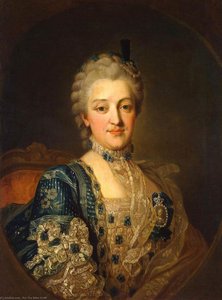 Portrait of Natalia Alexandrovna Repnina - Per Krafft the Elder
Born in Arboga in 1724, Per Krafft the Elder stands as a definitive figure among 18th century Swedish painters, embodying the transition from the playful whimsy of the Rococo to the disciplined structure of the Enlightenment. His technical mastery was forged through a prestigious lineage of mentorship; after beginning his studies in Uppsala, he moved to Stockholm to study under the court painter Johan Henrik Scheffel. This foundation in precision was further refined during his travels to Copenhagen, where the influence of Carl Gustaf Pilo helped him master the art of chiaroscuro, allowing him to sculpt form through light.
Krafft’s ability to capture the very soul of the aristocratic elite is perhaps best exemplified in his 1767 work, Portrait of Natalia Alexandrovna Repnina. In this piece, he moves beyond mere likeness to create a sophisticated narrative of status and grace. Through meticulous brushwork, he renders the tactile reality of silk and lace, imbuing the sitter with a serene, breathing presence. His work remains a vital testament to the elegance of 18th century Swedish portraiture, capturing a society defined by both opulent ornamentation and burgeoning neoclassical ideals.
Georg Engelhard Schröder
 Madonna and Child - Georg Engelhard Schröder
Georg Engelhard Schröder stands as a preeminent figure among 18th century Swedish painters, having shaped the visual identity of the Swedish court during a period of profound cultural transition. Born in Stockholm in 1684, his career reached its zenith as he transitioned from a student of David von Krafft to a master of international standing. His work is easily identified by a sophisticated synthesis of the dramatic Italian Baroque and the refined elegance of the London portrait scene, a style forged during his extensive travels through Germany, France, and England.
A viewer can recognize Schröder’s hand through his meticulous attention to detail and a luminous, vibrant color palette that imbues his subjects with aristocratic dignity. In his Madonna and Child (c. 1720), we see this technical mastery applied to a religious motif. The composition utilizes directional lighting to cast soft shadows, defining the heavy folds of a blue mantle and creating a profound sense of three-dimensionality. His ability to capture both the psychological depth of royalty and the tender, intimate emotions of maternal devotion makes his oeuvre a cornerstone of Swedish art history.
Conclusion
The masters of this era collectively defined a golden age of Swedish visual culture, bridging the gap between the rigid formality of the Baroque and the delicate, emotive grace of the Rococo. From the exquisite textile textures captured by Alexander Roslin to the grand, dramatic compositions of Adolf Ulrik Wertmüller, these artists transformed the Swedish aesthetic through a profound understanding of light, portraiture, and social elegance. Whether through the intimate still lifes of Pehr Hilleström or the sweeping landscapes of Michael Dahl, their work reflects a sophisticated era of European art history that continues to resonate with modern sensibilities.
At Mus3ums.com, we invite you to bring this historical elegance into your own space. You can explore our full collection to find your favorite piece from this illustrious period. Our artisans specialize in creating museum-quality, hand-painted oil reproductions that preserve the authentic brushstrokes and tonal depth of these 18th-century masterpieces, allowing you to live with the beauty of Swedish art every day.