Introduction
The 20th century marked a profound metamorphosis for the visual language of Turkey, as artists navigated the complex intersection of deep-rooted Ottoman traditions and the burgeoning currents of Western modernism. This era was defined by a dynamic tension between the calligraphic elegance of the past and the bold, experimental impulses of abstraction and impressionism. As the nation transitioned through significant cultural shifts, painters began to move beyond classical portraiture and landscape traditions, seeking new ways to express a modern identity through color, form, and texture.
This period of creativity was not merely a stylistic evolution but a dialogue between East and West. Artists were influenced by the light of the Mediterranean, the geometric complexities of traditional motifs, and the revolutionary movements emerging from Europe. Their work serves as a vital bridge, capturing a society in flux and translating the spirit of a changing era into enduring visual narratives. Today, these painters remain essential for understanding the evolution of modern art, offering a unique perspective on how cultural heritage can coexist with avant-garde expression.
In the following sections, we examine the lives and legacies of ten pivotal figures who shaped this artistic landscape, from the pioneers of early modernism to the masters of contemporary abstraction.
Arshile Gorky
Born in 1904 in the Ottoman Empire in what is now Turkey, Arshile Gorky represents a profound bridge between Eastern origins and the vanguard of Western modernism. His inclusion in the canon of 20th century Turkish painters is rooted in his birth in the region, a fact that precedes his transformative journey toward becoming a pioneer of Abstract Expressionism. After leaving his birthplace, Gorky underwent a radical process of reinvention, shedding his original identity to embrace a name inspired by classical mythology.
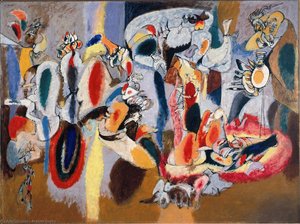
His artistic evolution was shaped by rigorous self-study at the Museums of Fine Arts, Boston, where he absorbed the techniques of the old masters. While his early works reflected the influence of Impressionism and Post-Impressionism through thick, textured brushstrokes, he eventually moved toward a more lyrical and gestural language. His landmark 1944 work, The Liver is the Cock's Comb, exemplifies this shift. In this piece, he deconstructs traditional form, utilizing biomorphic shapes and a vibrant, chaotic palette to evoke deep emotional landscapes. By blending the structural fracturing of Cubism with the subconscious explorations of Surrealism, Gorky forged a unique visual language that remains a cornerstone of modern art history.
Abdülmecid II
 Hanzade Sultan - Abdülmecid II
A signature of Abdülmecid II is the seamless fusion of imperial tradition and modern Western techniques, a style that defines his place among the 20th century painters from Turkey. His work is instantly recognizable through its vibrant color palettes and a sophisticated command of texture, often blending the intricate patterns of Ottoman heritage with the soft, luminous qualities of European realism. His brushwork demonstrates a remarkable ability to balance complex geometric motifs with the delicate, organic details of the human form and nature.
In his 1936 masterpiece, Hanzade Sultan, this duality is masterfully displayed. The painting captures a poised elegance, utilizing oil on canvas to create deep, soulful tones in the subject's blue attire. The artist's skill is evident in the way he manages light, transitioning from the smooth textures of skin to the intricate, botanical details of a floral arrangement. His artistic journey, shaped by a life of immense historical transition, allowed him to draw inspiration from diverse sources, ranging from the romanticism of Goya to the vibrant, detailed figures reminiscent of Surrealism. Through his unique vision, he transformed the essence of Turkish life into enduring visual narratives.
Osman Hamdi Bey
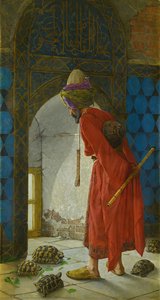
In his 1906 masterpiece, The Tortoise Trainer, Osman Hamdi Bey presents a profound meditation on patience and the slow pace of reform. The work depicts a figure in dignified, layered robes standing within a space characterized by intricate Iznik tiles and architectural gravity. Through a meticulous application of oil on canvas, Bey captures the textures of stone and fabric with academic precision, utilizing light to sculpt a scene of quiet, contemplative tension. His technique bridges the gap between traditional Orientalist themes and a deeply personal, psychological realism.
As a foundational figure whose influence extended well into the 20th century, Bey’s legacy is inextricably linked to the modernization of Turkish art. He was a polymath who served as the founder of the Istanbul Archaeology Museums and the Academy of Fine Arts, now known as Mimar Sinan Fine Arts University. His oeuvre, which includes notable works like Portrait of Naile Hanım and Odja Reading the Koran, showcases a mastery of portraiture and genre scenes. By blending his legal training in Paris with a passion for the visual arts, he established the institutional framework that allowed the next generation of Turkish painters to flourish.
Karsh Of Ottawa
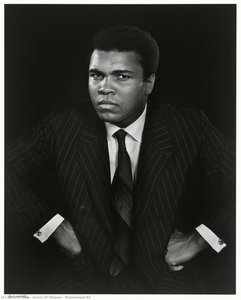 Muhammad Ali - Karsh Of Ottawa
Born in Mardin in 1908, Karsh Of Ottawa represents a profound connection between the Anatolian roots of the early 20th century and the global stage of modern portraiture. Although his career flourished in Canada, his origins in the Ottoman Empire place him firmly within the diverse tapestry of 20th century Turkish painters and visual creators. His journey, shaped by the migrations of his family, led him to master a style that would redefine how the world perceived its most influential figures.
His work is defined by a masterful command of chiaroscuro and theatrical lighting, a technique that allows him to sculpt the human face with intense psychological depth. This is vividly realized in his 1970 work, Muhammad Ali. In this striking portrait, Karsh captures the boxer not merely as an athlete, but as a titan of conviction. Through dramatic shadows and a powerful, close-up composition, he distills the essence of Ali’s defiance and strength, transforming a photographic moment into a timeless study of character and presence.
Elli Sougioultzoglou-Seraidari
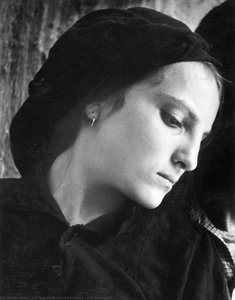 Girl from Ipati - Elli Sougioultzoglou-Seraidari
Born in Adana, Turkey, in 1899, Elli Sougioultzoglou-Seraidari—widely known by her professional moniker, Nelly—represents a vital link in the artistic heritage of the 20th century. Her early years in Turkey provided a rich cultural foundation that allowed her to bridge Eastern sensibilities with Western aesthetic traditions. While she is celebrated for her profound impact on Greek visual identity, her origins place her firmly within the diverse tapestry of 20th century painters and visual artists from Turkey.
Nelly was a poet of light and shadow who approached photography with the emotive depth of an Impressionist. Her work often mirrored the atmospheric textures found in the paintings of masters like Claude Monet, using dramatic contrasts to transform rugged landscapes into spiritual narratives. In her representative work, Girl from Ipati (c. 1930), she demonstrates a masterful command of naturalism. This monochrome portrait captures a young woman in profile, utilizing a shallow depth of field and soft, diffused lighting to create an introspective, almost melancholic mood. Through her lens, the physical world is elevated to a realm of timeless, mythical vitality.
Füsun Onur
 Water by the Sidewalk - Füsun Onur
A central figure in the evolution of modern Turkish art, Füsun Onur represents the transformative energy of the 20th century. Born in Istanbul in 1938, her artistic journey reflects the broader shifts in Turkish aesthetics as the nation navigated modernization. After studying sculpture under Ali Hadi Bara at the Istanbul Academy of Applied Fine Arts, she expanded her conceptual horizons through a Fulbright scholarship at the Maryland Institute College of Art in the United States.
Onur is distinguished by her departure from traditional, solid sculpture toward a practice that blurs the boundaries between painting and three-dimensional form. By establishing her atelier in the historic neighborhood of Kuzguncuk, she began to dismantle conventional boundaries, utilizing everyday materials such as paper, cardboard, and wood to explore the rhythm of urban life. In her evocative work Water by the Sidewalk (1981), she masterfully employs collage and assemblage to investigate the complex relationships between space, time, and fragmentation. Through her use of geometric abstraction and muted putty and blue tones, Onur captures the essence of Istanbul, turning found objects into profound meditations on the tactile nature of existence.
İNci Eviner
 Body Geography - İNci Eviner
Born in Polatlı in 1956, İnci Eviner represents a vital evolution in the lineage of 20th century Turkish painters, moving beyond traditional canvas to redefine the boundaries of contemporary expression. Her academic journey began at the Painting Department of the Istanbul State Academy of Fine Arts, where she eventually earned her PhD, establishing a rigorous technical foundation that she would later use to dismantle conventional artistic norms. As a prominent figure emerging from the late 20th-century Turkish art scene, her work is deeply intertwined with the sociopolitical shifts of her era, particularly regarding gender roles and identity formation.
Eviner’s practice is profoundly multidisciplinary, weaving together drawing, video, performance, and installation to probe the complexities of power and authority. Her representative work, Body Geography, exemplifies this approach; it is a sophisticated inquiry into the relations between the human body and modernization, utilizing a diverse array of media including photography and motion picture techniques. By integrating organic materials like wax, copper, and leather, she explores themes of desire and the performative nature of gender, securing her place as a transformative voice in the modern Turkish canon.
Burhan Doğançay
 Untitled (D2X9XM) - Burhan Doğançay
Born in Istanbul in 1929, Burhan Doğançay represents a vital link in the evolution of 20th century Turkish painters, bridging the artistic traditions of his homeland with the vibrant energy of the New York art scene. After receiving foundational training from his father, Adil Doğançay, and Arif Kaptan, he pursued an academic path in law and economics before dedicating his life to fine arts. His decision to settle in New York in 1964 marked a transformative period, where he transitioned from a student of the Académie de la Grande Chaumière to a master of urban texture.
Doğançay is celebrated for his monumental "Walls of the World" project, a photographic and visual exploration of the urban landscape. He viewed the surfaces of cities as barometers of the human condition, capturing the layers of graffiti, posters, and weathering that define societal life. His 1982 work, Untitled (D2X9XM), exemplifies this fascination with materiality. Through a meticulous approach to texture, the piece mimics the weathered facades of the metropolis, transforming the ephemeral marks of urban decay into a profound meditation on time and memory.
Feyhaman Duran
 Still Life with Melon - Feyhaman Duran
A visitor can immediately recognize a work by Feyhaman Duran through his sophisticated command of light and the dignified presence of his subjects. His brushwork reflects a rigorous academic foundation, characterized by a seamless transition between shadow and form that lends a tactile, sculptural quality to his compositions. Whether capturing the subtle textures of a fruit or the nuanced features of a portrait, his palette remains controlled and harmonious, often emphasizing a quiet, classical prestige.
As a pivotal figure in the development of modern Turkish art, Duran’s career spanned the transformative decades of the 20th century. His journey from the studios of the Académie Julian in Paris back to Istanbul allowed him to bridge Western Impressionism with a deep, local sensibility, making him a cornerstone of the 1914 Generation. His ability to synthesize European academic realism with the precision of Eastern traditions defines his unique contribution to the era.
In his 1965 work, Still Life with Melon, this mastery is on full display. The painting is a quiet study of domestic abundance, where the interplay of light on the surfaces of apples, oranges, and bananas creates a sense of profound stillness. Through this arrangement, Duran elevates the everyday into a moment of enduring grace.
Nazmi Ziya Güran
 Lady in Pink on a Chaise Longue - Nazmi Ziya Güran
A Nazmi Ziya Güran masterpiece is instantly recognizable through its luminous, atmospheric quality and a profound sensitivity to the interplay of light and shadow. As a central figure among 20th century Turkish painters, his work bridges the gap between traditional academic training and the vibrant, fleeting sensations of Impressionism. His style is defined by soft, dappled brushwork that prioritizes the movement of light over rigid outlines, creating a sense of tranquil, living air within the frame.
His artistic journey was shaped by the prestigious Académie Julian and the École Nationale Supérieure des Beaux-Arts in Paris, where he studied under masters like Fernand Cormon. This European influence, combined with his deep roots in Istanbul, allowed him to master the art of capturing nature's ephemeral beauty. In his notable 1917 work, Lady in Pink on a Chaise Longue, this technique reaches a peak of serenity. The canvas depicts a woman reclining in a sun-drenched garden, where the light filters through a dense canopy to cast soft, colorful reflections upon her attire. Through his delicate handling of color and texture, Güran transforms a private moment of quietude into a timeless study of light and atmosphere.
Conclusion
The legacy of these 20th-century masters reflects a profound era of transition, where the traditional roots of the Ottoman era met the bold, experimental currents of modernism. From the structural innovations of Burhan Doğançay to the expressive, emotive brushwork of Arshile Gorky, these artists collectively bridged the gap between regional identity and global art movements. Whether through the delicate portraiture of Feyhaman Duran or the vibrant, modern compositions of Füsun Onur, each painter contributed a unique visual language that helped define a nation's aesthetic evolution during a century of immense change.
For those looking to honor this rich cultural heritage, Mus3ums.com offers a way to bring these historical narratives into your own living space. Our artisans specialize in creating museum-quality, hand-painted oil reproductions that capture the authentic texture and soul of these masterpieces. You can explore the breadth of this artistic era by browsing our full collection and find a piece that resonates with your personal style. We invite you to live with these works through our exquisite, handmade oil paintings, crafted to preserve the legacy of these incredible painters for generations to come.