A Life of Science and Service
Willem Thomas De Vogel was not primarily a visual artist, but rather a distinguished colonial Dutch doctor and official whose life was defined by his profound contributions to public health in the Dutch East Indies. Born in 1863 in Toeban, Java, his early years were shaped by a complex heritage, with a Dutch father and an English mother. Though he initially pursued studies in mathematics and physics at the University of Leiden, the shifting fortunes of his family led him to work aboard the sailing ship Nicholaas Beets, traveling between the Netherlands and Batavia. This period of maritime labor provided him with a unique perspective on the colonial landscape that would later inform his medical career.
Driven by a renewed academic purpose, De Vogel returned to Leiden to master the art of medicine, eventually graduating with honors in 1893. His professional journey took him to the sugar plantations of Tegal, where he acted as a physician and oversaw vital smallpox vaccination efforts. His work during this era was marked by a commitment to improving sanitary living conditions, successfully reducing mortality rates among plantation workers through dedicated medical intervention and care.
Medical Pioneering and Tropical Research
The scope of De Vogel's influence expanded significantly as he sought specialized training across Europe, studying internal medicine, bacteriology, and psychiatry in Berlin, and ophthalmology in Utrecht, Heidelberg, and Vienna. Upon returning to the East Indies in 1898, he established a practice in Semarang, a city then grappling with the devastating effects of dysentery, typhoid, cholera, and malaria. His scientific rigor led him to conduct groundbreaking research into the transmission of malaria through mosquitoes, a discovery that would have lasting implications for tropical medicine.
Beyond his clinical practice, De Vogel was a foundational figure in the institutionalization of colonial healthcare. He was instrumental in several key achievements:
- The establishment of the Department of Public Health in the Dutch East Indies.
- The founding of the Dutch Society for Tropical Medicine alongside Dr. van der Scheer.
- The creation of essential quarantine ordinances for the colony.
- Serving as the Chief State Physician for Semarang and later as a high-ranking inspector for the Civil Medical Service.
Legacy and Historical Significance
De Vogel's legacy is etched into the very infrastructure of the regions he served. His advocacy for healthful living led him to purchase estates in the highlands to encourage the movement of populations away from pestilential lowlands, contributing to the development of neighborhoods like Candisari in Semarang. His dedication to scientific progress was recognized through numerous prestigious honors, including being named an officer of the Order of Orange–Nassau and a knight in the Order of the Dutch Lion.
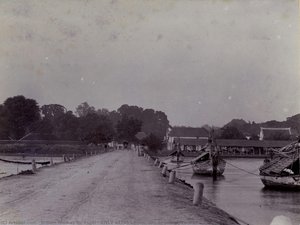
While his name is occasionally associated with historical scenes such as Boten aan de pier bij Toeban, his true masterpiece was the advancement of medical science and the preservation of life in the Dutch East Indies. Through his roles as a researcher, administrator, and physician, Willem Thomas De Vogel left an indelible mark on the history of tropical medicine and public health administration.
Otázky a odpovědi
V jakém městě a z jaké země pochází Willem Thomas De Vogel?
Willem Thomas De Vogel se narodil(a) ve městě Tuban v zemi Indonesia.
Kde a v jakém roce se narodil/a Willem Thomas De Vogel?
Willem Thomas De Vogel se narodil(a) v roce 1863 ve městě Tuban.
Odkud pochází Willem Thomas De Vogel?
Willem Thomas De Vogel se narodil(a) v Indonesia.