

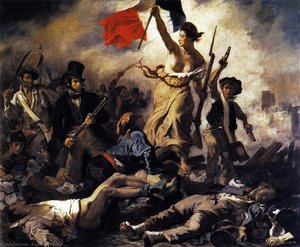
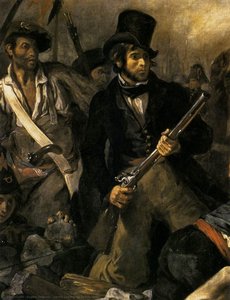
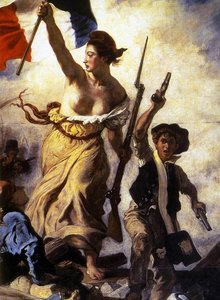
Bare-breasted woman, tricolour flag, musket, a pile of bodies, a boy waving pistols on either side of her.
It's been on album covers, banknotes, a generation's T-shirts, and the poster for approximately every stage adaptation of Les Misérables ever printed.
Ask most people what it's depicting and you'll get one of two answers. Both are wrong.
It is not 1789 and it is not Les Misérables. It is the July Revolution of 1830 — three specific days in Paris, forty-one years after the Bastille and two years before the uprising Victor Hugo wrote about.
You know this painting. You have the date wrong. Nearly everyone does.
The Received Wisdom, And Why It's Such An Easy Mistake
Here's why everyone gets this wrong, and it isn't stupidity — it's that French history hands you three separate Parisian uprisings within about forty years and expects you to keep them straight without a scorecard.
1789 is the one everyone learns in school: the Bastille, the guillotine, the end of the monarchy outright, the Terror. It's the big one. It's also the one Delacroix did not paint — he was born in 1798, nine years after it happened.
1832 is the one pop culture actually put this exact imagery into your head for, without you noticing the swap: the barricades of Victor Hugo's Les Misérables, its climax staged during a real, failed, two-day republican uprising known as the June Rebellion.
Squeezed in the middle, doing the actual work, is 1830 — the one nobody names, and the one this painting is actually about.
Decode The Dates, One By One
Three uprisings. Forty-three years. Only one of them is on this canvas.
| Event | When | What actually happened | Is it in this painting? |
|---|---|---|---|
| The French Revolution | 1789 | Storming of the Bastille, fall of the absolute monarchy, the Terror | No. Delacroix wasn't born until 1798. |
| The July Revolution — “Les Trois Glorieuses” | 27–29 July 1830 | Charles X issued ordinances gutting press freedom and voting rights; Parisians threw up barricades for three days; Charles X abdicated on 2 August; the more liberal Louis-Philippe took the throne | Yes. This is it. |
| The June Rebellion | 5–6 June 1832 | A republican uprising triggered by the funeral of a popular general, crushed within two days by roughly 60,000 troops and National Guardsmen against some 3,000 insurgents. Basis for the climax of Hugo's Les Misérables (1862) | No. Two years after Delacroix finished painting. |
Now look at the woman herself with that timeline in mind. She's carrying the Tricolour — the flag restored as the ordinances were torn up — and a musket with a fixed bayonet, an infantry weapon, not a symbolic prop. Beside her a boy brandishes two pistols; a second, younger figure crouches with a sword nearly too big for him.
These aren't costume-drama revolutionaries. Delacroix was painting an event that had happened, specifically, days before he picked up a brush. The fighting ended on 29 July 1830 and the picture was substantially underway within the same year.
That's not artistic licence reaching back four decades for atmosphere. That's a painter responding to breaking news.
They Bought It, Then They Were Terrified Of It
Here's the part that gets left off every reproduction poster.
The new government — Louis-Philippe's regime, the very one this revolution had installed — purchased the painting in 1831. The plan was to hang it in the throne room of the Palais du Luxembourg, a permanent reminder of exactly how the “Citizen King” had got his crown.
They hung it. Then they took it straight back down.
A painting of ordinary Parisians, armed, marching over the bodies of the dead behind a bare-breasted allegorical figure — commissioned by the government it helped install — turned out to be too dangerous to display. A picture built to celebrate the July Monarchy's legitimacy instead read as an open invitation to do the whole thing again. So it was removed and returned to Delacroix.
It came back out, briefly, during the revolution of 1848 — of course it did — and then went back into storage under Napoleon III, who had even less use for paintings encouraging Parisians to build barricades. It did not enter the Louvre's permanent collection until 1874, eleven years after Delacroix himself had died, once the Third Republic finally decided a painting of revolutionary defiance was safe to call a national treasure rather than a national threat.
Read that timeline again. This canvas spent roughly forty years being too politically alive to hang on a wall.
That's not a footnote. That's the measure of how accurately Delacroix caught the thing he was painting.
What France Actually Looks At
One more correction, and this one is about you rather than the painting.
On this site's public visitor statistics, the most-engaged-with artist in France over a rolling thirty-day window is not French. It's Leonardo da Vinci, by a distance — roughly three and a half times the score of the highest-placed French painter in his own country, who is Jean-François Millet at fifth. Delacroix himself surfaces highest in Spain, at ninth.
And French visitors skew hard toward the Mystical mood tag — 23.6% of everything they look at, against a global 15.5% — with the nineteenth century taking 27% of their attention and the Renaissance 36.5%.
So the country that produced the most politically explosive painting of the nineteenth century spends its browsing time on an Italian who died in 1519. Nations are not reliable judges of their own art. They never have been.
Three Things You're Muttering To Yourself Right Now
Wait — so this isn't the French Revolution painting?
No. It depicts the July Revolution of 1830 — three days in late July that forced King Charles X to abdicate and replaced him with Louis-Philippe. The French Revolution most people picture happened in 1789, forty-one years earlier, and Delacroix wasn't born yet. The confusion is understandable — “the French Revolution” gets used loosely for any French uprising with a flag in it — but 1789 and 1830 are different politics, different kings and different outcomes.
Isn't this the painting from Les Misérables, then?
Close, and this is the sneakier mix-up. Les Misérables is set around the June Rebellion of 1832 — a real but much smaller and swiftly crushed uprising, two years after this painting was finished, and the one Hugo actually wrote about. Stage and film productions have spent decades reaching for imagery that echoes Delacroix's composition anyway, because it's the picture everyone's mental library of “the barricades” draws on — which is exactly how a painting of one uprising quietly became the visual shorthand for a different one.
Why does the woman have bare breasts if this is a serious historical event?
Because she isn't a historical figure — she's an allegory, a personification of Liberty itself, in the long-standing convention where an abstract idea is given the form of a partially draped classical female figure to signal that she represents something larger than any one person in the crowd. Everyone else in the painting is a specific, contemporary, clothed Parisian of 1830. She's the one figure who wasn't literally on that barricade — she's the idea the barricade was being built for.
The Verdict
The novelist owes the painter a footnote.
Every ticket stub, every tote bag, every stage poster for a musical about 1832 that reaches for this exact composition is, whether anyone involved realises it or not, borrowing the visual authority of a painting about 1830 — made by a man documenting an uprising he'd just watched happen, in a picture so accurate to its own political danger that the government that bought it couldn't stand to look at it for the next four decades.
Next time the poster comes round for the musical, you can be the one who says: wrong barricade, right instinct.
Sources
- Wikipedia, Liberty Leading the People — dating, dimensions, the 1831 state purchase, the withdrawal, the 1874 Louvre accession.
- Britannica, Liberty Leading the People.
- Smarthistory, Eugène Delacroix, Liberty Leading the People.
- Wikipedia, June Rebellion, and The Collector, “June Rebellion: The Uprising that Inspired Les Misérables.”
- Paris to Versailles, “Liberty Leading the People: Meaning, History and Hidden Details.”
Catalogue and visitor-data references
- Liberty Leading the People, plus the detail study and the Delacroix artist page.
- Delacroix visitor statistics.
- Global visitor statistics.
Historical facts verified 8 August 2026. Delacroix died in 1863, so the painting is public domain worldwide. Visitor figures read on 11 August 2026 and move daily.


